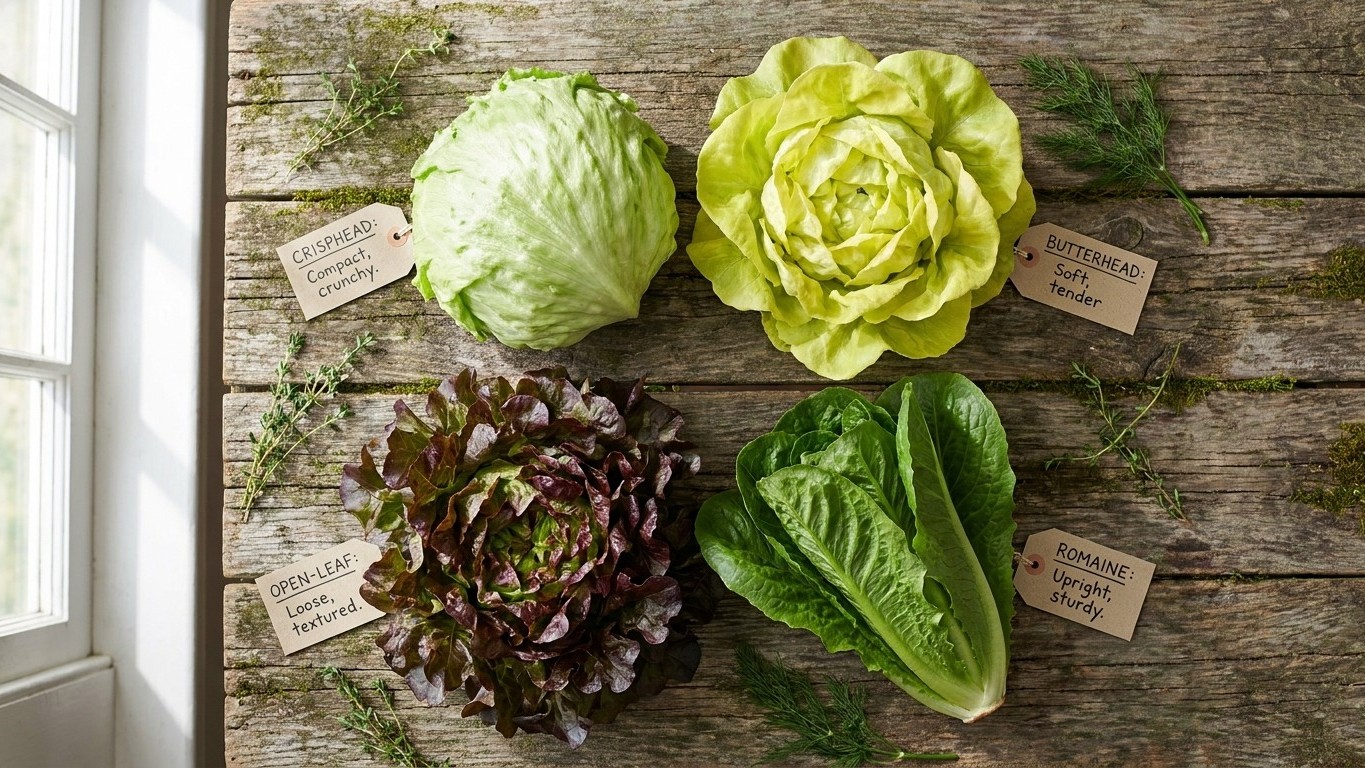

Utah State University Extension’s guide, Lettuce in the Garden, sorts lettuce into four head types: crisphead, butterhead, cos (romaine), and leaf. Under each type, the Extension names varieties by name only, with no days-to-maturity figure, no size rating, and no numerical score attached to a single one. The names describe how the plant grows, not how fast or how big.
The short answer
Utah State University Extension groups sixteen named lettuce varieties into four head types, and it does so without ever attaching a number to any of them. Crisphead includes Summertime, Salinas, Great Lakes, and Iceberg. Butterhead includes Buttercrunch and Esmeralda. Cos, also called romaine, includes Lentissima, Cimmaron Red Romaine, and Italian Blonde Romaine. Leaf includes Red Sails, Oakleaf, Salad Bowl, and Black Seeded Simpson. That’s the full list, and that’s the whole answer to what those four extension names mean: they’re categories of head structure, each holding a handful of named varieties.
The Extension is direct about why it stops there. As the guide puts it, “varieties vary greatly in maturity, flavor, texture, and tolerance to garden conditions.” Instead of ranking varieties against each other with a number, the source treats the four type names themselves as the useful information. A crisphead is going to behave differently in your garden than a leaf lettuce, and that difference matters more for planning than any days-to-maturity figure would.
This matters for how you read seed packets and catalogs elsewhere. Plenty of sources attach a days-to-maturity number to lettuce varieties, and those numbers aren’t wrong. But Utah State University Extension chose not to include them in this particular guide, which tells you something: the type name (crisphead, butterhead, cos, leaf) is doing the heavy lifting for identification, while maturity timing gets handled separately, tied to the season and to whether you’re direct-seeding or transplanting, not to the variety name itself.
The practical takeaway is that if you’re picking varieties for a Utah garden, or any garden with a similar climate pattern, you’re better off choosing based on head type first. Want a lettuce that holds up in a lunch sandwich? Crisphead. Want tender, buttery leaves for a simple salad? Butterhead. Want the tall, upright structure people associate with classic Caesar salads? Cos. Want to cut-and-come-again all season without waiting for a head to form? Leaf. The Extension’s advice to plant “a range of different types” reflects this: mixing head types gives you a more varied harvest than picking four varieties that all happen to be crispheads.
What actually decides it
The four names aren’t marketing categories. They describe genuine structural differences in how the plant builds its leaves, and those differences are what determine how a variety performs in your specific garden conditions.
Head formation and leaf architecture
Crisphead varieties, the Iceberg-type lettuces, form a dense, tightly wrapped head with leaves that fold in on themselves as they mature. Butterhead varieties form a looser, more open head, with the outer leaves cupping around softer, oilier inner leaves, which is where the “butter” name comes from. Cos, or romaine, grows upright in a narrow column rather than a round head, with sturdy midribs that give the leaf its characteristic crunch. Leaf lettuce doesn’t form a head at all. It grows as a loose rosette of individual leaves that can be harvested one at a time or all together, which is why it’s the type most associated with cut-and-come-again harvesting.
Tolerance to garden conditions
The Extension notes that varieties differ in “tolerance to garden conditions,” and this is where head type matters practically. A tightly wound crisphead needs more time and more consistent moisture to fill out its dense structure, so it’s more exposed to problems like tipburn or premature bolting if conditions turn hot or dry mid-season. Leaf lettuce, with its open growth habit, tends to be more forgiving, since you’re not waiting on a head to fully form before you can start harvesting. This is a partial repair, not a full fix. If a crisphead bolts before it heads up, no amount of watering afterward brings back a usable head. The plant has already shifted its energy into a flower stalk, and the leaves turn bitter. Switching to a more tolerant type for a difficult spot doesn’t fix a plant already in trouble. It’s a decision made before planting, not a repair made during the season.
Flavor and texture as a byproduct of structure
Flavor and texture, which the Extension also flags as varying “greatly” between varieties, follow largely from that same structure. Cos lettuce’s upright, ribbed leaves give it a crunch that loose-leaf types don’t have. Butterhead’s loosely folded leaves hold more moisture near the surface, giving that soft, buttery texture. None of this is measured with a number in the Extension’s guide, but it’s the direct, physical reason the four type names exist in the first place.
How to do it
Whether you’re starting a crisphead, a butterhead, a cos, or a leaf variety, the timing sequence works the same way. Only the variety choice changes, not the schedule.
- Identify your last frost date first. Every other date in this sequence counts backward or forward from that single point on your calendar, so it needs to be nailed down before you plan anything else.
- Count backward to find your seed-starting date, if starting transplants indoors. Lettuce transplants need five to six weeks of growth before they go into the ground, so count five to six weeks back from your last frost date to know when to start seed indoors.
- Move transplants outside near your last frost date, not ahead of it. Unlike crops that need to go into the ground well Before the Last Frost, lettuce transplants are set out near that date itself.
- If direct-seeding instead, start two to three weeks earlier than the transplant schedule. Direct-seeded lettuce goes into the ground two to three Weeks Before the point where transplants would normally go out, since it needs that extra time in the soil to germinate and establish.
- Choose your varieties by head type before you plant, not after. Decide whether you want crisphead, butterhead, cos, or leaf lettuce (or a mix) based on how each type performs and what you’ll use it for, since the Extension’s advice to plant “a range of different types” only works if that mix is planned before seed goes in the ground.
- Stagger plantings across head types rather than repeating one type. Because varieties differ so much in tolerance to garden conditions, spreading your planting across more than one head type gives you a buffer if one type struggles with heat or moisture swings partway through the season.
What goes wrong
- Choosing a variety by name alone, without knowing its head type. A gardener picks “Buttercrunch” or “Salinas” off a list without realizing one is a butterhead and the other a crisphead, then plants it in conditions suited to a different type entirely. The remedy is simple: check the head type first, using the Extension’s four categories, before choosing based on the variety name.
- Planting only one head type across the whole garden. This leaves the entire planting vulnerable to the same weakness, since all crispheads share similar tolerance issues, and all leaf lettuce shares a similar growth habit. The fix is to follow the Extension’s own recommendation and mix head types, so a problem with one type doesn’t take out the whole harvest.
- Starting transplants too early relative to the last frost date. Because lettuce transplants only need five to six weeks before going out near the last frost date (not well ahead of it, the way some other crops are handled), starting seed too early leaves transplants overgrown and stressed by the time it’s safe to plant them out. Recalculate from the last frost date rather than from a fixed date on the wall calendar.
- Direct-seeding on the same schedule as transplants. Since direct-seeded lettuce needs to go in two to three weeks earlier than transplants, following the transplant schedule for a direct-seeded crop pushes germination later than it should be. Separate the two schedules and count them independently from the last frost date.
- Assuming a crisphead that bolted can still be salvaged. Once a crisphead lettuce shifts into flowering before the head has filled out, no amount of water or feeding brings the head back, and the leaves turn bitter. The only remedy is prevention next season, choosing a more heat-tolerant type or head structure for that particular spot, since there’s no in-season fix for a plant that has already bolted.
Common questions
Does Utah State University Extension rank these sixteen varieties against each other?
No. The guide names varieties under each of the four head types (crisphead, butterhead, cos, leaf) without a days-to-maturity figure, size, or rating attached to any of them.
Is cos the same thing as romaine?
Yes, the Extension lists cos and romaine as the same head type, naming Lentissima, Cimmaron Red Romaine, and Italian Blonde Romaine under that single category.
Should transplants go out before the last frost date, like some other garden crops?
No. Lettuce transplants are set out near the last frost date itself, not well ahead of it, and they need five to six weeks of growth beforehand.
Why plant more than one head type instead of just picking a favorite?
Utah State University Extension notes that varieties differ greatly in maturity, flavor, texture, and tolerance to garden conditions, and states directly that planting a range of different types makes salads more interesting.