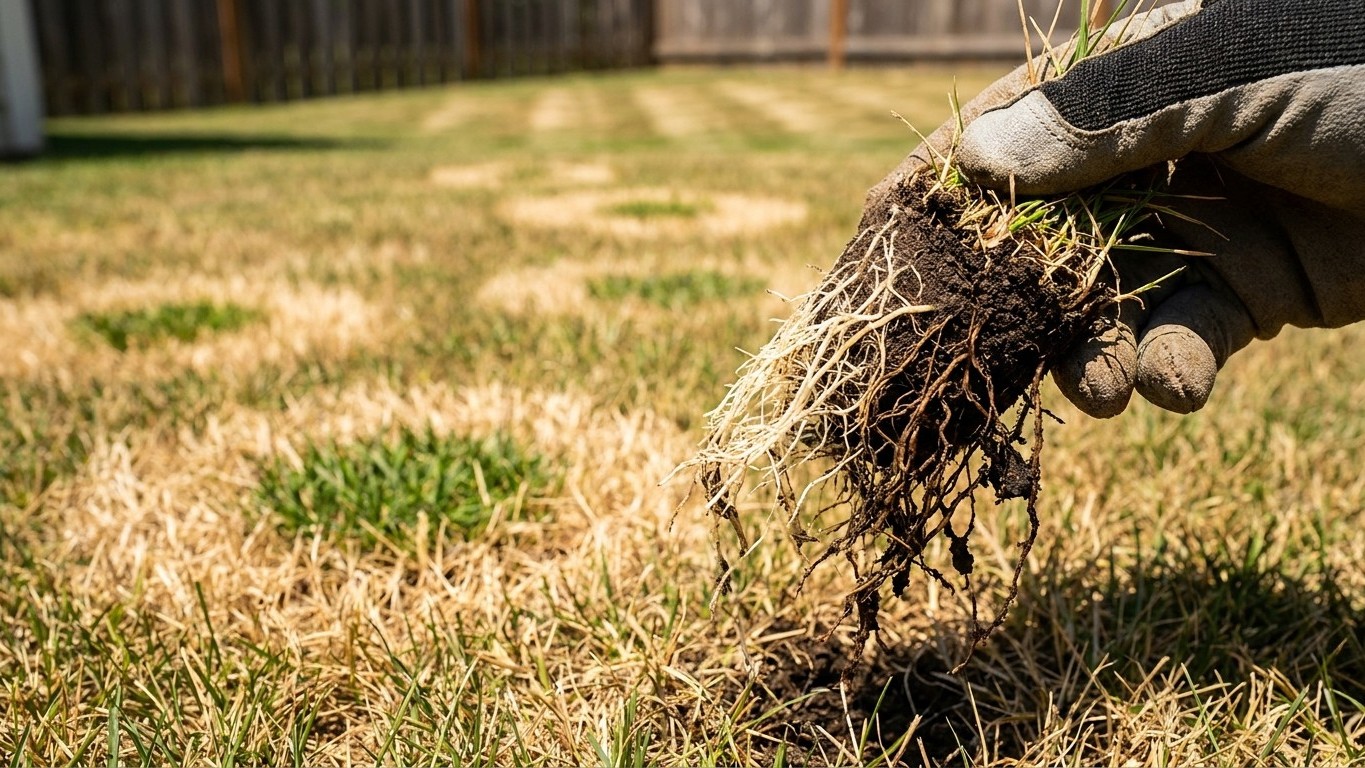

Summer Patch is a root-rotting fungal disease that attacks cool-season lawns, mainly Kentucky bluegrass, fine fescue, and annual bluegrass. The fungus infects roots and crowns in late spring when soil warms, but the grass itself doesn’t show damage until summer heat and drought stress push the weakened plant past its limit. By the time you see brown patches, the roots have been failing for weeks.
What you are looking at
The pattern shows up as circular or irregularly shaped patches of tan or straw-colored grass, ranging from a few inches across to two feet or more in a heavily infected lawn. Patches often merge into larger, ragged areas as the season goes on. One detail sets Summer Patch apart from a lot of other lawn trouble: a “frog-eye” look, where the outer ring of dead grass surrounds a patch of green, still-living turf in the center. That green island survives because the fungus doesn’t move through soil in a perfectly even circle, and grass in the middle sometimes escapes the worst of the root damage.
The blade itself won’t tell you much on its own, which is why the second check matters more. Pull on a few blades in the affected patch. If the grass comes up with almost no resistance, roots snapping off cleanly or crumbling instead of holding fast in the soil, that’s the confirming sign. Dig up a small plug and look at the root system: healthy cool-season grass roots are white to cream-colored and fibrous. Roots damaged by this fungus turn dark brown to black, often stunted to less than an inch long, with a rotted, waterlogged look near the crown. Under magnification (a hand lens helps) you may see dark strands of fungal growth running along the root surface, which plant pathologists call ectotrophic runner hyphae.
Timing adds another clue. Symptoms typically show up from mid-June through August, peaking during stretches of high heat and humidity, and they tend to reappear in the same spots year after year if the lawn isn’t managed differently, since the fungus survives in soil and thatch between seasons.
What it is not
A lot of what gets called “disease” in a home lawn is really a watering or mowing habit catching up with the grass, and Summer Patch has several look-alikes worth ruling out first. Dog urine spots are the most common mix-up: they’re usually smaller, more uniformly round, and edged with a ring of unusually dark green grass (the nitrogen burst from urine) rather than the muted green center of a frog-eye pattern. If the “damaged” spots line up along a fence or near where a dog runs, that’s your answer, not a fungus.
Drought stress spreads more evenly across the whole lawn rather than forming discrete patches, and it responds fast, within a few days, to a good deep watering. Dull mower blades shred grass tips instead of cutting them cleanly, giving the whole lawn a grayish, frayed look under close inspection rather than isolated brown circles. That’s a mower maintenance issue, not a pathogen.
Brown patch, a different disease that shows up in warm, humid weather, tends to have a smoky gray-brown ring around the edge of the affected area in the early morning dew, and it favors tall fescue and perennial ryegrass rather than the fine fescue and Kentucky bluegrass that Summer Patch prefers. Necrotic ring spot is the closest relative, caused by a similar root-infecting fungus and producing nearly identical frog-eye patches on the same grass species. Telling the two apart by eye alone is genuinely difficult, and for a home lawn it usually doesn’t change what you do next: both call for the same cultural fixes described below.
If patches are diffuse, lawn-wide, and improve with better watering within a week, you’re very likely dealing with drought or heat stress, not a fungal disease at all.
The conditions that bring it on
This disease targets cool-season lawns specifically. Kentucky bluegrass is the most susceptible, fine fescues follow close behind, and annual bluegrass (Poa annua) is also a common host. Perennial ryegrass and tall fescue are rarely affected, so if your lawn is a tall fescue blend showing frog-eye patches in summer, look at brown patch or another cause instead. Warm-Season grasses like bermudagrass, zoysia, or St. Augustine are not hosts for this fungus at all.
The infection cycle is what makes this disease deceptive. Root infection actually begins in spring, when soil temperatures climb into a range that favors fungal growth while air temperatures are still mild and the grass looks perfectly fine on top. The fungus works quietly underground for weeks, colonizing roots and crown tissue. Visible symptoms don’t appear until later, once summer heat arrives and the plant’s damaged root system can no longer pull enough water and nutrients to keep the leaf tissue alive. That’s the gap the title of this piece points to: the roots have already failed by the time anyone notices trouble at the surface.
Prolonged leaf wetness plays a role too. Lawns that stay damp overnight, whether from evening irrigation, heavy dew, or poor drainage, give the fungus more hours of favorable conditions to spread through the root zone. Compacted soil makes things worse, since compaction itself stresses roots and reduces the oxygen available to them, compounding the damage the fungus is already doing. Thatch layers thicker than about half an inch also tend to harbor the fungus between seasons, giving it a place to survive the winter and re-infect roots the following spring.
Lawns mowed too short, fertilized heavily with fast-release nitrogen right before summer heat, or watered on a shallow, frequent schedule tend to show the worst outbreaks, because all three practices push roots to stay shallow instead of growing deep enough to tolerate a damaged root system.
What to do now
Here’s the honest part: once you can see Summer Patch on the lawn surface, the root damage that caused it is already done. Fungicides applied at this stage won’t repair rotted roots or bring back grass that’s already dead, so spraying a curative product on visible brown patches in July or August is, in most cases, money spent chasing a problem that’s already happened. The fungus is done doing its worst by the time symptoms show.
What actually helps at this stage is reducing stress on the grass that’s still alive. Water deeply but infrequently, aiming to soak the root zone rather than wetting the surface daily, and do it early in the morning so the grass isn’t sitting wet overnight. Raise the mowing height, since taller grass shades the soil, keeps it cooler, and reduces stress on a compromised root system. Hold off on nitrogen fertilizer until temperatures moderate; a stressed lawn pushed into fast top growth during heat just burns through reserves it doesn’t have.
Preventive fungicides, applied in spring before soil temperatures rise and before any symptoms appear, are the only application timing that reliably works against this disease, and that decision needs to be made based on a lawn’s history, not on what’s visible in August. Products containing propiconazole or azoxystrobin are among the active ingredients labeled for home lawn use against root-rot diseases like this one, but always check the product label for your state, since some fungicide formulations are restricted to licensed applicators and not sold for homeowner use. If a lawn has had Summer Patch for the first time this year, mark the calendar for a preventive conversation next spring rather than reaching for a bottle right now.
Most lawns with mild to moderate Summer Patch recover some ground on their own once cooler fall weather arrives and the surviving grass can grow new roots, though badly damaged patches may need overseeding to fill back in.
Preventing it next season
Prevention here is mostly a change in habits rather than a product purchase. Watering time matters more than most people expect: irrigating early in the morning lets the grass blades dry off within a few hours, while evening watering leaves the lawn wet overnight and hands the fungus exactly the damp conditions it needs. Switching from frequent shallow watering to less frequent, deeper soaks also trains roots to grow down instead of staying near the surface, which gives the lawn more resilience if infection does occur.
Nitrogen timing is worth rethinking too. Heavy spring nitrogen applications push fast, soft top growth right as the fungus is doing its underground work, and that combination tends to make symptoms worse later in summer. A lighter, slower-release approach in spring, with the bulk of nitrogen feeding saved for fall when cool-season grass roots recover and grow, tends to produce a lawn that handles summer stress better across the board.
Mowing height is one of the simplest adjustments: keeping Kentucky bluegrass and fine fescue around 3 to 3.5 inches through the growing season shades the soil surface, keeps root zone temperatures a bit lower, and reduces the overall stress load on the plant. Avoid scalping the lawn in late spring right before the heat sets in.
Airflow and soil structure round out the list. Core aerating in fall relieves compaction and lets water and oxygen reach roots more easily, and dethatching when the thatch layer builds up past about half an inch removes one of the fungus’s favorite overwintering spots. Lawns with a documented history of Summer Patch are also good candidates for overseeding with more resistant grass types, since blending in some improved cultivars or a small percentage of resistant species can dilute the susceptible turf without a full renovation.
Common questions
Does Summer Patch kill grass permanently?
Individual plants with badly rotted roots and crowns often die and won’t come back on their own, which is why patches sometimes need overseeding in fall. But the lawn as a whole isn’t permanently ruined; surviving grass typically fills back in over one or two growing seasons with better cultural care.
Can I treat Summer Patch with a fungicide I buy at a garden center?
Some homeowner-labeled products containing propiconazole or azoxystrobin are available, but they only work as a preventive spring application before symptoms appear, not as a cure once brown patches show up in summer. Check the label for your state, since some formulations are restricted to licensed applicators.
Will Summer Patch spread to my neighbor’s lawn?
The fungus lives in soil and thatch and spreads slowly within a lawn rather than jumping quickly between properties. Shared mowing equipment or soil movement (on tools, shoes, or mower wheels) is a more realistic transmission route than wind or casual contact.
How long do Summer Patch symptoms last?
Visible patches usually persist through the hottest weeks of summer and start improving once temperatures cool in early fall, as surviving grass grows fresh roots. Badly damaged spots that don’t fill back in naturally are the ones worth overseeding.