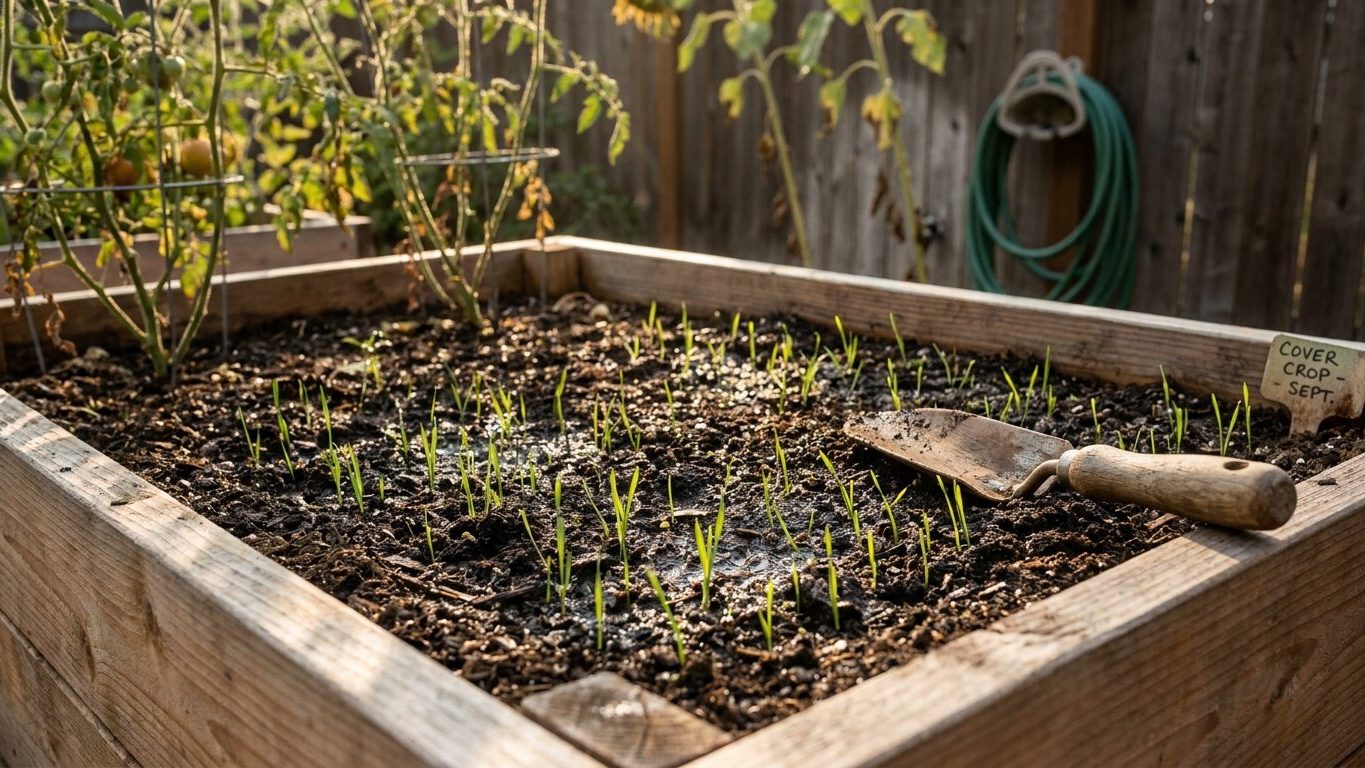

Sowing a cover crop comes down to matching a job to a season. Erosion control, nutrient capture, compaction relief and organic matter all call for different species, and the calendar that governs them is your first frost date, not the calendar month. Get the species-to-season match right and the crop does the work on its own; get it wrong and you’re mowing down a plant that never had time to do anything.
What a cover crop is actually for
Ask five gardeners what a cover crop does and you’ll likely get one answer: it stops soil from washing away over winter. That’s true, but it’s only a quarter of the story. A cover crop can hold soil, scavenge nutrients that would otherwise leach out with fall rains, break up compacted layers with its roots, or build organic matter that feeds soil biology the following season. Most gardens benefit from combining two or three of these jobs rather than chasing all four with one species.
| Job | Kind of species that does it | Season typically sown |
|---|---|---|
| Erosion control | Cereal grains such as rye, wheat or oats | Late summer through early fall |
| Nutrient scavenging | Fast-rooting grasses and brassicas (oats, mustard, radish) | Right after a summer crop is cleared |
| Breaking compaction | Deep taprooted brassicas like forage radish, or deep-rooted grains | Late summer to early fall, ahead of first hard freeze |
| Adding organic matter | High-biomass grasses (cereal rye, sorghum-sudangrass) or summer smother crops (buckwheat) | Fall for grains, summer for buckwheat between spring and fall crops |
Here’s the part that trips people up: a cover crop is not fertilizer, and it doesn’t act like one. A grass or brassica cover crop recycles nutrients already in your soil, pulling nitrogen and other minerals down deep or leftover from a previous crop back up into its tissue instead of letting them wash away. When that plant is later cut down and left to break down, those nutrients become available again, closer to the surface, for the next planting. That’s recycling, not creation.
A legume works through a different mechanism entirely. Species like clover, vetch and field peas partner with soil bacteria to pull nitrogen out of the air and convert it into a form plants can use, which is genuinely adding a nutrient rather than just holding onto one. That process, how much nitrogen actually ends up available to next season’s tomatoes and when, deserves its own explanation rather than a quick mention here.
The organic matter benefit is the slow one. A single season of cover cropping won’t transform heavy clay into loam. But repeated seasons of roots growing and decomposing, feeding fungi and bacteria that in turn improve soil structure, add up over several years into looser, better-draining soil that holds water more evenly. Gardeners expecting a one-season fix are usually the ones who give up on cover crops before they’ve had a fair trial.
The question that decides everything: does it survive winter
Every cover crop species falls into one of two camps, and knowing which camp before you sow saves you a spring headache. A crop that winter-kills dies once temperatures drop far enough, leaving a dead mulch on the surface that you can rake aside or plant straight through come spring. A crop that overwinters survives the cold, keeps growing (slowly) through winter, and greens up fast in spring, which means you have to kill it yourself before it goes to seed or gets too tough to manage.
Neither approach beats the other. Winter-kill species suit a gardener who needs a bed ready to plant early and doesn’t want a spring termination chore. Overwintering species suit someone chasing maximum root growth and soil coverage, and who doesn’t mind an extra step in April. The mistake isn’t picking one type over the other, it’s picking the wrong one for a bed you actually need to use early. Sow an overwintering cereal rye in a bed you’re counting on for April peas, and you’ll spend a cold, wet spring morning cutting down a stubborn stand instead of planting.
Why the same species behaves differently in different yards
Oats are the textbook example of why this can’t be answered with a blanket rule. In a harsh winter with sustained hard freezes, oats reliably winter-kill and leave a clean mulch. In a mild winter, or in a milder region, that same oat crop can limp through and still be green in March. The species doesn’t change. The winter does. That’s why a cover crop’s winter-kill behavior has to be checked against your own state and typical winter lows rather than treated as a fixed trait printed on a seed packet.
Termination, when it’s needed, happens mechanically on this site: mowing a stand down before it sets seed, crimping to lay stems flat and stop growth without pulling out the roots, cutting by hand in a small bed, or simply letting frost finish the job on a species that can’t survive it. There’s no chemical shortcut described here, and for a home garden bed that’s often the more practical route anyway, since a small area is easy to mow or cut by hand in a way that a farm field isn’t.
The species worth knowing
A handful of species cover most home garden situations. Each does a different job, and each behaves differently once winter arrives, which is exactly why the table is worth studying before you buy seed.
| Species | Primary job | Fixes nitrogen | Typically winter-kills | Termination difficulty |
|---|---|---|---|---|
| Cereal rye | Erosion control, biomass, weed suppression | No | No, overwinters | Hard once mature; needs timely mowing or crimping |
| Oats | Nutrient scavenging, quick cover | No | Yes, in cold winters | Easy, usually dies on its own |
| Winter wheat | Erosion control, moderate biomass | No | No, overwinters | Moderate |
| Crimson clover | Nitrogen fixing, pollinator forage | Yes | Varies by region | Moderate |
| Hairy vetch | Nitrogen fixing, high biomass | Yes | No, overwinters | Hard; vigorous regrowth if not fully cut |
| Field peas | Nitrogen fixing, quick cover | Yes | Yes, in cold winters | Easy |
| Forage radish | Breaking compaction | No | Yes, in cold winters | Easy, root rots and leaves a channel |
| Buckwheat | Fast summer smother crop, organic matter | No | Yes, killed by first frost | Easy |
| Annual ryegrass | Erosion control, fine root mass | No | Varies by region | Moderate to hard |
| Mustard | Nutrient scavenging, pest suppression | No | Yes, in cold winters | Easy |
Notice how the legumes (clover, vetch, peas) sit alongside grasses and brassicas that do completely different jobs. A garden bed sown with a mix of, say, oats and a legume is chasing two goals at once: quick, reliable winter-kill cover plus a nitrogen contribution, without needing to guess which single species can do both.
Why the answer changes with where you garden
Few garden decisions are as location-dependent as this one. The sowing window is counted backward from your average first fall frost date, since most cover crops need several weeks of active growth before cold weather slows them down. A gardener in northern Minnesota might need seed in the ground by late August, while a gardener in coastal Georgia has until October or later. Sow too late in either place and the crop barely germinates before winter, which defeats the purpose of planting it at all.
The winter-kill question runs into the same geography problem. A species that reliably dies back in a Zone 4 winter can sail through a Zone 7 winter without a scratch, which means the “does it survive winter” answer for oats, crimson clover or annual ryegrass is really a question about your specific climate, not a universal fact about the plant. Two gardeners three states apart, both growing the exact same seed, can end up with completely different spring scenes: one with a clean, dead mulch ready to plant into, the other with a green, growing stand that needs mowing before it flowers.
That’s the reason this site breaks cover crop timing and species selection down by state rather than offering one national sowing calendar. Local frost dates, typical winter lows and even soil type all shift the recommendation enough that a generic answer risks wasting a season. Checking your state’s cover crop page for the specific sowing window and expected winter behavior in your area is the difference between a mulch ready to plant through in April and a tangle of overwintered growth you weren’t expecting to deal with.
For finer detail than any general guide can offer, your local Cooperative Extension office is worth a call or a visit to its website. Extension agents track regional frost data, soil conditions and even recent seasons’ performance for specific species, and they can weigh in on seeding rate for your setup, something that depends on the species, your seeding method and your soil, and is better answered locally than guessed at nationally. The USDA’s Cooperative Extension System, searchable through USDA NIFA’s extension directory, is the fastest way to find the office covering your county.