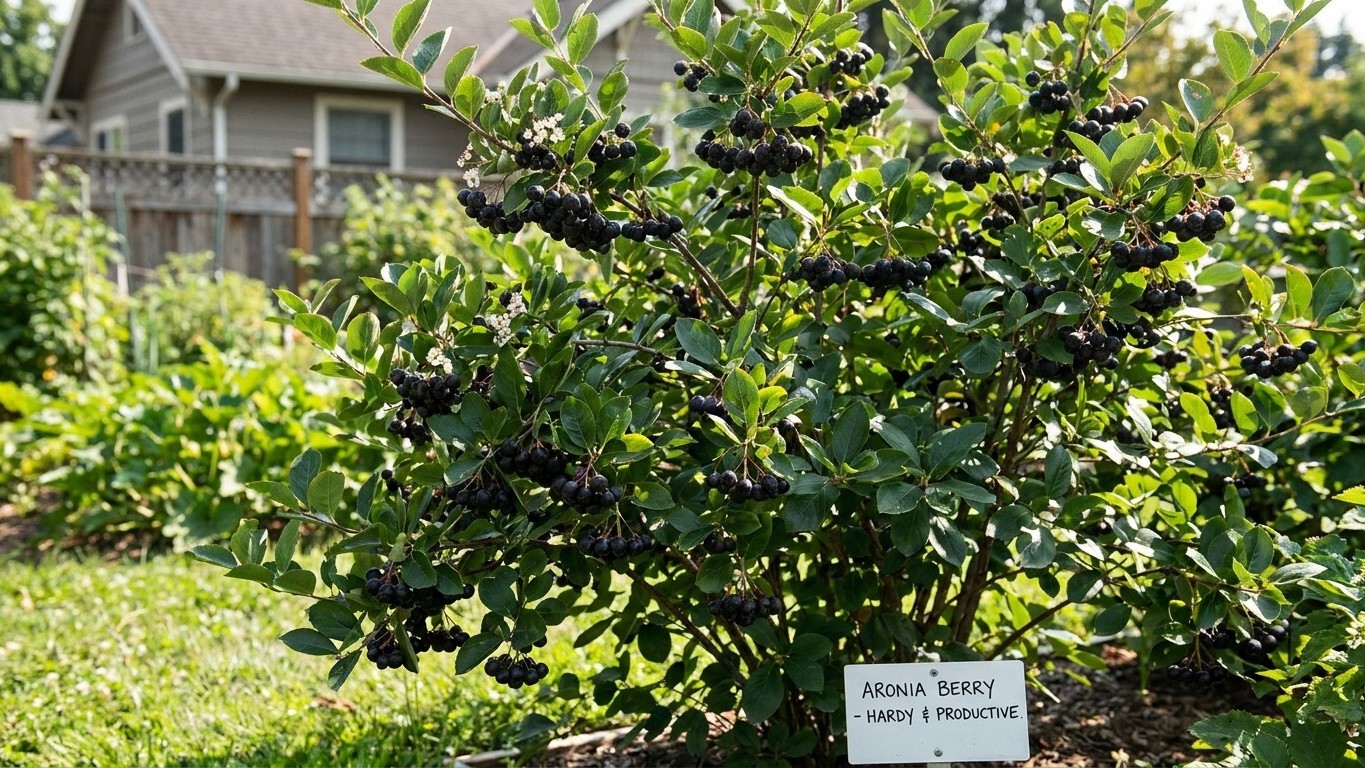

Aronia melanocarpa, commonly sold as black chokeberry, is hardy in USDA zones 3a through 8b, tolerates a wide range of soils, and needs full sun to produce its best fruit crop. It stays compact at 3 to 6 feet at maturity, blooms in spring, and yields small blackish-purple fruit valued more for jam and jelly than for eating fresh off the branch.
Where it will and will not survive
The USDA hardiness range for this shrub runs 3a to 8b. The useful way to read that number isn’t “where will this thrive” but “where will this simply not make it through winter.” Below zone 3a, stems and buds face freeze damage severe enough that the plant won’t reliably return year after year. Above 8b, the shrub runs into a different problem: not enough cold accumulation, and summer heat that this species, bred from cold-climate ancestry, wasn’t built to handle.
A hardiness range describes survival, not comfort. A shrub rated hardy to 8b can technically live at that edge without necessarily looking good there, flowering well, or setting a strong fruit crop. Treat the top of any range as the line past which the plant probably won’t make it, not as an invitation to expect a happy, productive specimen once you’re inside it. The same logic applies at the cold end: being inside 3a to 8b tells you the plant can survive, not that it will perform well.
None of this tells you which zone you’re actually in. Zone assignments shift by county, elevation, and microclimate, and guessing from a state name alone is how people end up planting something that dies its first hard winter or limps through summers it was never suited for. Look up your own zone using the hardiness zone guide on this site before you buy, and cross that number against 3a-8b rather than assuming.
The growing information for this shrub is drawn from the North Carolina Extension Gardener Plant Toolbox, and the USDA hardiness range it lists is a national standard, applicable wherever you garden. Any regional planting advice tied specifically to North Carolina’s coastal, piedmont, or mountain regions is local to that state and shouldn’t be applied elsewhere. The hardiness numbers travel. The regional commentary doesn’t.
What it is called, and why that matters here
Two common names show up for this shrub in the source material: Black Berried Aronia and Black Chokeberry. Both are in active use, and neither is flagged as official or preferred. The source lists common names alphabetically, which is a reminder that alphabetical order is not a ranking of accuracy or popularity, it’s just a list. This page is titled by the botanical name, Aronia melanocarpa, precisely to sidestep that problem.
“Chokeberry” is worth flagging directly: the name has nothing to do with a choking hazard from the fruit. It comes from the intensely astringent, mouth-puckering quality of the raw berry. “Chokeberry” also gets confused with “chokecherry,” an entirely different plant in the genus Prunus. They are not the same species and are not close substitutes in the landscape, so mixing them up when buying or researching care is an easy way to end up with the wrong advice.
Neither name given here is declared correct at the expense of the other. If a nursery tag, a neighbor, or an online listing uses either “Black Berried Aronia” or “Black Chokeberry,” you’re looking at the same plant discussed on this page, provided the botanical name Aronia melanocarpa is attached to confirm it. That Latin name is the one detail worth double-checking before a purchase.
The site it needs to actually crop
This shrub tolerates a genuinely broad range of site conditions, which is part of its appeal for low-maintenance plantings. But tolerance for survival and the conditions needed for a strong fruit set are two different questions, and the source doesn’t fully separate them for every factor.
| Condition | What it tolerates |
|---|---|
| Light | Full sun (6+ hours direct) or partial shade (2-6 hours) |
| Soil texture | Clay, high organic matter, loam/silt, sand, shallow rocky |
| Soil pH | Acid (below 6.0), neutral (6.0-8.0), alkaline (above 8.0) |
| Drainage | Good drainage, moist, occasionally dry, occasionally wet |
The soil texture, pH, and drainage tolerances above describe what the plant can survive in, not a yield guarantee; the source doesn’t specify which soil type produces the heaviest fruit set. Light is the one factor where the distinction is explicit: the source states plainly that the best fruit production occurs in full sun. Partial shade is tolerated, meaning the shrub will live and likely flower there, but a site with only two or three hours of direct light a day works against a strong crop, not toward one.
Space at maturity: the number that costs the most later
At maturity, this shrub reaches 3 to 6 feet, with an erect, multi-stemmed, rounded to spreading habit. That’s a modest footprint compared to a full-size fruit tree, but still enough to crowd a narrow foundation bed or a tight property line if placed without that number in mind. Because the habit is spreading and multi-trunked, a single shrub will fill out wider than a single stem might suggest, and reaching the fruit for harvest is easiest when there’s room to walk around the full mature width. Plan the planting spot around the 6-foot upper figure, not the 3-foot lower one, and you won’t be pruning back into a walkway a few seasons in.
When it crops, and whether it needs a partner
Bloom time falls in spring, given here as a season rather than a calendar date because actual timing shifts with latitude and elevation. What the season does predict reliably is vulnerability: a shrub that flowers early in the spring window is the one a late frost is most likely to catch. If your area is prone to a cold snap after the first mild stretch of spring, that timing is worth watching, since frost damage to open blossoms can knock out a season’s fruit set even on an otherwise healthy, well-sited shrub.
What this page cannot tell you, because the source data doesn’t include it, is whether this shrub needs a second, genetically different plant nearby to set fruit at all, or how many years after planting it takes before you’ll see a first meaningful crop. Both are common sticking points with fruiting shrubs generally, and these traits vary even between closely related species, sometimes between cultivars of the same species. Guessing based on plant type or genus is a bad idea.
Before buying, ask a nursery or supplier two direct questions: does this specific plant need a second, compatible aronia nearby to fruit, and roughly how many years after planting should I expect the first real crop. Get clear answers on both before committing to a spot in the yard, particularly if you’re planting a single specimen and expecting fruit from it alone.
What the fruit is, and what it is for
The fruit itself is a shiny, showy, blackish-purple pome, roughly a half inch across, though it’s commonly called a berry in casual use even though it’s botanically closer to a small pome fruit. It appears from August into September, and the best fruit production happens on plants grown in full sun, tying back to the site requirements above.
On taste, the source is blunt: the fruit is edible but quite astringent, and that astringency is the reason behind the common name chokeberry. Astringent, in plain terms, means a dry, puckering, tannic sensation on the tongue. It’s not a fruit built for eating straight off the branch by the handful. The suggested use, per the source, is making it into jams or jellies, cooking the fruit down with sugar to temper that raw astringency into something more palatable.
That’s the extent of the flavor and use information this page can responsibly offer. No sweetness claim, no comparison to other fruit, and no nutrition or health benefit is made here, because none of that appears in the source material, and inventing it would go beyond what’s actually documented. If you’re picking this shrub with fresh eating in mind, adjust that expectation. If you’re picking it to fill a pantry shelf with homemade preserves, the astringency that makes it a poor snacking fruit is exactly what a slow simmer with sugar is designed to fix.
What it resists, and what it does not
Resistance, as used here, means a tendency to shrug off a particular stress under normal conditions, not immunity from it. A shrub “resistant” to drought can still die in an extreme, prolonged dry spell, and one resistant to wet soil can still struggle in standing water that never drains. Resistance buys margin; it doesn’t remove risk entirely.
| Challenge | What resistance means here | What you’d actually see |
|---|---|---|
| Drought | Established plants tolerate dry stretches better than average | Less wilting and leaf drop during a dry summer, once the root system is settled in |
| Dry soil | Handles a soil profile that stays on the dry side as a baseline condition | Steady growth in a bed that doesn’t hold much moisture, without constant supplemental watering |
| Wet soil | Tolerates soil that stays damp or occasionally saturated | No root rot or dieback in a low spot that collects runoff after rain |
The drought tolerance listed here applies to established plants, not a freshly planted specimen, which still needs regular watering through its first season or two while its root system develops.
This resistance list addresses the plant itself: its foliage, stems, and general vigor against environmental stress. It says nothing about pests or diseases that specifically target the fruit rather than the shrub, and this brief carries no information on that front. That’s a real gap. Anyone growing this shrub specifically for a fruit harvest, rather than as an ornamental or wildlife planting, should treat fruit-specific pest and disease pressure as an open question to research separately.
Common questions
Is Aronia melanocarpa the same as chokecherry?
No. Despite the similar-sounding common names, chokeberry and chokecherry are different plants entirely, with chokecherry belonging to the genus Prunus. Confirm the botanical name Aronia melanocarpa before buying to avoid the mix-up.
Can the fruit be eaten fresh off the shrub?
The source describes the fruit as edible but quite astringent, which is why it’s typically made into jams or jellies rather than eaten raw by the handful.
Does it need full sun to grow?
It tolerates partial shade and will survive there, but the source specifies that the best fruit production happens in full sun, so shade is a survival option, not a cropping one.
How much space should I leave when planting it?
Plan around 6 feet, the upper end of its 3-foot to 6-foot mature spread, given its erect, multi-stemmed, spreading habit that fills out wider than a single young stem suggests.