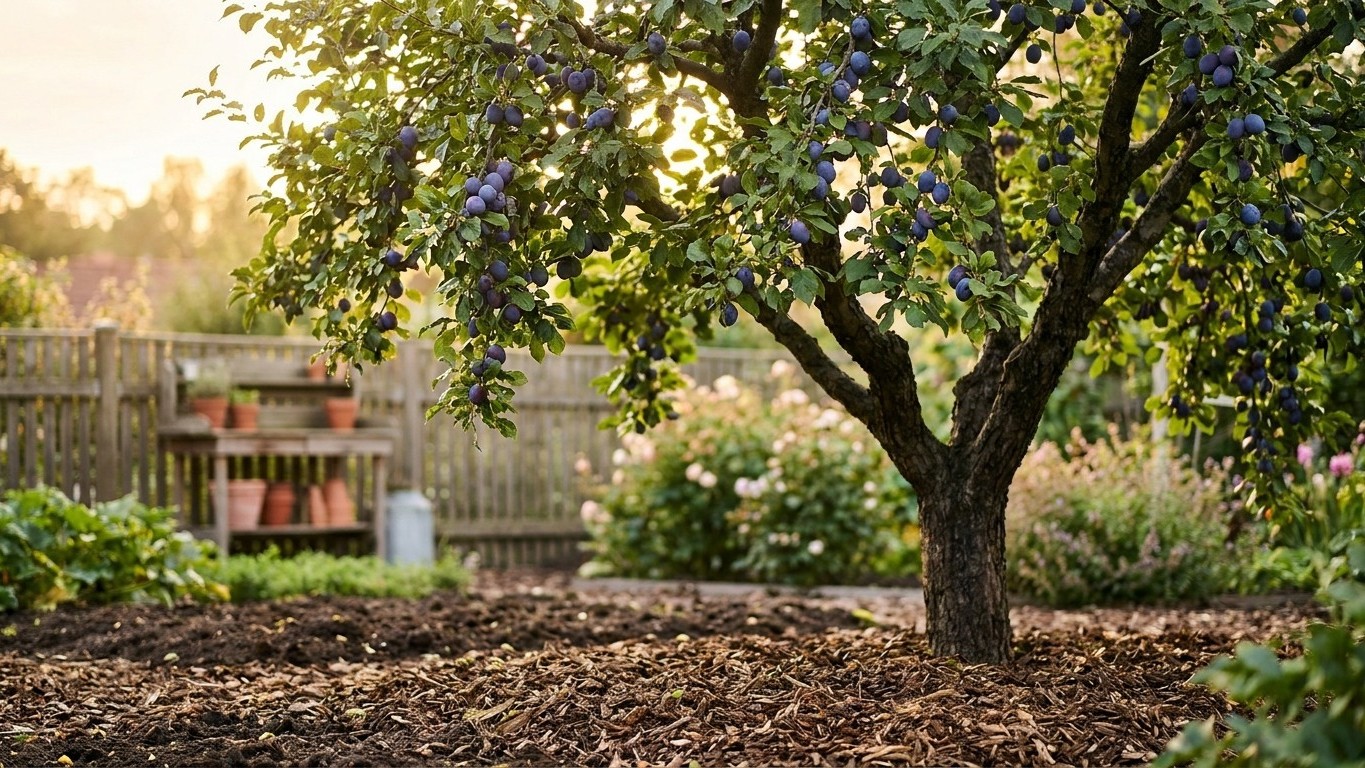

Prunus domestica, the European plum, survives across USDA hardiness zones 4a through 9b, a wide band that covers most of the country, but that range alone doesn’t decide whether a tree will ever bear fruit. It needs full sun, soil rich in organic matter, and steady moisture with good drainage just to crop well, not merely stay alive. It’s an erect, medium-growing deciduous tree or shrub that blooms in spring and carries a blue-black, one-seed drupe by September. Whether it actually fruits, and how soon, depends on questions this plant’s basic data doesn’t answer.
Where it will and will not survive
The USDA hardiness range for Prunus domestica is zones 4a-9b, according to the North Carolina Extension Gardener Plant Toolbox. Below the bottom of this range, winter cold is expected to kill the tree outright, regardless of soil quality, pruning, or how sheltered the site is. Above the top of it, summers too warm and winters too mild prevent a deciduous fruit tree from going through a proper dormancy, which usually shows up as weak flowering and a tree that limps along without cropping well, even if it doesn’t die outright.
A hardiness range describes survival, not comfort. A tree rated hardy to 9b isn’t necessarily thriving there for a full life cycle; it’s simply not expected to be killed by that zone’s typical winter minimum. The same logic applies at 4a. Read the range as a boundary the tree can cross without dying, not as a recommendation for where it will do well.
Because zone boundaries run in bands that ignore state lines, and a single state can span several zones from one county to the next, guessing a zone from a general sense of climate is a bad habit. Checking the actual zone for a specific property is the only reliable step, and this site’s hardiness zone guide breaks the national range down further, county by county, for that purpose.
One more caution: the North Carolina Extension source behind these hardiness figures also publishes region-specific advice for its own coastal, piedmont, and mountain zones. That regional guidance belongs to North Carolina specifically and doesn’t transfer elsewhere, even when a county in another state happens to share the same zone number. The 4a-9b range travels nationally; the rest of that source’s regional advice does not.
What it is called, and why that matters here
The North Carolina Extension Gardener Plant Toolbox lists four common names for Prunus domestica: Common Plum, European Plum, Plum, and Prune Plum. They’re given alphabetically, with none marked as primary or official, which is why this page uses the botanical name instead of settling on one of the four.
That distinction isn’t a formality. “Plum” alone gets applied loosely to dozens of species across the genus Prunus, including wild and ornamental plums that aren’t Prunus domestica at all. Hearing a tree called “a plum” at a nursery doesn’t confirm the species, since it could be something else in the same genus, with different hardiness, size, and fruit entirely.
“Prune Plum” adds its own layer of confusion. A prune is a dried plum, not a separate fruit or a different tree, the fruit of this species is a plum whether it ends up eaten fresh or dried. Some plum varieties are traditionally favored for drying more than others, which likely explains the name, but the tree’s identity doesn’t change based on how the fruit is eventually prepared.
None of these four names is wrong. They’re four different habits of speech pointing at the same species, and the source doesn’t rank them against each other. If a supplier, a plant tag, or a neighbor uses one of these names, confirming the botanical name before assuming which specific tree is meant is the safer move.
The site it needs to actually crop
Survival and cropping are different standards, and the growing conditions the source lists split roughly along that line. Full sun is the condition most tied to fruiting specifically, a plum tree can survive with less light, but a fruit tree that doesn’t get enough direct sun typically flowers and fruits poorly even while staying alive. Soil and drainage matter for both standards at once: a tree planted where drainage is poor can decline or die, not just underperform.
| Condition | What the source specifies | Survival or yield |
|---|---|---|
| Light | Full sun : 6 or more hours of direct sun a day | Yield: needed to flower and fruit well |
| Soil texture | High organic matter | Both: poor soil limits vigor and fruiting |
| Drainage | Good drainage, moist | Survival: standing water can kill the roots |
| Soil pH | Not specified in these facts | Not settled by this source |
| Growth rate | Medium | Neither, describes speed, not condition |
| Maintenance | High | Yield: affects how consistently the tree stays productive |
The source doesn’t give a specific height or spread figure for Prunus domestica at maturity, and that gap is worth stating rather than filling with a guess. It does note an erect habit and a medium growth rate, useful for picturing the general shape, but not a substitute for an actual mature-size number. Since spacing errors with fruit trees are expensive to correct once roots are established, confirming expected mature height and spread with whoever supplies the actual tree, before choosing a planting spot, is worth the extra step.
When it crops, and whether it needs a partner
The source lists spring as the bloom time for Prunus domestica, given as a season rather than a specific month; bloom timing shifts with latitude and elevation, so the same tree can flower weeks apart depending on where it’s planted. What a spring bloom generally predicts is frost exposure: an early-blooming fruit tree is the one a late cold snap catches with open flowers, and damaged blooms in a given year usually mean little or no fruit that season, regardless of how healthy the tree is otherwise.
This is also where this page has to stop rather than guess. Two questions decide whether a Prunus domestica tree ever produces fruit, and neither is answered by these facts: whether it needs a second, compatible tree nearby to set fruit, and how many years after planting it typically takes to bear. Many fruit trees require a pollinator partner of a compatible variety to fruit at all; some plums are self-fertile and don’t need one. Assuming self-fertility based on the genus or a general reputation for plums is risky, since that trait varies tree to tree even within one species.
The years-to-bearing question carries just as much weight for planning. A young tree that hasn’t fruited in its first few seasons isn’t necessarily failing, it may simply not be old enough yet, and pulling it out too early over an assumption is a common and avoidable mistake.
Both questions belong on the list to settle before buying, not after: does this specific tree need a pollinator partner, and if so what variety works with it, and how many years should reasonably be expected before a first real crop. A nursery or local extension office selling the actual tree can answer both; a general plant-data page cannot.
What the fruit is, and what it is for
The source describes the fruit of Prunus domestica as a fleshy drupe, 2 to 3 inches long, maturing to blue or black with a single seed inside, and appearing in September. That’s a description of size, color, and timing, not a note on flavor. The source doesn’t say whether the fruit is sweet, tart, or anything in between, and nothing here should be read as implying a taste that isn’t actually stated.
On use, the source notes that the fruit is dried into what most people call prunes, and can also be eaten raw or cooked. Worth being precise: the fresh fruit is the plum, and the dried fruit is the prune, drying doesn’t change what the tree produces, it changes what the fruit is called once it’s dehydrated.
That leaves three stated uses from the source: eaten fresh, cooked, or dried. It doesn’t name specific dishes, other preservation methods, or a preferred way to prepare the fruit, and nothing beyond that note is added here.
The source is explicit about one thing: this is a fruit meant to be eaten, not an ornamental species where edibility is incidental. Beyond that, any specific nutrition claim would have to come from the source directly, and this particular entry doesn’t make one, so none is repeated here.
What it resists, and what it does not
Resistance, in a plant profile, describes a tendency to fend off or tolerate a particular pressure, not immunity from it. A tree marked resistant to something can still be damaged under the wrong conditions; a tree with no listed resistance isn’t guaranteed to suffer, either. It’s a general leaning, not a guarantee in either direction.
For Prunus domestica, the facts drawn from the North Carolina Extension Gardener Plant Toolbox entry don’t include a specific pest or disease resistance list. What the source does flag is a maintenance level of “High”, a signal that this tree tends to need more ongoing attention than a low-maintenance species, though the entry doesn’t break that demand down into particular causes.
| Term | What it means | What a reader would see |
|---|---|---|
| Resistant | Tends to fend off or tolerate a given pressure | Less damage, or slower damage, than a susceptible tree nearby |
| Susceptible | Has little natural defense against a given pressure | Damage sets in faster or more severely under similar conditions |
| Not specified | The source states no tendency either way | No reliable expectation from this data alone |
There’s a second gap worth naming plainly. Even a complete resistance list for a plant typically covers threats to the tree itself, its leaves, bark, and roots. It says nothing about pests and diseases that target the fruit specifically, which for a plum can be an entirely separate set of problems from anything affecting the wood and foliage. Treating a general plant resistance list as protection for the crop itself would be a mistake.
Common questions
Is Prunus domestica the same as a prune tree? Yes, in the sense that there’s no separate “prune tree”, the tree is a plum tree, and prunes are simply the dried version of its fruit. The source lists Prune Plum as one of the common names in use, which is where the confusion usually starts.
How much space does a European plum tree need? The facts used here don’t give a specific mature height or spread, only that the habit is erect and the growth rate is medium. Confirming an exact spacing figure with whoever supplies the actual tree, before planting, avoids the most expensive mistake with a woody fruit tree: putting it too close to a structure or another tree.
Does a European plum tree need a second tree to produce fruit? That’s not settled by these facts. Pollination requirements vary by variety within this species, so it’s a question to ask the supplier directly rather than assume one way or the other.
Why didn’t my young plum tree fruit yet? These facts don’t include an age at first bearing, and fruit trees generally take a number of years to mature into cropping. A lack of fruit in the first few seasons isn’t necessarily a sign of a problem, it may just mean the tree hasn’t reached bearing age.