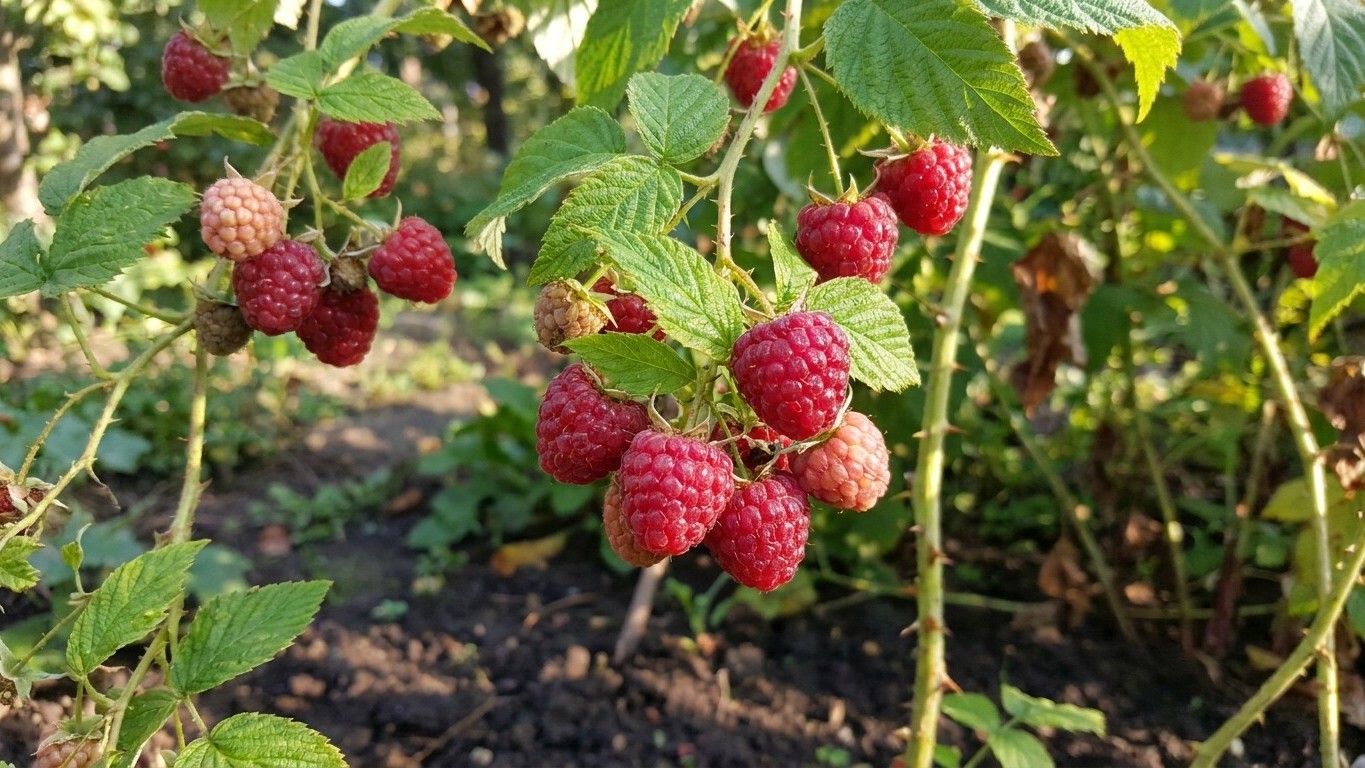

Rubus idaeus is the red raspberry, a hardy, thicket-forming shrub rated for USDA zones 4a-8b, needing full sun or partial shade, acidic well-drained soil, and 3 to 12 feet of room depending on habit. It flowers in spring and summer, fruits in early-to-late summer, and the fruit is eaten fresh, cooked, or dried. What it will not tolerate, and what a buyer still needs to ask before planting, matters more than the basic profile.
Where it will and will not survive
The USDA hardiness range for Rubus idaeus is 4a-8b. That is a wide band as woody fruiting plants go, but it is still a boundary, not a suggestion. Below the bottom of this range, winter cold routinely kills the canes back past the point of recovery, or kills the plant outright before it produces a crop worth the space it takes up. Above the top of it, the plant may survive winter and still struggle through summer heat and humidity it was never suited to, showing weak growth, poor fruit set, or a shortened life even where it technically clings on.
A hardiness range describes survival, not comfort. A raspberry at the warm edge of 8b is not the same as one in the cooler middle of the range; it may leaf out and fruit for a season or two, then decline as summer stress accumulates. At the cold edge, surviving one mild winter is no guarantee of surviving a harder one the next year.
None of this can be answered from a national map alone, since hardiness zones are drawn county by county and a single state can span three or four of them. Check the actual zone for the property using a hardiness zone guide that carries data down to the county level, not just a regional label.
One more caution: the USDA hardiness range is a national standard and applies wherever a reader lives, but the source behind this page’s growing information is a North Carolina extension service, and its regional advice about coastal, piedmont, or mountain conditions is specific to North Carolina. It does not transfer to a reader in a different state, even one sharing the same zone number. The zone number travels; the regional growing notes do not.
What it is called, and why that matters here
Common names attached to Rubus idaeus include Blackberry, Dewberry, Raspberries, Raspberry, and Red Raspberry. That list is worth reading slowly: the source lists these names alphabetically with none flagged as primary, which is why the first name a reader sees is “Blackberry” even though the plant is a raspberry.
This is a genuine point of confusion, not a quirk of alphabetizing. Blackberries and dewberries belong to the same broad Rubus genus and produce a similar-looking aggregate fruit, but they are typically distinct species or hybrids from Rubus idaeus, with different growth habits, different fruit color at maturity, and, for dewberries, a trailing rather than upright or arching form. Someone expecting the trailing habit of a dewberry, or the color of a blackberry, is working from the wrong plant picture.
The safer route is to treat “Raspberry” and “Red Raspberry” as the names that actually describe this species, while recognizing that “Blackberry” and “Dewberry” appearing on the same list reflects how loosely these common names get applied across the Rubus genus in nursery tags and casual speech. The only way around the confusion is the one this page takes: naming the plant by its botanical name, Rubus idaeus, and treating every common name as a name people use rather than the name.
The site it needs to actually crop
Rubus idaeus tolerates a wider range of conditions than many fruiting shrubs, but tolerating a condition and cropping well under it are two different things. The table below separates what the plant will simply live through from what actually affects whether it fruits.
| Condition | What the source lists | Survival or yield |
|---|---|---|
| Light | Full sun (6+ hours) or partial shade (2-6 hours) | Both tolerated for survival; the source does not state how much shade cuts into fruit production |
| Soil texture | Clay, high organic matter, loam, sand | Survival across a broad range of textures |
| Soil pH | Acid (below 6.0) | A requirement, not a tolerance |
| Drainage | Good drainage | Survival; poor drainage is a common cause of root problems in Rubus generally, though the source frames this as a requirement rather than a yield factor |
Full sun is generally understood to push more fruit on bramble fruits than partial shade, but that comparison is not stated by this source, so it is left as a gap rather than a guess. What the source is clear about is space at maturity, and this is the figure most likely to cause regret later. Rubus idaeus is listed at 3 feet to 6 feet, and 6 feet to 12 feet at maturity, reflecting its arching, erect, and spreading habits rather than one tidy footprint.
A raspberry planted three feet from a fence or walkway can end up leaning into both within a few seasons, and a spreading habit means new canes can emerge well outside the original hole. Reaching the fruit at harvest without wading through overgrown canes depends on giving this plant room at the upper end of that range, not the lower one.
When it crops, and whether it needs a partner
Bloom time for Rubus idaeus is listed as spring and summer, given as a season rather than a date because actual timing shifts with latitude and elevation. That spread still tells a reader something useful: a plant that flowers as early as spring is one a late frost can catch, and frost hitting open blossoms is a common way a fruiting shrub loses a season’s crop before it ever sets fruit.
What this page cannot tell a reader, because the source does not carry the information, is whether a given Rubus idaeus plant needs a second, compatible plant nearby to set fruit at all. Some fruiting plants are self-fertile; others need a genetically distinct partner within pollinating distance and, without one, may flower every year and never set fruit. Guessing which applies here based on genus alone is not safe, since self-fertility varies within Rubus plant by plant and cultivar by cultivar.
The same caution applies to how long a newly planted Rubus idaeus takes to bear its first real crop. Some woody fruiting plants bear within a year; others take several years, and a buyer expecting the earlier timeline can mistake a healthy, correctly sited plant for a failed one.
Both questions belong to whoever sells the plant, not to a general reference page. Before buying, ask directly: does this plant need a pollinating partner, and how many years until it bears a full crop?
What the fruit is, and what it is for
The source describes the fruit in strictly botanical terms: what looks like a single raspberry is not, technically, a berry at all. It is made of many small drupes held together in a hollow cone, which is why the fruit pulls cleanly off the plant’s central core when picked, leaving that core behind. Cultivars exist in a range of colors and are noted as generally more productive than the straight species, though the source does not describe taste or performance beyond that.
On edibility, the source is direct: the fruit can be eaten raw or cooked, and is described as delicious eaten out of hand. It is also used in pies, preserves, and wines, and the dried leaves are made into an herb tea, sometimes blended with blackberry leaf and used as a coffee substitute. None of that is a nutrition claim; it is a use claim, repeated here exactly as stated.
Red raspberries are among the more familiar fruits in American gardens: the flavor runs sweet with a distinct tang, the texture is soft and slightly seedy, and the fruit bruises easily, part of why it is eaten fresh so often rather than shipped or stored long. That balance of sweetness and sharpness is exactly what makes it work in the uses the source lists. Any specific claim about a named cultivar’s flavor is a different matter, since cultivars of the same species can vary widely, and that variation is not part of what this page can responsibly state.
What it resists, and what it does not
Resistance, as used here, means a tendency the plant shows toward a particular pressure, not a guarantee against it. A plant listed as resistant can still be affected under the right conditions; the label describes what usually happens, not what always happens.
| Pressure | What resistance means here | What a reader would typically see |
|---|---|---|
| Deer | Listed with unspecified degree, meaning a general tendency toward being less preferred by deer, not deer-proof | Reduced browsing pressure compared to more palatable plants nearby, but not guaranteed protection where deer pressure is heavy |
That is the full resistance data this source provides. It says nothing about the plant’s resistance to insects or diseases that attack canes, leaves, or roots, and even less about pressures that threaten the fruit itself, whether insects, fungal disease, or birds competing for the crop. That is a real gap for a fruiting plant, worth naming plainly rather than filling with guesses this source never makes.
The plant does attract pollinators and other wildlife worth noting: bees, butterflies, small mammals, and songbirds are all listed as drawn to it. That activity is generally a sign of a healthy planting, though it also means birds and small mammals may compete for the fruit at harvest time.
Common questions
Is Rubus idaeus the same plant as a blackberry?
No. “Blackberry” appears among the common names sometimes attached to it, but Rubus idaeus is the red raspberry, a distinct species from the plants more commonly called blackberries within the same genus.
Will Rubus idaeus survive in a colder or hotter zone than 4a-8b?
Below zone 4a, winter cold typically kills it back past recovery. Above zone 8b, it may survive but is likely to struggle with summer heat, so check the actual local hardiness zone before planting rather than assuming.
Does Rubus idaeus need another plant nearby to produce fruit?
That is not something this source specifies, and it varies within the genus. Ask a supplier directly whether the specific plant being sold needs a pollinating partner.
How much space does Rubus idaeus need?
The source lists 3 to 6 feet and 6 to 12 feet at maturity depending on habit. Planting at the low end of that range is the most common mistake, since the arching and spreading growth habit tends to fill the larger figure over time.