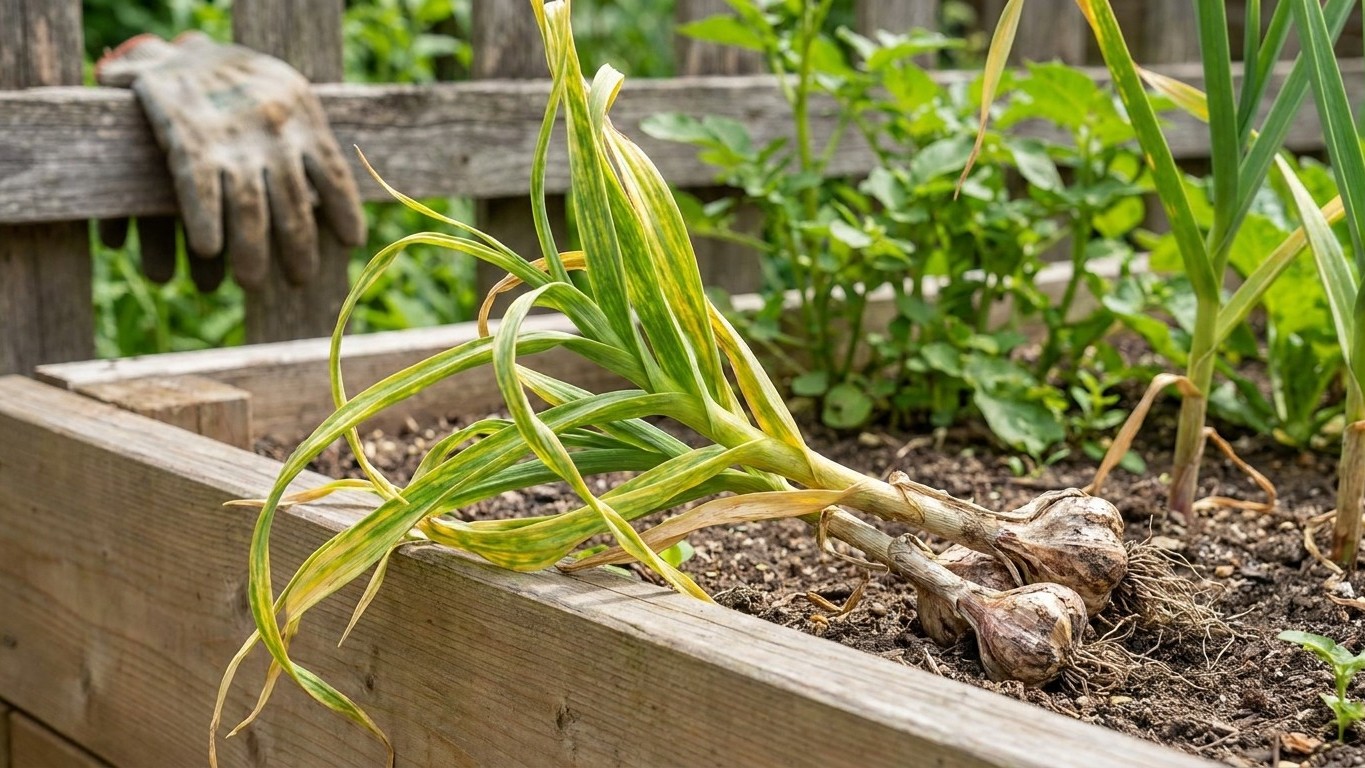

Garlic mosaic virus shows up as light-green to yellow streaking and irregular blotching that runs lengthwise along the leaf blade, not as an overall yellow. Bulbs from an infected planting come in smaller than they should, even on plants that otherwise look like they’re growing fine. If your garlic has this kind of striping, the one thing to do now is stop saving cloves from that patch for next year’s seed, and source certified virus-free planting stock instead, per the University of California‘s UC IPM Pest Management Guidelines for Onion and Garlic (Publication 3453).
What you are looking at

The first thing most gardeners notice is a pattern in the leaf, not a color change across the whole plant. Garlic mosaic virus produces small angular light-green to yellow patches that sit inside the leaf rather than spreading from the tip or the base. Look closer and you’ll usually find irregular light-green blotches mixed in with the patches, plus striping and streaking that runs parallel to the leaf veins rather than crosswise.
The pattern is uneven from leaf to leaf and even within a single leaf, which is part of what marks it as viral rather than nutritional. A plant can carry the virus and still send up leaves that look almost normal for a while, then show streaking more heavily as the season goes on.
Symptoms in the order you’ll meet them
- Faint light-green to yellow mottling on younger leaves, easy to miss at first glance
- Streaks and stripes running the length of the blade, not across it
- Irregular light-green blotches scattered unevenly across the leaf surface
- Overall stunting of the plant compared to unaffected garlic nearby
- At harvest, bulbs that are visibly smaller than expected for the variety and planting date
That last point is the one that costs money. A grower can tolerate some cosmetic streaking on the leaves, but a whole row of undersized bulbs at harvest is the real damage this disease does, and it’s the reason certified seed stock matters more for garlic than for almost any other crop discussed on Garlic Diseases.
What it is not
Most yellowing garlic is not mosaic virus. Garlic yellows for ordinary reasons far more often than it yellows from disease: too little nitrogen, uneven watering, or the natural bottom-up dieback that happens as the plant matures toward harvest. The discriminating detail is pattern. Nutrient and water stress tend to yellow the whole leaf or the whole plant fairly evenly, starting at the leaf tip or the oldest leaves and working inward. Mosaic virus instead leaves patches and stripes inside otherwise green tissue, with neighboring leaves on the same plant looking different from each other.
Rust is a separate look-alike worth ruling out directly, since it also breaks up the leaf surface rather than yellowing it uniformly. Rust shows raised orange pustules you can feel with a fingertip, covered in Rust on Garlic: Orange Pustules and What They Cost the Bulb, and there’s nothing raised about a mosaic streak. It stays flat, a color change in the tissue rather than a growth on top of it.
| Cause | Pattern on the leaf | Texture | Timing |
|---|---|---|---|
| Garlic mosaic virus | Angular streaks and blotches, lengthwise | Flat, no raised tissue | Present through the growing season |
| Rust | Scattered pustules, roughly round | Raised, feels bumpy | Usually appears as the season warms |
| Nitrogen deficiency | Uniform pale yellow, oldest leaves first | Flat, smooth | Any time nitrogen runs short |
| Natural pre-harvest dieback | Whole leaf browning from the tip down | Flat, drying | Weeks before bulbs mature |
If your garlic is only yellowing from the tip down and the lower leaves are browning on schedule as harvest nears, that’s dieback, not disease, and no action is needed.
Where it comes from and when it strikes
Garlic mosaic virus belongs to the potyvirus group, and in garlic the two viruses usually named are garlic yellow stripe virus and leek yellow stripe virus. Unlike a soil fungus, this pathogen doesn’t live free in the ground waiting for the next crop. It travels almost entirely inside the plant material itself. Garlic is grown from cloves, not seed, which means every clove planted is a cutting from a parent bulb, and if that parent carried the virus, every clove from it carries the virus too.
That’s the core problem UC IPM’s guidelines for onion and garlic point to: the pathogen is carried in vegetatively propagated planting stock, so an infected planting doesn’t clean itself up over a season or two the way some soil problems do. Once it’s in your seed garlic, it stays in your seed garlic, generation after generation, unless you interrupt the cycle with new stock.
Aphids are the other half of the story. They feed on infected leaves, pick up the virus, and carry it to healthy plants nearby, which is why UC IPM’s recommendation to multiply clean stock away from commercial garlic fields exists. It isn’t about isolating a home garden from soil-borne rot. It’s about keeping aphids from shuttling the virus from an infected planting into a clean one. A home gardener won’t be running a multiplication field, but the same logic applies at a smaller scale: garlic grown near an infected planting, whether your own or a neighbor’s, is at higher risk simply because the aphids that visit one visit the other.
There’s no published local threshold for how much aphid pressure it takes to spread the virus meaningfully in a given season, and conditions vary by region and by year. If you want to know how heavy aphid flights are running in your area at a given time, your state’s cooperative extension service is the right place to check, not a general gardening guide.
What to do about it now
There is no cure for a plant already carrying garlic mosaic virus, and no spray or soil treatment reverses it once symptoms show. The honest answer for a plant with the characteristic streaking is that it will finish the season as it is: some leaf function lost, some bulb size lost, and nothing you do this year changes that outcome. What you control is what happens next.
Do not save cloves from a symptomatic plant for next year’s planting. That’s the single most consequential decision in managing this disease, because the virus travels with the clove, not with the soil. A bulb that looks fine at harvest but came from a plant that showed streaking earlier in the season should still be treated as suspect seed stock, not eaten seed.
Pull and discard infected plant debris rather than composting it. Home compost piles rarely reach temperatures that reliably knock down plant viruses, and there’s no upside to giving aphids another infected source to feed from while your pile breaks down. Bag the foliage with household trash or dispose of it per your municipal yard-waste rules rather than working it back into garden beds.
Bulbs harvested from infected plants are still bulbs, just smaller ones, and there’s nothing in the published guidance suggesting a food-safety concern. The loss here is yield, not safety. If you’re also seeing softened necks or gray mold developing on stored bulbs afterward, that’s a separate problem worth reading up on: see Neck Rot in Garlic: The Storage Loss That Starts in the Field, since neck rot and mosaic virus can show up on the same weakened plants but need different handling.
Keeping it out of your garden
Because the virus rides inside the clove, everything about prevention starts with what you plant, not what you spray. UC IPM’s published guidance for commercial growers centers on planting virus-free stock produced through meristem tip culture, a lab process that strips the virus out of a growing tip before it’s multiplied into new planting material. A home gardener isn’t going to run that process, but the takeaway still applies directly: buy seed garlic from a supplier who sells certified virus-tested stock rather than relying on saved cloves indefinitely.
What a home grower can actually do
- Start with certified or lab-tested seed garlic rather than supermarket garlic or unverified saved stock
- Renew your seed stock periodically instead of replanting the same saved cloves year after year
- Keep new plantings some distance from any bed showing symptoms, since aphids move the virus between plantings
- Rogue out and discard any plant showing the characteristic streaking as soon as you spot it, rather than letting it stand through harvest
- Manage aphids generally in the garden, since they’re the vector that moves the virus plant to plant
The commercial-scale practice of multiplying clean stock in isolation away from established garlic fields isn’t something a backyard grower can replicate, and there’s no reason to try. The home-scale version of the same idea is simpler: don’t keep propagating an infected line indefinitely just because it’s free, and don’t plant new garlic directly next to a bed you know is symptomatic. Since garlic is always grown from cloves rather than true seed, there’s no reset button the way there is with an annual seed crop. Renewing your stock from a clean source periodically is the only practical substitute, which is the same reasoning behind not replanting your own harvest forever without bringing in fresh material.
Common questions
Can I still eat Garlic Bulbs That had mosaic virus?
Yes. The published guidance treats this as a yield and bulb-size problem, not a food-safety issue. The bulbs will likely be smaller than usual, but there’s no indication they’re unsafe to cook with.
Will crop rotation get rid of garlic mosaic virus?
Rotation helps with soil-borne problems, but this virus isn’t living free in your soil. It’s carried inside the cloves themselves, so rotating beds does nothing if you keep replanting infected stock into the new location.
How do I know if my seed garlic is actually virus-free before I plant it?
You mostly can’t tell by eye, since a bulb can look normal while carrying the virus. Buying from a supplier who specifically sells certified or meristem-tip-cultured seed garlic is the only reliable way to start clean.
Does one streaky leaf mean the whole planting is infected?
Not necessarily, since aphids introduce the virus to individual plants rather than the whole bed at once. Check nearby plants for the same angular streaking and blotching before assuming the entire planting is affected, and rogue out confirmed cases individually.