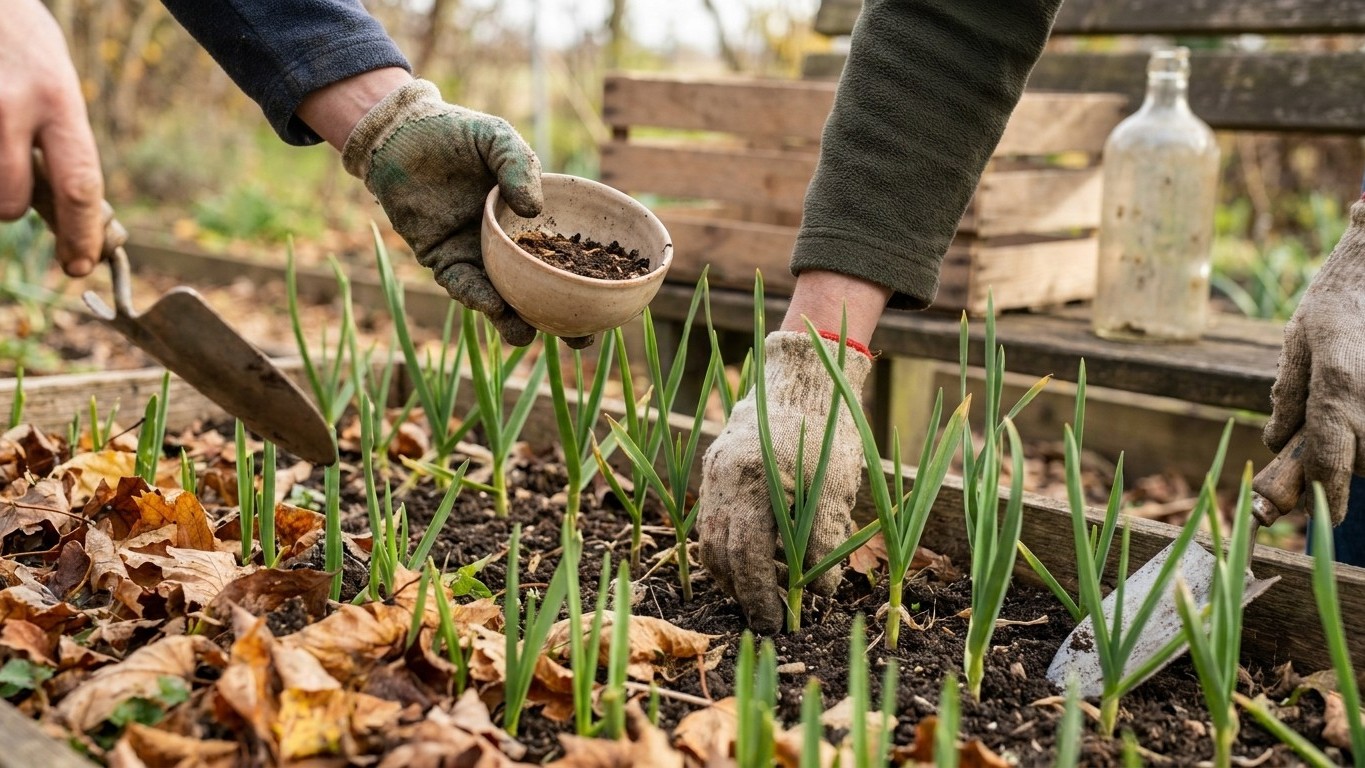

Garlic gets fed twice, never once: a light dose at planting in fall, and a heavier feeding the following spring once green shoots push up and start growing fast. The fall feeding is about roots, not leaves, so it stays modest. The spring feeding is what actually builds bulb size, and it has to land before the plant shifts from making leaves to making a bulb. Check with your state extension service for rates suited to your soil, and set your calendar by the plant’s growth stage rather than a date on a page.
Why this matters for garlic

Garlic spends around nine months in the ground, from planting in fall to harvest the next summer, and the feeding decisions you make now don’t show their results until the very end. Skip the spring nitrogen application, or time it too late, and you won’t see the damage in April. You’ll see it in July, when you dig up bulbs that are undersized, or split into just four or five thin cloves instead of a full head.
The opposite mistake is just as costly and just as slow to appear. Feed too much nitrogen too late in spring, after the plant has already started forming a bulb, and you get lush green tops on a plant that never finishes bulking up properly. Those bulbs also cure worse, with necks that stay soft and skins that don’t seal, which means shorter storage life come fall. Because garlic occupies the bed for so long, there’s no midseason fix once either error is visible. The feeding schedule is set months before the harvest tells you whether it worked.
When to do it
Anchor the fall feeding to planting itself, not to a specific week. Work amendments into the bed when you plant the cloves, since that’s the one moment you can improve the soil at root depth without disturbing the plant later. Some extension programs recommend a starter feeding right at planting, while others suggest waiting until the first green shoots have emerged in fall so you’re not feeding bare soil. Sources genuinely disagree here, so treat either approach as workable rather than searching for a single correct week.
The spring feeding is anchored to growth resuming, not to a calendar date. Garlic breaks dormancy as soon as the soil warms enough for roots to become active again, often well before the top growth looks impressive. That first flush of new green leaf is the signal to feed, because the plant is about to do most of its leaf growth for the season, and leaf growth is what eventually feeds the bulb. Wait too long past that point and you’ve already lost some of the growing window. Feed too early, while the plant is still essentially dormant, and much of the nitrogen leaches away before roots can use it.
How to do it
Fall feeding should favor phosphorus and slow-release organic matter over fast nitrogen. A finished compost or well-rotted manure worked into the top several inches of the bed before the cloves go in, alongside a slow-breakdown source like bone meal, supports root establishment without pushing tender top growth right before frost. If you haven’t planted yet, the depth and spacing decisions belong on a separate page: see Planting Garlic: How Deep, How Far Apart, and Which End Up for that step, since feeding and planting happen at the same visit to the bed.
Fall versus spring feeding at a glance
| Feeding | Main goal | Typical source | Timing signal |
|---|---|---|---|
| Fall | Root establishment | Compost, aged manure, bone meal | At planting or first green shoots |
| Spring, first round | Leaf growth | Blood meal, feather meal, balanced granular | New growth resumes after winter |
| Spring, second round | Sustained leaf growth on a long season | Fish emulsion or a lighter granular top-dress | Three to four weeks after the first round |
Blood meal and feather meal are both fast-breaking organic nitrogen sources, generally around 12-0-0, and work well as a side-dress worked lightly into the soil surface and watered in. Fish emulsion, typically close to 5-1-1, is gentler and suits a second, lighter application a few weeks after the first if your season is long enough to support it. Whatever source you choose, water it in rather than leaving granules sitting on dry soil, since garlic’s roots are shallow and won’t reach nutrients that stay on the surface.
Stop feeding nitrogen once the plant shifts into bulking. For hardneck varieties, the appearance of a scape is a useful visible marker that the plant has moved past the leaf-growth phase and into bulb formation. Continued nitrogen after that point delays maturity rather than helping it, and can leave you with bulbs that are still soft-necked when everything else in the bed is ready to lift. Growers working in raised beds or nursery pots should expect to feed a bit more often overall, since containers drain and leach nutrients faster than open ground, a difference covered in more detail in Growing Garlic in Containers: Pot Depth, Winter Cold and Watering.
What goes wrong
Most garlic feeding failures fall into a short list, and each one has a specific tell if you know when to look for it.
- Fall nitrogen pushed too hard: lush young leaves go into winter tender and get burned back by frost, visible as blackened, mushy tips as soon as the ground thaws.
- Spring feeding skipped or delayed: invisible until harvest, when bulbs come up small or with fewer cloves than the variety normally produces.
- Nitrogen applied after bulking has started: plants stay green longer than neighbors, and at harvest the necks are still soft with skins that haven’t fully dried and sealed.
- Fresh, unfinished manure used instead of compost: can scorch young roots or introduce soilborne disease, sometimes showing as patchy, stunted stands within the first few weeks after planting.
The common thread is timing relative to the plant’s own stage, not the calendar. A grower who tracks scape emergence and the first flush of spring growth will catch most of these before they turn into a disappointing harvest, while one who feeds on a fixed date every year is gambling on the season matching last year’s.
How this changes across the country
Winter severity changes how much of the fall feeding decision is really about protection rather than nutrition. Growers in places like Minnesota, Wisconsin, and northern New England typically mulch heavily right after planting, and that mulch layer also slows how fast the soil warms in spring, which pushes the spring feeding window later than it would be for a grower further south. In these colder regions, waiting for visible green growth rather than guessing at a date matters even more, since a late, hard spring can sit for weeks with the ground barely thawed.
In milder winter regions, such as coastal Georgia or much of coastal California, garlic often keeps some low-level root activity through winter instead of going fully dormant, so the fall-to-spring feeding line is less sharp. Growers there sometimes split the spring feeding into smaller, more frequent doses rather than one strong application, since the plant is drawing on nutrients over a longer stretch of the cooler months rather than in one concentrated spring surge. Soil that stays wet through a mild, rainy winter can also leach nitrogen faster, which is another reason feeding decisions in these areas lean on watching the plant rather than following a fixed schedule borrowed from a colder climate. For the planting and spacing decisions that set up either scenario, Growing Garlic covers the steps that come before feeding ever enters the picture.
Common questions
Do I need to feed garlic in fall at all, or can I just feed in spring?
You can get away with a light fall feeding or none at all if your soil is already reasonably fertile, since the spring feeding does most of the heavy lifting for bulb size. Skipping fall entirely is riskier in poor or sandy soil, where roots have less to draw on before winter.
Can I use the same all-purpose fertilizer for both feedings?
You can, but it’s not ideal. A balanced or phosphorus-leaning product suits the fall application better, while a nitrogen-heavy source works better in spring when leaf growth is the priority, so using one product for both is a compromise rather than the best fit for either stage.
My garlic leaves are yellowing in early spring. Is that a feeding problem?
It can be, but yellowing right after winter is also common simply from cold stress or waterlogged soil, and it often resolves once growth resumes and you get the spring feeding down. If yellowing persists past the first few weeks of active growth, that’s a stronger signal of a nitrogen shortfall worth correcting.
Will feeding more make my bulbs bigger?
Only up to a point, and only if the feeding lands in the right window. Extra nitrogen after bulking has started doesn’t add bulb size, it just prolongs leaf growth and delays maturity, so more feeding late in the season usually hurts rather than helps.