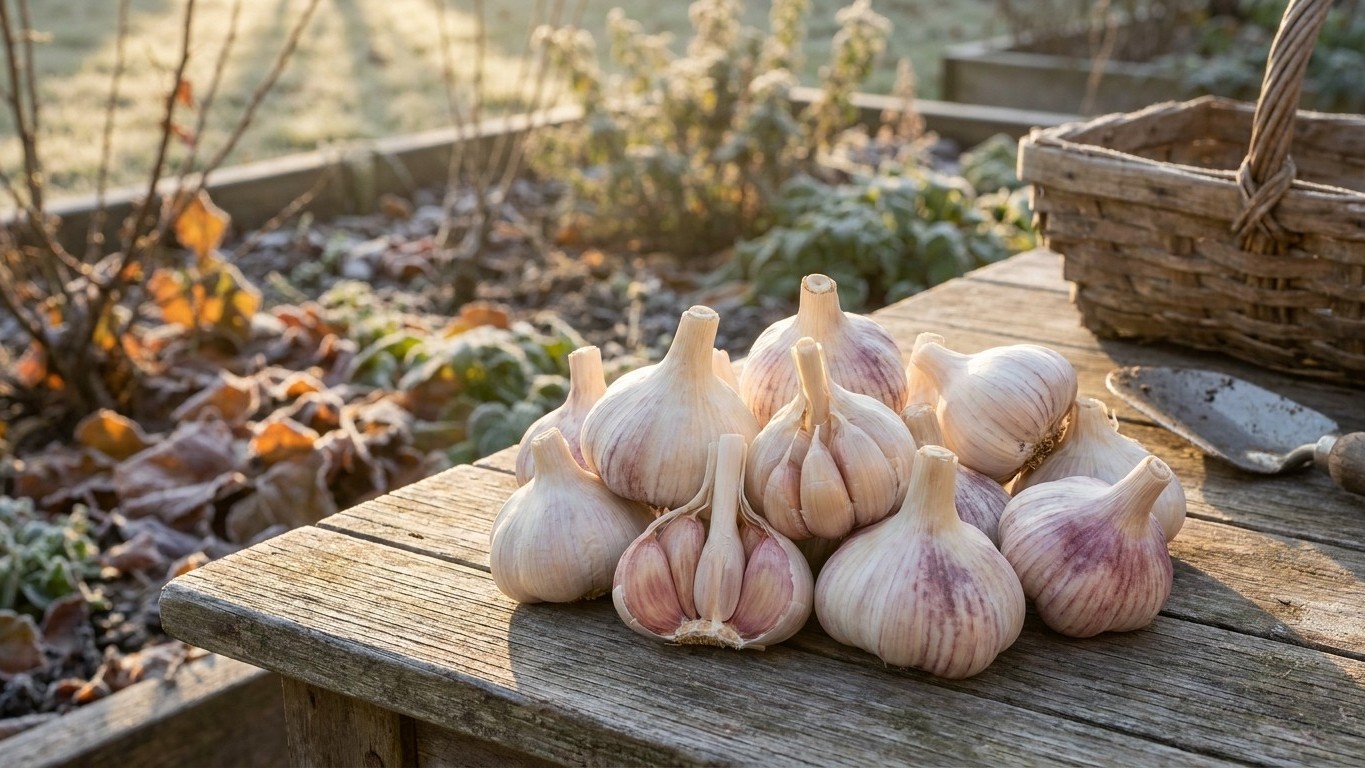

Early Red Italian Garlic is a softneck Artichoke type, and that single fact answers the planting question before any calendar does: it wants a fall planting timed to your first frost, followed by a stretch of cold that’s shorter and gentler than what hardneck types demand. Gardeners in mild-winter regions have the easiest path with this one.
What Music actually is
Early Red Italian Garlic belongs to the Artichoke group, the softneck side of the garlic family, distinguished by white wrappers that sometimes blush with a faint red tint near the base. There’s no stiff central stalk here and no scape to cut in early summer, which already sets it apart from the hardneck varieties (Porcelain, Rocambole, Purple Stripe) that dominate cold-climate gardens.
The catalog description for this variety says it “originated in southern Italy and produces large heads of creamy, sumptuous garlic,” with a flavor pitched as mild rather than sharp. That southern Italian background lines up with what the plant asks for in the ground: a lighter winter chill than a Siberian hardneck would tolerate, which is exactly the trait a mild-climate grower is looking for.
In the kitchen, this softneck type yields between 10 and 40 cloves per head, smaller and more numerous than the four-to-twelve fat cloves of a typical hardneck bulb. It braids well, which matters if you’re planning to hang a string of it in the pantry, and it keeps for 6 to 9 months at room temperature, making it a genuine winter keeper rather than a garlic you need to use up by Thanksgiving. No resistances are published for this variety, which isn’t a red flag so much as a gap in the available data worth knowing about before you plant a large bed of it.
Will it get the cold it needs where you are
Garlic doesn’t split into cloves on its own. A planted clove sits in the ground as a single growing point, and it only divides into a multi-clove head after it experiences a run of cold weather, a process growers call vernalization. Skip that cold exposure and you don’t get a head of garlic in July, you get one round, undivided bulb that looks more like a small onion than the garlic you planted. This is the mechanism that generic planting guides gloss over, and it’s the whole reason variety choice matters as much as planting date.
Artichoke type softnecks, including this one, sit at the low end of the chill requirement scale. That’s their entire appeal for a mild-winter garden. In coastal and southern regions where winter lows rarely dip into serious cold for more than a few weeks, a hardneck Porcelain or Rocambole often fails to divide properly, or does so weakly, because the ground never stays cold long enough. An Artichoke type softneck like this one is built for exactly that shorter, milder chill window. Growers along the Gulf Coast, in coastal California, across the Southeast, and through the warmer parts of the Southwest tend to have the best results with this class of garlic specifically because the winter there, modest as it is, is usually still enough.
Where this variety turns genuinely marginal is at the extremes on either end. In USDA zones 9 and warmer, particularly frost-free coastal strips or low-desert areas where winter nighttime lows barely brush the 40s, even a low-chill Artichoke type can come up short on cold hours. The workaround there is refrigeration: storing the seed cloves in a paper bag in the refrigerator for four to six weeks before planting substitutes for the missing field cold and reliably improves clove division. It’s a routine trick among growers in Florida, southern Texas, and similar climates, and it costs nothing but a little crisper drawer space.
At the opposite end, in genuinely cold northern winters, this variety usually gets more than enough chill, but the plant itself is less cold-hardy in the ground than a hardneck is, since softnecks generally show weaker winter survival without protection. A grower in Minnesota or Vermont can absolutely grow Early Red Italian Garlic, but it needs a heavier mulch blanket than a hardneck bed would, to keep the cloves from heaving or freezing out before they root. Nobody should be told to skip this variety outright; it’s a matter of adjusting either the pre-planting routine or the mulch depth, not swapping varieties.
When to put the cloves in
Garlic is a fall-planted, summer-lifted crop almost everywhere in the country, and the anchor point for timing isn’t a date on the calendar, it’s your local first fall frost. The goal is a planting window that lets the clove root into the soil before the ground locks up hard, without giving it so much time that it pushes several inches of green top growth before winter arrives. Top growth that’s too advanced going into a hard freeze can get burned back and set the plant back in spring.
In cold-winter regions, that generally means getting cloves into the ground somewhere around four to six weeks ahead of the ground freezing solid, often in September or October depending on how far north you are. In mild-winter areas of the Southeast and Mid-Atlantic, growers commonly wait until October or November, since the ground stays workable and warm-ish much longer. In the warmest zones, the Gulf Coast, southern California, and the low desert Southwest, planting often slides into November through January, timed more to when temperatures finally cool off than to any frost date at all, since a hard frost may not show up until deep winter, if it shows up at all.
It’s worth being upfront that regional guidance genuinely disagrees on the exact window, and that’s not sloppiness on anyone’s part, it’s a reflection of how differently the first frost lands from a Vermont hillside to a Georgia lowland. Rather than chase a universal date, watch your own soil and your own frost history: cloves need three to four weeks of root growth before a hard freeze locks the ground, and that number stays consistent even when the calendar date moves by two months from one region to the next.
Hardneck or softneck: what this one asks of you
Early Red Italian Garlic is a softneck, and that habit shapes nearly everything about growing and using it. There’s no woody scape to worry about in early summer, no curling flower stalk demanding to be snapped off so the plant’s energy goes back into the bulb. That’s one less task on the calendar compared with a hardneck bed, where skipping the scape cut routinely means smaller heads at harvest.
In exchange for skipping the scape, this variety gives you more cloves per head, generally in that 10-to-40 range, but each one is noticeably smaller than a hardneck’s four to twelve fat cloves. Peeling takes a little more patience as a result. What you gain is storage life: 6 to 9 months at room temperature, well past what most hardneck varieties manage, and the flexible, papery stem lets you braid a whole harvest into a rope for the pantry wall instead of storing loose bulbs in a mesh bag.
That combination, easier winter needs plus long storage, is exactly why softneck Artichoke types like this one are the default recommendation for mild-winter gardens, while hardneck types stay the standard pick for growers dealing with genuinely long, hard winters where the extra cold isn’t in short supply.
Growing and curing it without losing the crop
Plant individual cloves pointed end up, about 2 inches deep and 4 to 6 inches apart, in rows spaced roughly 12 inches apart. Once they’re in, a mulch layer of straw or shredded leaves, 3 to 4 inches thick, matters more for this overwintered crop than it would for almost any other vegetable in the garden: it buffers the soil temperature swings that can heave shallow-rooted cloves out of the ground during freeze-thaw cycles, and it holds moisture through a winter that may bring long dry stretches.
Watering should stop about two to three weeks before you expect to lift the crop, generally when the lower leaves start yellowing and drying back in early to mid-summer depending on your region. Wet soil at harvest time is the fastest route to bulbs that rot in storage instead of keeping for months. The plant tells you it’s ready when four to six lower leaves have browned while the upper leaves are still green; pulling too early leaves you with undersized, unfilled heads, and waiting too long risks the wrapper splitting open in the ground, which ruins storage potential even if the bulb itself looks fine.
Curing is the step most new growers rush, and it’s the one that decides whether that 6-to-9-month storage window actually happens. Lift the bulbs carefully, keep the roots and tops attached, and let them dry in a shaded, well-ventilated spot, a garage or covered porch works, for two to four weeks. Only trim the roots and tops once the outer wrappers are fully papery and dry. Skipping the cure, or curing in direct sun or a damp basement, is the classic mistake that turns a good harvest into a moldy one by midwinter.
Common questions
Does Early Red Italian Garlic need refrigeration before planting?
Only in the warmest, frost-free zones where winter cold is minimal. In most mild-to-moderate winter regions the natural chill is enough for this Artichoke type softneck; refrigerating cloves for four to six weeks becomes useful mainly in low-desert or frost-free coastal climates.
How is this different from a hardneck garlic like Porcelain or Rocambole?
This variety sends up no scape, produces more but smaller cloves (10 to 40 per head versus a hardneck’s 4 to 12), peels a bit less easily, and stores considerably longer at 6 to 9 months versus the shorter shelf life typical of hardnecks.
Can it be grown in a genuinely cold northern climate?
Yes, though softnecks generally handle deep winter cold less well than hardnecks do without help. A thicker mulch layer, 3 to 4 inches, protects the cloves from freeze-thaw heaving through a harsh winter.
What does published catalog data say about disease resistance?
None is published for this variety. That’s not the same as a documented vulnerability; it simply means no resistance claims are on record to state here.