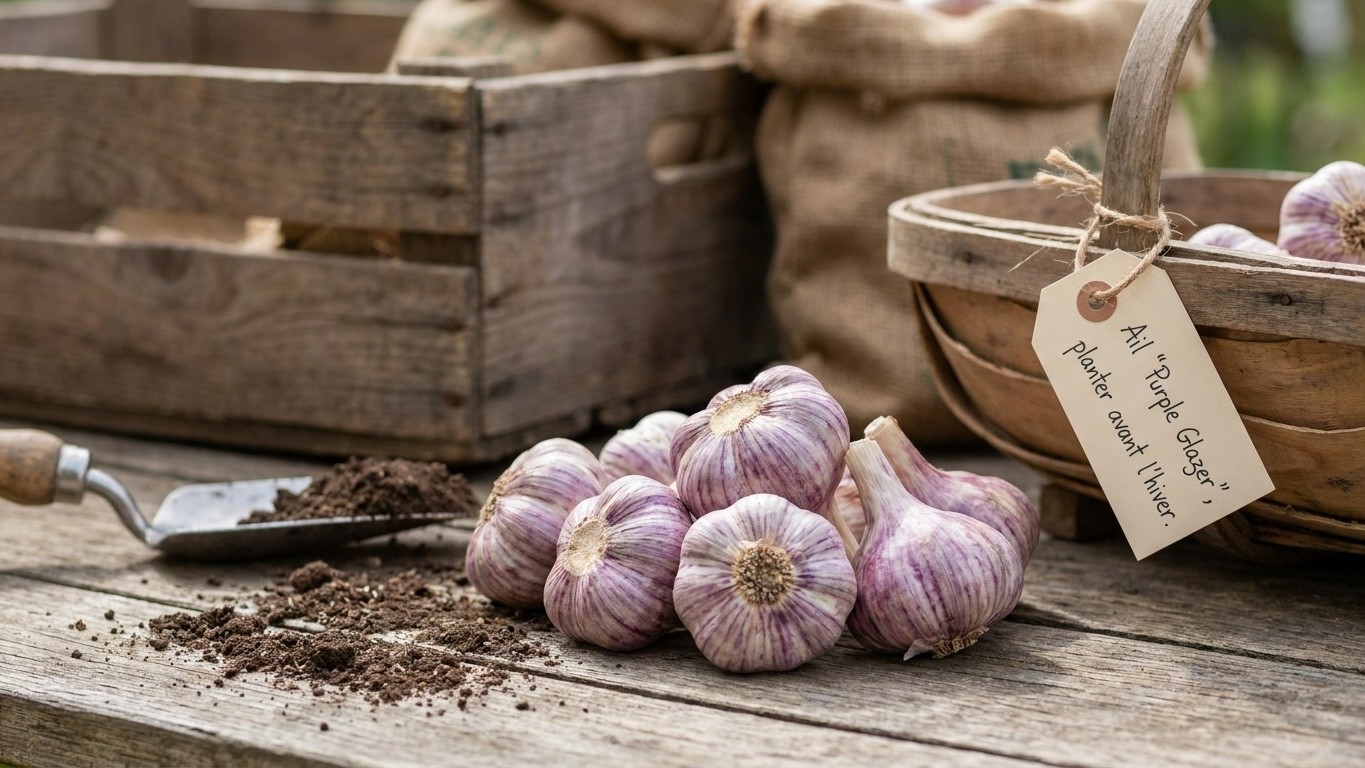

Purple Glazer is a hardneck garlic in the Glazed Purple Stripe family, its wrappers streaked deep purple over ivory, its cloves hot and lingering on the tongue with a sweetness that builds in storage. Like other hardnecks, it needs roughly six weeks of temperatures below 40°F after planting to split into a full head of cloves rather than staying one round bulb. Before you order seed stock, check your region’s winter chill against that six-week threshold, because it decides whether this variety is worth planting at all where you garden.
What Purple Glazer actually is

Purple Glazer is a b-variety within the purple stripe group, specifically classed as a glazed purple stripe. Purple stripe garlics as a group have a reputation as the best garlic for baking, and that reputation often gets read as a promise of heat — the assumption being that a variety prized for roasting must also bring a sharp bite raw. Purple Glazer doesn’t work that way. Its flavor is strong and it lingers, but it is not hot, and it leaves no aftertaste. That combination — intensity without heat, and a clean finish rather than a lingering burn — is the detail worth knowing before you plant or cook with it, because it sets Purple Glazer apart from what the group’s name might lead you to expect.
Like all purple stripe garlics, Purple Glazer is a hardneck variety. It sends up a stiff central scape and produces a smaller number of large, easy-to-peel cloves arranged around that stalk, rather than the many small irregular cloves typical of softnecks. The bulb wrappers are where the “glazed” part of its name comes from: they have a glossy, almost lacquered sheen, streaked and blotched with deep purple over a lighter base, making the heads noticeably more eye-catching than plainer-skinned hardnecks.
Storage is the tradeoff that comes with belonging to this subgroup. Glazed purple stripes tend to have thinner skins than other hardnecks, and Purple Glazer is no exception — it keeps for a shorter stretch than many other garlics, typically holding up well for a few months after harvest rather than lasting through an entire year. It’s a variety best grown with the expectation that it will be used up over the fall and winter rather than stored deep into the following spring.
What Purple Glazer tastes like, and what to do with it
Being a hardneck variety comes with a trade-off that has nothing to do with flavor description and everything to do with how the plant is built. Hardnecks put their energy into a central flower stalk and a handful of large cloves around it, and that same structure is what gives hardneck garlic its typically more complex, layered flavor compared with softnecks. The cost is storage: hardneck bulbs generally keep for a few months rather than the better part of a year, and their stiff central stalk means they can’t be braided the way softneck garlic is. If you’re choosing Purple Glazer, you’re choosing flavor and looks over long shelf life and braid-ability — that’s the actual trade, not a matter of taste.
Raw garlic bite is mostly a cooking-stage phenomenon, not a fixed trait of the clove. Heat and sharpness come from compounds that break down as garlic cooks, so a variety’s raw pungency has little bearing on how it behaves once it hits a pan or an oven — long, slow roasting in particular converts almost any garlic toward sweetness. Since Purple Glazer is already documented as not hot and clean-finishing rather than sharp, that character is likely to be most obvious raw or lightly cooked — in a dressing, a salsa, or crushed into something uncooked — where its strength and lack of aftertaste can actually register, rather than being masked the way a milder garlic gets lost next to something more aggressive.
Beyond what’s documented — its strength, its lack of heat, its clean finish, and its category’s baking reputation — there’s no published detail on how Purple Glazer performs in specific dishes, how it compares side-by-side with other purple stripes, or how its flavor shifts with storage age. That information simply isn’t available, and it shouldn’t be guessed at.
Will it get the cold it needs where you are
Hardneck garlic vernalizes: the clove has to sit through a real stretch of cold, generally reckoned at around six weeks below 40°F, before it will divide into separate cloves instead of growing into a single rounded bulb. Skip that chill and the plant still grows leaves and still bulks up something underground, just not a head. This is the single most common reason a gardener plants a fancy hardneck like Purple Glazer and lifts a disappointing round instead of a garlic head.
Where the winter falls short
Growers gauged from Los Angeles temperatures, standing in for California, see essentially zero weeks below 40°F in a typical winter against the six this variety wants. The same shortfall shows up in Louisiana, measured from New Orleans, where growers who set cloves out from late November to mid December still see no meaningful stretch of that cold and lift a first crop in late August with undivided bulbs to show for it. Texas, gauged from Houston with a set-out window running early to late November and a first-ripe date in early August, and Florida, gauged from Jacksonville on a similar early-to-late November planting and early August lift, land in the same spot, and Arizona and Hawaii round out the list of places where this variety is simply fighting the climate.
Two real fixes exist for a grower in one of those states. Refrigerate the cloves for roughly the six weeks the plant would otherwise spend in cold ground, breaking them apart and storing them in a paper bag in the refrigerator before planting, which tricks the clove into vernalizing artificially. Or plant a type that doesn’t ask for the chill at all: a softneck in the Artichoke or Silverskin group is the sensible substitute in a warm-winter garden, and our guide to Susanville garlic covers an Artichoke type bred for exactly this kind of mild winter.
Where the cold is free but heat is short
At the opposite extreme, chill is not the limiting factor at all. Alaska, gauged from Anchorage, logs only around 917 growing-degree-days in a year, Yukon, gauged from Whitehorse, logs about 600, and Northwest Territories, gauged from Yellowknife, around 905, nowhere near enough cumulative summer heat to bulk a bulb properly regardless of how long the ground stays frozen. Growers there need a greenhouse or high tunnel to bank the extra warmth the bulb needs between an early-spring set-out and a lift the following spring or summer. Prince Edward Island, gauged from Charlottetown, sits closer to workable with roughly 1569 growing-degree-days a year, described as tight rather than short, where an early cultivar and a black plastic mulch to bank a bit more heat make the difference.
| Territory | Station | What limits it | Verdict |
|---|---|---|---|
| California | Los Angeles | 0 of 6 weeks below 40°F | Risky, refrigerate cloves or switch to softneck |
| Texas | Houston | 0 of 6 weeks below 40°F | Risky, same fix |
| Florida | Jacksonville | 0 of 6 weeks below 40°F | Risky, same fix |
| Alaska | Anchorage | ~917 growing-degree-days a year | Cold is fine, needs a tunnel for heat |
| Yukon | Whitehorse | ~600 growing-degree-days a year | Cold is fine, needs a tunnel for heat |
| Prince Edward Island | Charlottetown | ~1569 growing-degree-days a year | Comfortable but tight, use an early cultivar |
When to put the cloves in
Garlic goes in the ground in autumn and comes out the following summer, and the planting window is set by the first fall frost in your area rather than by a date on the calendar. The goal is a clove that has time to root into the soil before it freezes solid, but that hasn’t pushed enough top growth to get bitten back hard by an early freeze. That balance shifts by region, and extension offices in different states genuinely disagree on how many weeks of lead time to give it, so treat any single number you read online as a starting point rather than gospel for your yard.
In places with a hard, early winter, cloves generally go in while the soil is still workable but cooling fast, giving roots a few weeks to establish before the ground locks up. In places with a mild, late winter, planting stretches later into the season since there’s little risk of the ground freezing hard before the roots catch on. In places with no real frost at all, like the warm-winter states discussed above, growers plant in late fall regardless, since Louisiana, Texas and Florida all show a set-out window running from early to mid December, simply because there’s no colder alternative window to wait for.
Your local extension office’s planting calendar and your county’s average first-frost date, both available from your state’s cooperative extension service, are the two things to check before you set a date. Garlic Varieties as a category all follow this same autumn-to-summer cycle, so once you’ve nailed the timing for one hardneck you’ve nailed it for most of them.
Hardneck or softneck: what this one asks of you
Purple Glazer is a hardneck through and through, and that habit sets the whole growing calendar. A rigid central stalk called a scape rises from the plant in late spring or early summer and has to be cut off while it’s still curled, both to keep the plant’s energy going into the bulb and to get a usable, mild garlic-flavored green for the kitchen. Skip that step and the bulb stays noticeably smaller.
Hardneck cloves run fewer and larger per head than softneck cloves, which makes them easier to peel at the cutting board, a real advantage if you cook with a lot of garlic. The tradeoff is storage life: hardnecks hold for a matter of months rather than the better part of a year a Silverskin softneck manages, and they can’t be braided the way a soft, pliable softneck neck can.
This tracks with climate for a reason beyond taste. Hardnecks like Purple Glazer evolved to need, and to tolerate, a long, cold winter, which is exactly why the cold-country territories in the table above suit it and the warm ones don’t. A grower in a genuinely cold climate gets the full benefit: big cloves, easy peeling, and no fight to vernalize the crop. If you want a second hardneck with the same long-winter appetite for comparison, Spanish Roja is a Rocambole type with a similar cold requirement and a milder, sweeter flavor when cooked.
Growing and curing it without losing the crop
Planting and mulch
Set individual cloves pointed end up, spaced a hand’s width apart in rows a foot or so apart, deep enough that the tip sits a couple of inches under the soil surface. A thick mulch of straw or shredded leaves matters more here than for a spring-planted crop, since it’s insulating roots through the entire winter rather than just protecting against one late frost, and it also suppresses the weeds that would otherwise compete with a plant that’s already slow to get going.
Watering, lifting and curing
Water through spring while the plant is bulking up, then stop a few weeks before you expect to lift, since wet soil at harvest time invites rot and stains the wrappers. The signal to lift is foliage: when roughly the bottom third to half of the leaves have browned and dried while the top ones are still green, the bulb is at its peak. Dig, don’t pull, since a snapped stalk on a hardneck ruins the seal that keeps the bulb from drying out too fast in storage.
Cure the whole plant, roots, stalk, leaves and all, in a shaded, dry, well-ventilated spot for a few weeks before trimming and storing. The classic mistakes with garlic are lifting too late, after the wrapper skins have started to split and separate in the ground, and curing in a spot that’s too humid or too dark to let air move, both of which cost you the crop months later in the pantry rather than at harvest.
- Lift when about a third to half the leaves have browned, not when the plant looks fully dead
- Cure whole, unwashed, out of direct sun, for several weeks before trimming
- Store hardneck bulbs cool and dry, and plan to use them within a few months rather than saving them for next year’s seed stock alone
Common questions
Can I grow Purple Glazer in a raised bed in a warm climate if I chill the soil somehow?
Chilling the soil itself isn’t practical at garden scale. Refrigerating the cloves for the weeks before planting is the workable version of the same idea, since it’s the clove tissue that needs the cold exposure, not the bed it sits in.
What happens if I just plant it anyway in a mild-winter state?
You’ll usually still get a plant, and often still get something edible, but expect a single round bulb with no clove divisions in a meaningful number of them rather than a proper head. It’s not a wasted season, just a smaller and less useful harvest than a hardneck should give.
Is Purple Glazer the same as regular Purple Stripe garlic?
It’s a member of that broader Purple Stripe group but specifically classed as Glazed Purple Stripe, a subgroup known for the glossy sheen on the wrapper skins. Catalogue names within Purple Stripe vary in clove count and heat, so treat “Purple Stripe” as a family name rather than a single variety.
Can I save my own cloves from this year’s harvest to replant?
Yes, and most garlic growers do exactly that, saving the largest, healthiest bulbs from the current crop as next season’s seed stock. Just keep those seed cloves in the same short storage window as eating garlic, since a hardneck clove that’s sat too long and started to soften won’t root reliably.