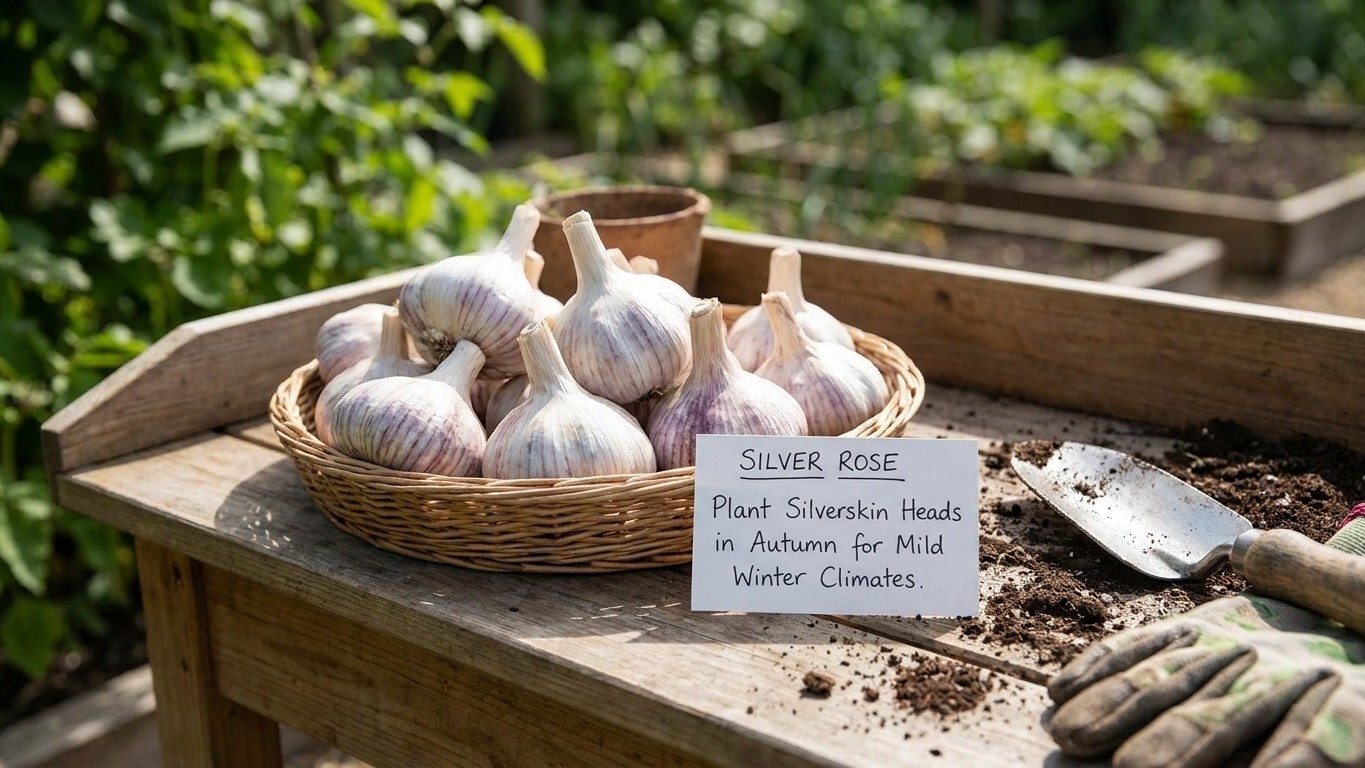

Silver Rose is a Silverskin garlic, a softneck type prized for its long storage life and mild, slow-building heat rather than a sharp bite. The single biggest question with this variety isn’t soil or spacing, it’s whether your winter gets cold enough, long enough, for the clove to actually split into a head. Check your first fall frost date through your state’s extension service or NOAA’s local climate data, then use that to set your planting window before you order seed stock.
What Silver Rose actually is

Silver Rose belongs to the Silverskin group, the same family that includes braiding garlics like Nootka Rose and Silver White. It is a softneck variety, meaning it never sends up a flowering stalk (a scape) the way hardneck types do, and its cloves wrap in several papery layers rather than clustering loosely around a woody core.
Seed catalogs that carry Silver Rose describe the flavor as mild and slow to develop heat, sweetening noticeably when roasted or cooked down, which is typical of the Silverskin group generally. What sets Silverskins apart from other garlic types is storage: they routinely outlast Porcelain and Rocambole types in the pantry, often keeping firm for many months past harvest when cured well. That long shelf life is the main reason growers choose a Silverskin over a showier hardneck, and it’s also why the variety turns up in kitchens that put up garlic braids for winter use.
None of that changes how you grow it. What does change everything is climate, and that’s where most guides to this variety stop short.
What Silver Rose tastes like, and what to do with it
Silver Rose is documented as mild, and that claim holds up rather than needing correction: Silverskins as a category are already the gentlest branch of the garlic family, so a Silverskin described as mild is running true to type, not breaking from it. Where a hardneck like a Rocambole or Purple Stripe throws a sharp, sometimes lingering raw bite, Silver Rose’s heat is described as slow to develop and quick to fade, which means the clove itself is not where this variety earns its keep. That happens in the pan or the oven.
Roasting is the documented strength, and the mechanism is straightforward: sustained heat breaks down the sulfur compounds responsible for raw garlic’s sharpness and converts starches to sugar, so any garlic sweetens under a long roast. A variety that starts out mild has less bite to burn off in the first place, which is why Silver Rose is called out specifically as excellent baked or roasted — whole heads softened in the oven until spreadable, cloves tossed with vegetables before a hot roast, or garlic worked into a sauce that simmers rather than one served raw. In those applications the mildness stays mild and simply turns sweeter, without the raw sting other varieties need to cook off first.
That also marks where Silver Rose is a weaker choice: dishes built around garlic’s raw punch — a quick salsa, an uncooked dressing, anything where the clove is barely warmed — will taste thin next to a hotter hardneck standing in the same role. This variety is suited to slow, forgiving cooking rather than a starring raw turn.
Beyond mild-and-sweet-when-roasted, no further detail on this variety’s flavor — heat level relative to other Silverskins, aroma, or performance in specific cooked dishes — has been published.
Will it get the cold it needs where you are
Garlic is not like a bulb such as a daffodil that just needs to go dormant. A clove planted in fall has to sit through a real stretch of cold, generally close to six weeks with temperatures staying near or below 40°F, before it will divide into the individual cloves that make up a head. Skip that chilling and you don’t get a smaller harvest, you get a completely different result: one round, undivided bulb, because the clove never received the signal to split.
This is the trap that catches gardeners in the warmest states. Weather records for the Los Angeles area, used as the reference station for California, show essentially no weeks that stay below 40°F through a typical winter, against the roughly six weeks Silver Rose wants. The same shortfall shows up around New Orleans for Louisiana, Houston for Texas, and Jacksonville for Florida. Growers in those areas who plant Silver Rose straight from the bag and hope for the best routinely lift a crop of single round bulbs instead of heads worth peeling.
Where it falls short, and what to do about it
In those risky zones, gardeners have two real options rather than one flat refusal. The first is to refrigerate the seed cloves for several weeks before planting, simulating the chill the ground itself won’t provide. The second is to grow a garlic type bred to ask for less cold, a route worth taking if refrigerator space is tight; a companion Silverskin such as Silver White carries the same low-chill flexibility.
At the other end of the map, the problem flips. In Prince Edward Island, referenced to the Charlottetown station, cold is not the issue, the season’s cumulative warmth is: growing-degree totals there run around 1,569, which is tight for finishing a bulb properly, and a plastic mulch to bank extra soil heat makes a real difference. Further north still, Alaska (Anchorage) totals around 917 degree-days, and Nunavut (Rankin Inlet) manages only about 159, both well short of what Silver Rose needs to bulb fully in the open ground regardless of how comfortably the chill requirement is met. A greenhouse or low tunnel is the practical fix in both places.
| Territory (station) | Cold or heat supplied | Verdict |
|---|---|---|
| California (Los Angeles) | 0 of ~6 weeks below 40°F | Risky, refrigerate cloves |
| Texas (Houston) | 0 of ~6 weeks below 40°F | Risky, refrigerate cloves |
| Florida (Jacksonville) | 0 of ~6 weeks below 40°F | Risky, refrigerate cloves |
| Louisiana (New Orleans) | 0 of ~6 weeks below 40°F | Risky, refrigerate cloves |
| Prince Edward Island (Charlottetown) | ~1,569 growing-degree-days | Chill fine, heat tight, mulch helps |
| Alaska (Anchorage) | ~917 growing-degree-days | Chill fine, heat short, tunnel advised |
| Nunavut (Rankin Inlet) | ~159 growing-degree-days | Chill fine, heat far short, needs cover |
If your state doesn’t appear here, don’t assume either extreme applies to you. Ask your county extension office for local winter chill-hour data before you order cloves, since conditions shift a great deal even within a single state.
When to put the cloves in
Garlic is a fall-planted, summer-lifted crop almost everywhere, and Silver Rose follows that rule. The date that matters is your first fall frost, not a spot on the calendar, because the goal is narrow: get roots established before the ground locks up, without pushing enough top growth that a hard freeze burns back green leaves.
In genuinely cold winter regions, that usually means planting several weeks before the ground freezes solid, which for a place like Prince Edward Island lands in late September based on the Charlottetown reference data. In places with only a brief, marginal chill window, growers plant later, closer to when nights are reliably cool but the soil hasn’t frozen at all; around New Orleans and Houston, that has meant windows running from early to mid or even late November, and around Jacksonville a similar early-to-late November stretch. Far to the north, where the ground can freeze hard early, growers front-load the calendar considerably, planting as early as August in the Yukon.
Why the advice varies so much by region
Extension services genuinely disagree by region on how many weeks before frost is ideal, and that disagreement is real, not sloppiness. A grower in a short, mild winter has almost no margin for error and often gets specific week-by-week guidance from their local office. A grower in a long, severe winter has more slack and more often gets a broader range. Rather than pick a single number for a whole state, check your state extension service or land-grant university’s garlic planting guide, since it will be built around your actual frost data rather than a national average. For background on how these planting windows are set across garlic types generally, see the overview at Garlic Varieties.
Hardneck or softneck: what this one asks of you
Silver Rose is a softneck garlic, and that fact governs several practical choices at once. Because it never sends up a scape, you skip the early-summer chore of cutting that curling flower stalk, a task hardneck growers do every year to push the plant’s energy back into the bulb.
The tradeoff runs the other way at harvest and in storage. Softnecks like Silver Rose typically produce more cloves per head, each one smaller, wrapped in tighter layers that make peeling a touch fussier than a big, loose hardneck clove. What you get in return is storage life: cured well, a Silverskin routinely outlasts most hardneck types in the pantry, which is exactly why this group is the traditional choice for braiding into long strings for the kitchen.
That softneck habit also lines up with where the variety performs best. Softnecks generally tolerate mild winters better than hardnecks do, since they didn’t evolve under the harsh, long-freeze conditions that produced tougher, hardier types like the Purple Stripe garlics. If your winters run genuinely severe rather than mild or moderate, a hardneck bred for that cold, such as Metechi, is worth comparing before you commit a whole bed to a softneck that wants a gentler season.
Growing and curing it without losing the crop
Plant cloves root-down, pointed tip up, roughly two inches deep and around six inches apart in rows spaced far enough apart to weed comfortably. Depth matters more with garlic than with most bulbs because a clove set too shallow can heave out of the ground during freeze-thaw cycles over winter.
Mulch, watering, and knowing when to stop
Mulch matters more for an overwintered crop than it does for almost anything else in the garden, since it buffers the soil against the freeze-thaw swings that push shallow cloves upward and expose roots. A loose layer of straw a few inches thick, pulled back partway in spring once new growth appears, does the job in most regions.
Water consistently through spring while the bulb is bulking up, then stop watering a few weeks before you expect to harvest. Garlic that’s watered right up to lifting cures poorly and rots in storage. The signal to lift is foliage color, not a date: when the lower third to half of the leaves have browned while the top leaves are still green, the bulb is generally ready. Pulling too early gives small, papery-skinned bulbs that don’t store; waiting too long past that point lets the wrapper split and the cloves separate in the ground, both of which shorten storage dramatically.
Curing before you store it
After lifting, don’t wash the bulbs or trim the roots and tops right away. Cure whole plants in a shaded, dry, well-ventilated spot for a few weeks until the outer wrappers are papery and the neck is fully dry. Only then trim roots and tops (or braid the softneck stems while they’re still pliable) and move the crop to long-term storage. A garlic that skips curing or gets cured somewhere damp is the single most common reason a good-looking harvest rots or sprouts within weeks instead of lasting through winter.
Common questions
Can I grow Silver Rose garlic in a warm climate at all?
Yes, but not by planting it the way you would in a cold state. You need to refrigerate the seed cloves for several weeks before planting to fake the chilling period your winter doesn’t provide, or switch to a garlic type bred to need less cold.
How do I know if my garlic didn’t get enough cold?
The harvest tells you: instead of a head made up of several distinct cloves under one wrapper, you’ll pull a single smooth, round bulb with no internal divisions at all. That’s the classic sign of insufficient chilling, not a disease or a growing mistake elsewhere.
Is Silver Rose the same thing as Silver White garlic?
No, they’re related but distinct cultivars within the same Silverskin group, so they share the mild flavor and long storage life but aren’t interchangeable seed stock. If you can’t source Silver Rose locally, Silver White is the closest substitute in habit and climate needs.
Do I need to cut a scape on Silver Rose garlic?
No. Silver Rose is a softneck variety and doesn’t send up a scape the way hardneck garlics like Metechi do, so there’s no mid-season stalk to cut back.