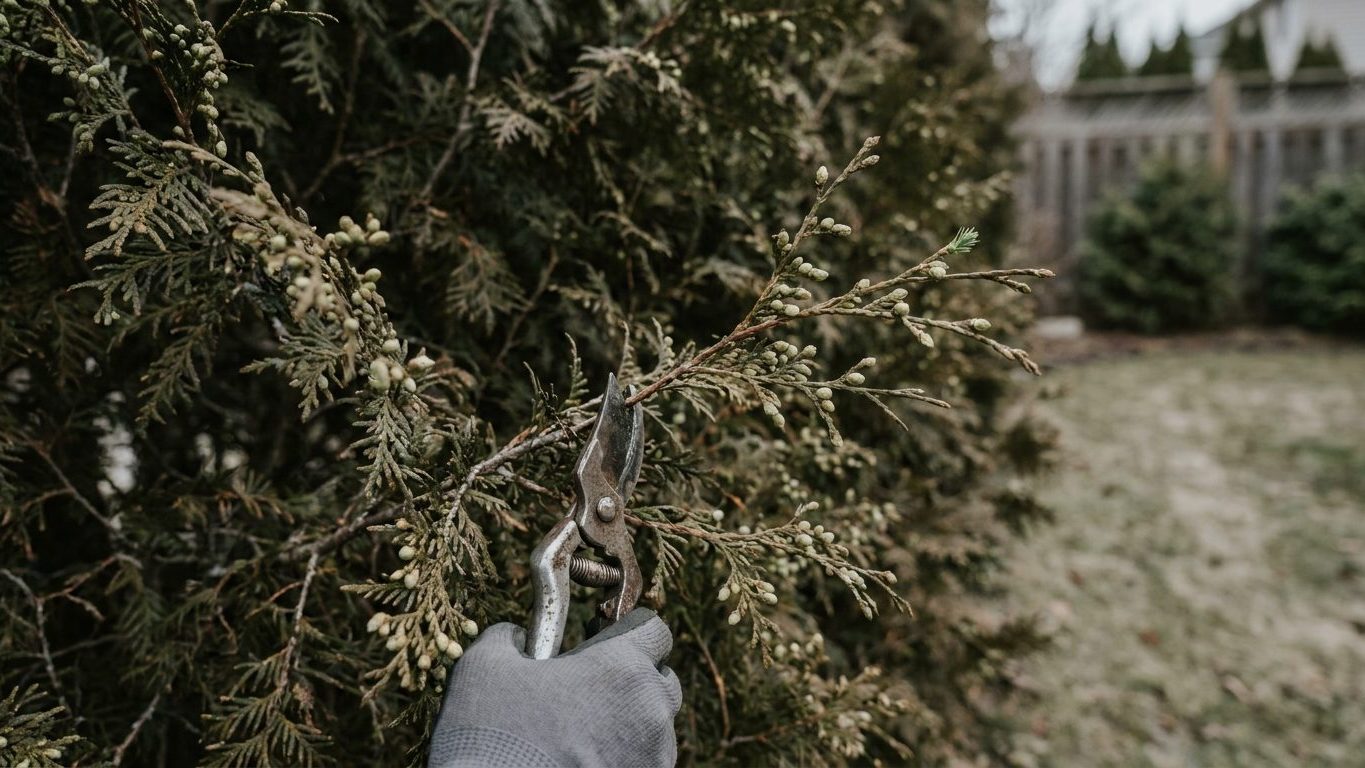

Late winter, just before new growth pushes, is the safe window for arborvitae. Midsummer works too, once the spring flush has hardened off. The plant’s own signal matters more than any date on a calendar, because arborvitae never regrows from bare wood the way most hedge shrubs do. Miss the window and there’s no fixing it later with a heavier cut.
When to prune arborvitae
The exact week moves with local frost dates, not with anything printed on a page. Arborvitae is hardy across USDA zones 3 through 7, and that late-winter window can fall anywhere from January in the Carolina Piedmont to April in northern Minnesota. What stays constant is the signal on the plant itself: prune once buds have swelled but before the new needles unfurl. Growth at that stage runs 6 to 9 inches a year, and that flush is what hides the cut. A branch trimmed just as growth starts gets buried in new foliage within a few weeks. The same cut made in October sits exposed through months of freezing nights, browning at the edges before spring arrives.
Midsummer is the second option, and it works for a different reason. By then the spring flush has stopped stretching and firmed up enough to hold a clean line. Trimming a hedge in midsummer also catches any second flush before it hardens, which is why kept hedges often get two light passes a year rather than one heavy one.
Skip the shoulder seasons. A cut made in late fall opens tissue that has no time to seal before a hard freeze, and that’s when winter burn shows up worst, on wood already stressed by a fresh wound. Pruning too early in spring, before buds have swelled, has no growth ready to cover the cut and leaves it open to a late frost.
Local extension offices track the actual week for a given county using accumulated growing-degree-days rather than a fixed date. A gardener in coastal Virginia is working from a different clock than one in Vermont, even though both are pruning the same species for the same reason.
How far back you can cut, and what happens if you go past it
Arborvitae does not regrow from bare brown wood. Not slowly, not thin, not at all. Unlike hedge shrubs that can be cut to a stump and resprout from buds hidden under the bark, arborvitae carries no such buds. Once a branch is cut back past its green, needled growth into the bare wood underneath, that spot stays bare for the life of the plant. The result is a permanent hole in the hedge, not a shorter branch.
The rule that follows is simple: cut into the green, never through it. Every pass of the shears should stop at foliage, leaving a stub of needled growth behind rather than exposing the woody interior underneath. A hedge can only ever be trimmed back to roughly where it already carries green growth, not to whatever size would look better from the driveway. The plant’s own growth over past seasons sets the outer limit of what shaping can do.
This answers the question most people are actually asking. A hedge that’s grown too wide for the walkway, or too tall for the window line, can’t be renovated back down the way a boxwood or a yew can. Cutting past the green to force a smaller footprint doesn’t produce a denser hedge. It produces a hedge with permanent brown gaps that get worse every year, as the surrounding growth fills in around them but never fills them in.
Honest options at that point are limited. Repeated light trims, done every year so the hedge never gets ahead of its green wood, keep a hedge from reaching this point at all. For a hedge already past it, living with the current size and trimming only the surface is one option. Moving the line, planting a replacement further out and removing the old run over a season or two, is another. Replacing the hedge outright is usually the more realistic call once large interior sections have gone bare, since no amount of feeding or watering brings back tissue that was never capable of resprouting in the first place.
The shape that keeps the bottom alive
A hedge sheared with straight vertical sides, or sides that lean inward toward the top, shades its own lower branches. Needles need direct sun to stay productive, and a top-heavy hedge blocks that light from ever reaching the bottom few feet. Within a few seasons the lower branches thin out and drop their needles, leaving the bare, woody-legged look known as a hedge gone bald at the bottom.
The fix is in the taper. A hedge sheared so the base is noticeably wider than the top lets sunlight reach the lower branches at an angle instead of getting blocked by the canopy above. Arborvitae kept as a hedge commonly runs 4 to 15 feet tall, and the taller that range, the more the taper matters, since a 15-foot hedge sheared flat-sided shades its own base far more than a 5-foot one does.
The one-third rule sets the other limit, on how much comes off at once rather than on shape. Removing more than about a third of a branch’s green growth in a single session stresses the plant past what it can recover from that season, showing up as sparse, patchy regrowth instead of a fuller shape. Light, frequent shearing that respects both the taper and the one-third limit keeps a hedge dense from the ground up, rather than full at eye level and hollow at the base.
A hedge already sheared straight-sided for years can be brought back toward a taper gradually, angling each season’s cut a bit more outward at the base than the year before. Trying to fix the taper in one pass usually means cutting into wood that has already gone bare on the sides, and that cut doesn’t come back. Spacing at planting, matched to mature width, does as much for a full-to-the-ground hedge as the shearing technique does later.
What actually kills arborvitae
Three threats account for most arborvitae losses, and pruning changes the odds on one of them directly.
- Bagworms can strip a plant of needles in a single season, feeding from inside small bag-shaped cases that are easy to miss until the damage is done.
- Winter burn browns the windward side of the plant, the result of cold, drying wind pulling moisture out of needles faster than frozen roots can replace it.
- Deer browse arborvitae down to the snow line in winter, when little else stays green and reachable above the snowpack.
Pruning doesn’t do much for winter burn or deer pressure, both come down to siting and fencing. Bagworms are different. A hedge sheared for airflow, with cuts that open the interior rather than leaving it dense and shaded, dries out faster after rain and holds less of the still, humid air that lets bagworm populations build unnoticed. A crowded, unthinned plant holds moisture against its own foliage, and that damp interior is what lets bagworms, and the fungal issues that follow storm damage, take hold before anyone spots them from the yard.
Some regional extension services have scaled back recommending arborvitae in areas with heavy, repeated bagworm pressure, pointing homeowners toward more resistant conifers instead. Checking with a state extension service, such as Penn State Extension, Clemson Cooperative Extension, NC State Extension, or UMass Extension, for identification is a more reliable step than guessing from a photo, since the cases resemble small pinecones and get overlooked easily on a dense hedge. Late winter, the same window used for pruning, doubles as the easiest time to spot last summer’s empty bags against bare branch tips, before a new generation hatches.
Common questions
Can you prune arborvitae in fall?
It’s the one season to avoid. A fall cut has no growth left to cover it and no time to seal before winter, which is exactly when winter burn shows up worst on the fresh wound.
What happens if you cut arborvitae too short?
Cutting past the green growth into bare wood leaves a permanent bald spot. There’s no dormant bud under that bark to push new growth, so the gap stays for the life of the plant.
How much can you trim off arborvitae at once?
No more than about a third of a branch’s green growth in a single session. Taking more than that stresses the plant past what it can recover in one season.
Does arborvitae recover from winter burn?
Often yes, if the buds under the browned needles are still alive, new growth fills in over the following season. Branches that come back with no green at all under the brown won’t recover and are usually pruned out once new growth confirms which parts are dead.