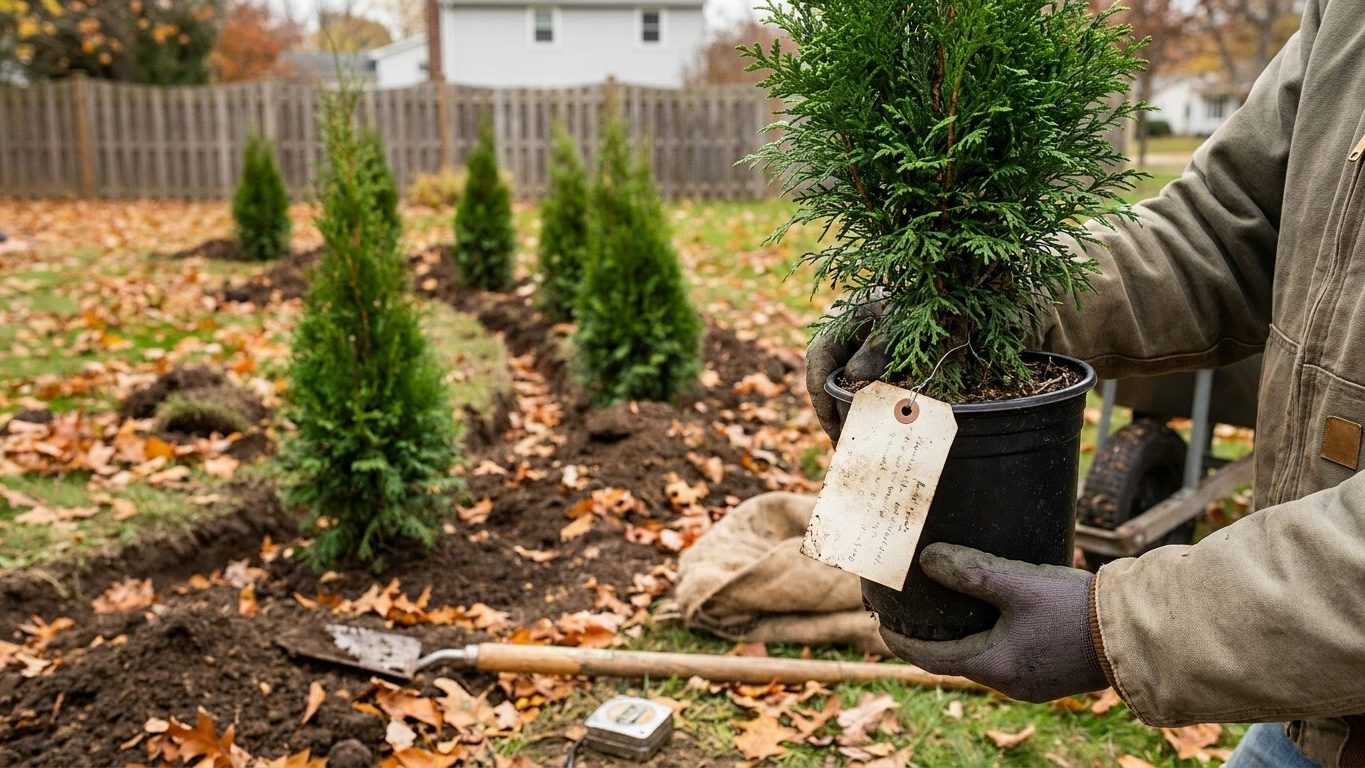

Spacing comes from the plant’s tag, not the species page. Take the mature width printed on the cultivar you’re buying, then plant at half of that number for a hedge that closes fast, or two-thirds for one that stays healthier for decades. A cultivar tagged at 4 feet wide gets set 2 to 2 feet 8 inches apart, never the 10 to 15 feet the untrimmed species can reach.
How far apart to plant arborvitae
The label on the pot is the only number that matters here. Nursery tags list mature width for the specific cultivar, and that figure already accounts for the fact that hedge plants get clipped and never left to sprawl the way a lone specimen would. The species itself, Thuja occidentalis, tops out at 10 to 15 feet wide if nobody ever touches it, but almost nobody plants the unimproved species as a hedge. They plant a selection bred to stay narrow, and that selection is what the tag describes.
Once you have that number, the math is simple. Multiply the tag width by 0.5 for the tight end of the range, and by roughly 0.67 for the wide end. Say the tag on your plant reads 4 feet at maturity. Half of that is 2 feet. Two-thirds is about 2 feet 8 inches. Anywhere inside that window works, and where you land depends on what you want out of the hedge.
Plant at the tighter end, 2 feet in this example, and the row reads as a solid screen sooner. Arborvitae grows 6 to 9 inches a year, so a young hedge at tight spacing can look continuous within two or three growing seasons. Plant at the wider end and the same hedge takes a season or two longer to knit, but the plants keep more root room and airflow for the rest of their lives, which in USDA zones 3 through 7 can mean decades.
There’s no wrong choice inside that half-to-two-thirds band. The mistake is spacing by the species number instead of the tag number, which is how hedges end up either gapped for years or so crowded they start failing before they’re mature.
What planting them closer really buys you
Tighter spacing does exactly one thing well: it closes the visual gap faster. Plant at half the tag width instead of two-thirds and you might get a solid-looking screen a year sooner. That’s the entire benefit, and it comes with a bill that arrives later and lasts longer.
Crowd the roots and the plants compete for the same soil volume for the rest of their lives, not just while they’re small. The bases thin out because sunlight can’t reach the lower branches once neighboring plants close ranks, and the air in the middle of a tight row stays damp and still long after a wider row has dried out. That still, damp interior is where canker and blight problems get a foothold, and it’s also where a bagworm infestation can strip foliage out of sight before anyone notices from the front.
This is where arborvitae’s biggest weakness matters. The species does not regrow from bare wood. There are no dormant buds hiding under the brown bark waiting to sprout, so any branch that dies back in that shaded, crowded interior, whether from disease, bagworms, or simple lack of light, leaves a hole that never fills back in. On a widely spaced plant that gap stays inside the canopy where it barely shows. On a tightly spaced hedge, a dead patch in one plant reads as a gap in the whole screen, because there’s no room for a neighboring plant’s growth to cover it.
Winter burn adds another version of the same problem. Wind-exposed foliage on the windward side of a hedge browns over the cold months, and a plant with plenty of root room and airflow recovers faster the following season than one already stressed by crowding. Deer browsing to the snow line is a separate issue entirely, driven by local deer pressure rather than spacing, but a hedge already thin at the base from overcrowding shows browse damage more obviously than one with full, healthy lower growth.
One row or two
A single row, spaced at half to two-thirds of the tag width, is what most residential hedges need. It’s enough to block a sightline, screen a patio, or mark a property edge, and it keeps the planting bed narrow enough to fit along a typical side yard or front border.
A staggered double row is a different tool for a different job. Set two rows a little more than the single-row spacing apart, then offset the plants in the second row so each one sits opposite a gap in the first. That staggering closes visual gaps faster than a single row at the same spacing, because a plant in the back row can fill a sightline where a front-row plant is still young. It also builds a deeper, more effective sound and wind screen, which matters more at the taller end of arborvitae’s 4 to 15 foot hedge height range than at the shorter end.
The trade-off is straightforward: roughly double the plants and close to double the bed width compared with a single row at the same spacing. If a single row needs 2 feet 8 inches between plants in a bed a few feet wide, a staggered double row needs two of those bands plus the gap between rows, easily 4 to 5 feet of total width once you add the stagger offset.
| Layout | Closure speed | Plants needed | Best use |
|---|---|---|---|
| Single row | Standard, based on tag spacing | Baseline count | Property line, side yard, patio screen |
| Staggered double row | Faster, gaps overlap | Roughly double | Road noise, tall screen, fast full privacy |
Choose the double row when the goal is an immediate, dense wall of green and the space and plant budget allow for it. Choose the single row for everything else, which covers most home landscapes.
Working out how many plants you need
The formula is run length divided by spacing, plus one. A 30-foot property line with plants spaced 2 feet 8 inches apart works out to roughly 11.25, rounded up to 12, plus one for the starting plant, for 13 total. A 40-foot run at the same spacing lands near 15, plus one, for 16 plants.
Two things push that number around before you order anything. The first is a corner. Measure each leg of an L-shaped run separately from the corner point rather than treating the whole thing as one straight line, or the corner plant gets counted twice, or not at all, and the spacing on either side of the bend comes out uneven.
The second is setback from a boundary, fence, or foundation, and it matters more than most planting plans admit. Arborvitae reaches its full mature width whatever the site plan says, and a plant tagged at 4 feet wide will eventually occupy roughly half that distance, 2 feet, on either side of its trunk. Set the row back from a property line or walkway by at least that half-width, or the hedge ends up encroaching on a neighbor’s yard or crowding a path within a few years of the 6 to 9 inch annual growth adding up.
Skipping the setback is also why the no-regrowth rule matters at planting time, not just later. Cut an overgrown row back hard enough to reach brown wood to fix a spacing mistake, and that section never fills back in, since arborvitae has no buds under the bark to push new growth from. Prune in late winter before growth starts, or in midsummer, and cut only into the green. A local Cooperative Extension office can confirm the right week for either window in a given zone.
Common questions
How far apart should arborvitae be planted for a privacy hedge?
Use half to two-thirds of the mature width listed on the cultivar’s tag. For fast, dense privacy, plant at the half-width end of that range. The species itself can span 10 to 15 feet unclipped, but that number is a ceiling for an untrimmed plant, not a spacing figure for a maintained hedge.
Can arborvitae be planted too close together?
Yes. Spacing tighter than half the tag width crowds roots for the plant’s entire life, thins the lower branches from shade, and traps damp air in the row’s interior, which is exactly the condition that lets canker and blight take hold. Because the plant never regrows from bare wood, any dieback that follows stays as a permanent gap.
Does closer spacing make arborvitae grow faster?
No. Growth rate stays at 6 to 9 inches a year regardless of spacing. Closer planting only closes the visual gap between plants sooner by using less bare soil, not by speeding up how fast any single plant grows.
How far from a fence or property line should arborvitae be planted?
Set the row back by at least half the mature width listed on the tag, measured from the trunk to the boundary. A plant tagged at 4 feet wide needs roughly 2 feet of clearance so it doesn’t encroach on a fence, walkway, or neighboring yard once it reaches full size.