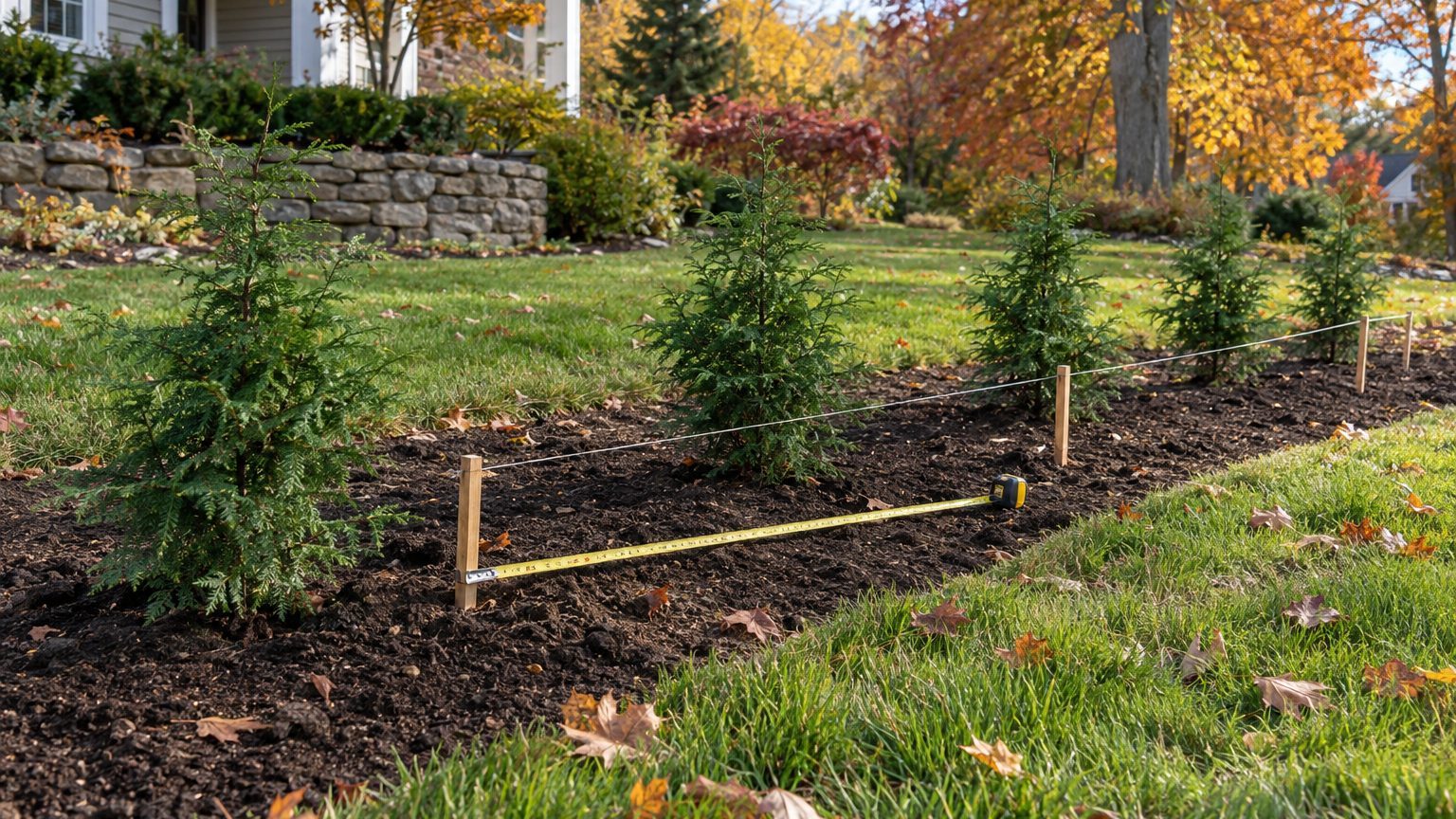

Plant an eastern hemlock hedge at half to two-thirds of the mature width printed on the tag of the cultivar you are buying. A tag reading 6 feet wide means 3 to 4 feet between trunks. The wild tree can spread 25 to 35 feet, so nobody spaces hedge plants by that number. Before you order, know that hemlock woolly adelgid has changed the advice on this species.
How far apart to plant eastern hemlock
The method is two multiplications. Find the mature width on the label of the plant in your hand, then multiply by 0.5 for a screen that closes fast or by 0.67 for plants that stay healthy longest. Nursery tags for hedge cultivars give a width because selected forms are far narrower than the type species, and hedge plants are clipped besides.
Here is a worked example with a made-up label so you can repeat it with your own. Say the tag reads 6 feet wide at maturity. Half is 3 feet. Two-thirds is 4 feet. For most yards, 3 to 4 feet apart, trunk to trunk, is the number that goes on the shopping list. Pick 3 if the screen matters more than the next twenty years, and 4 if you would rather wait a little longer for a hedge that keeps its lower branches.
| Width on the label (illustrative) | Half (fast screen) | Two-thirds (longest health) |
|---|---|---|
| 6 feet | 3 feet | 4 feet |
| 9 feet | 4.5 feet | 6 feet |
| 12 feet | 6 feet | 8 feet |
The species width of 25 to 35 feet belongs in a different role. It is a ceiling, the most an unclipped, unselected tree will do when left alone. Treat it as the upper bound of what happens if you stop trimming, not as a spacing. Use it only if the tag is missing, and even then expect any hedge cultivar to sit well under it.
Growth rate sets the timeline. Eastern hemlock adds 12 to 24 inches a year, and a finished hedge runs 10 to 20 feet tall. At the slow end of that range, gaps between plants set 4 feet apart take a few seasons to knit. It is hardy in USDA zones 3 to 7, so the arithmetic only matters if your yard falls inside that band.
Trimming is a late-spring job, and only light cuts. Your own frost dates decide when late spring arrives, and your state’s cooperative extension service can tell you the local window.
What planting them closer really buys you
Roughly a year. Set plants at half the label width instead of two-thirds and the row meets in the middle sooner. Then it spends the next two decades competing with itself. Roots fight for the same soil, the lower branches shade each other out, and the base of the hedge thins from the inside.
The thin base is the visible cost. The hidden one is the still, damp air that collects in the middle of a packed row. Foliage that dries slowly after rain is where canker and blight get a foothold, and once they are in a tight hedge there is little airflow to slow them down. Crowding to save one year trades away the decades a healthy hedge would have given you.
Hemlock has a bigger problem than spacing, and any honest page on this species has to say so. Hemlock woolly adelgid has killed hemlocks across the eastern range, and it is the reason many extension services no longer recommend planting the species. A hedge of a single species is a bet placed on one row. Spacing cannot save plants from an insect, so call your state’s cooperative extension office before buying and ask whether adelgid is active in your county.
If you do go ahead, the species has one real strength. Eastern hemlock regrows from bare brown wood, because it carries dormant buds under the bark. Most conifers cannot do this, and a hedge cut back into old wood usually never recovers. Hemlock takes hard renovation and comes back, which makes it a rescue option for an overgrown hedge that a lesser conifer could not survive. Ask your extension office when hard cuts suit your area, since routine trimming is a light-cuts-only, late-spring job.
That regrowth also means a crowded hedge is not a lost cause. It is still cheaper and slower to set plants correctly at the start than to renovate later, but the option exists. Compare that with other hedge conifers, where the same mistake can be final. If you are weighing alternatives, the spacing pages for How Far Apart to Plant Eastern red cedar for a Hedge and How Far Apart to Plant Leyland cypress for a Hedge walk through the same method for those plants.
One row or two
A single row is what most yards need. One line of plants at the spacing above gives a screen 10 to 20 feet tall at full height, uses the fewest plants, and leaves the most room for the yard.
A staggered double row closes faster and screens better. The second row fills gaps the first leaves, so there is no see-through spot while plants are young. The price is about twice the plants and a wider strip of ground. Using the 6-foot label from earlier, with rows offset by one spacing of 3 to 4 feet, a full-grown double row occupies a band about 9 to 10 feet wide, against 6 feet for a single row.
Stagger the plants so each one in the back row sits behind the gap in the front row, not directly behind a trunk. Keep the same spacing inside each row as you would for a single row. Do not squeeze both rows closer to make up for it, because the crowding problem from the last section returns with twice the plants.
The single row is the right call when the lot is narrow, when the budget is fixed, or when a fence already handles part of the privacy job. It also makes trimming easier, since you can reach both faces of the hedge. A double row is worth it where a screen has to work fast and there is land to spare. Think of a road with noise, a neighbor’s second-story window, or a long back boundary on a rural lot.
With a species facing adelgid pressure, a wider band has a second downside. Losing a double row means losing twice the investment. Another option is to mix plants of different species in the back row, though the mix should come from your extension office’s list of what does well locally.
Working out how many plants you need
Divide the length of the run by the spacing, then add one. The extra plant is because a row starts and ends with a plant, so a run always has one more plant than it has gaps. A 60-foot run at 4-foot spacing is 15 gaps, so 16 plants. Round any fraction up, never down.
A corner changes the count. Work out each leg on its own, add them, then subtract one because the corner plant belongs to both legs. Take a 40-foot leg and a 32-foot leg at 4 feet. The first is 10 gaps plus one, or 11 plants. The second is 8 gaps plus one, or 9. Add them for 20, subtract the shared corner, and you order 19.
The setback matters just as much as the count. A hemlock reaches its full width whatever the plan says, so the trunk line needs to sit back from the boundary by at least half the mature width on the label. For a 6-foot tag, that is 3 feet from the fence or property line to the center of the plant, and a little more gives you room to trim the outside face. Plant right on the line and the branches end up in your neighbor’s yard.
Local rules can add to that. Some towns and homeowners associations set hedge heights or minimum distances from a boundary or sidewalk. Check before you dig.
Common questions
What if the plant tag has no mature width?
Ask the seller for the cultivar’s width, or look it up in a university extension plant database. Do not substitute the 25 to 35 foot species figure. It describes an unclipped wild-type tree, so spacing by it leaves gaps that never close.
How far from the property line should the row go?
At least half the mature width on the label, measured from the line to the center of the trunk. A 6-foot tag means 3 feet. Add room if you want to trim the outer face without stepping onto the neighbor’s side.
Is eastern hemlock still a good hedge choice?
It depends on adelgid where you live. The insect has killed hemlocks across the eastern range, and many extension services no longer recommend planting the species. Call your state’s cooperative extension office and ask about your county before buying.
Can I cut an overgrown hemlock hedge back hard?
Yes. Eastern hemlock regrows from bare brown wood thanks to dormant buds under the bark. Routine trimming is light cuts only, in late spring. For hard renovation, ask your extension service what timing fits your frost dates.