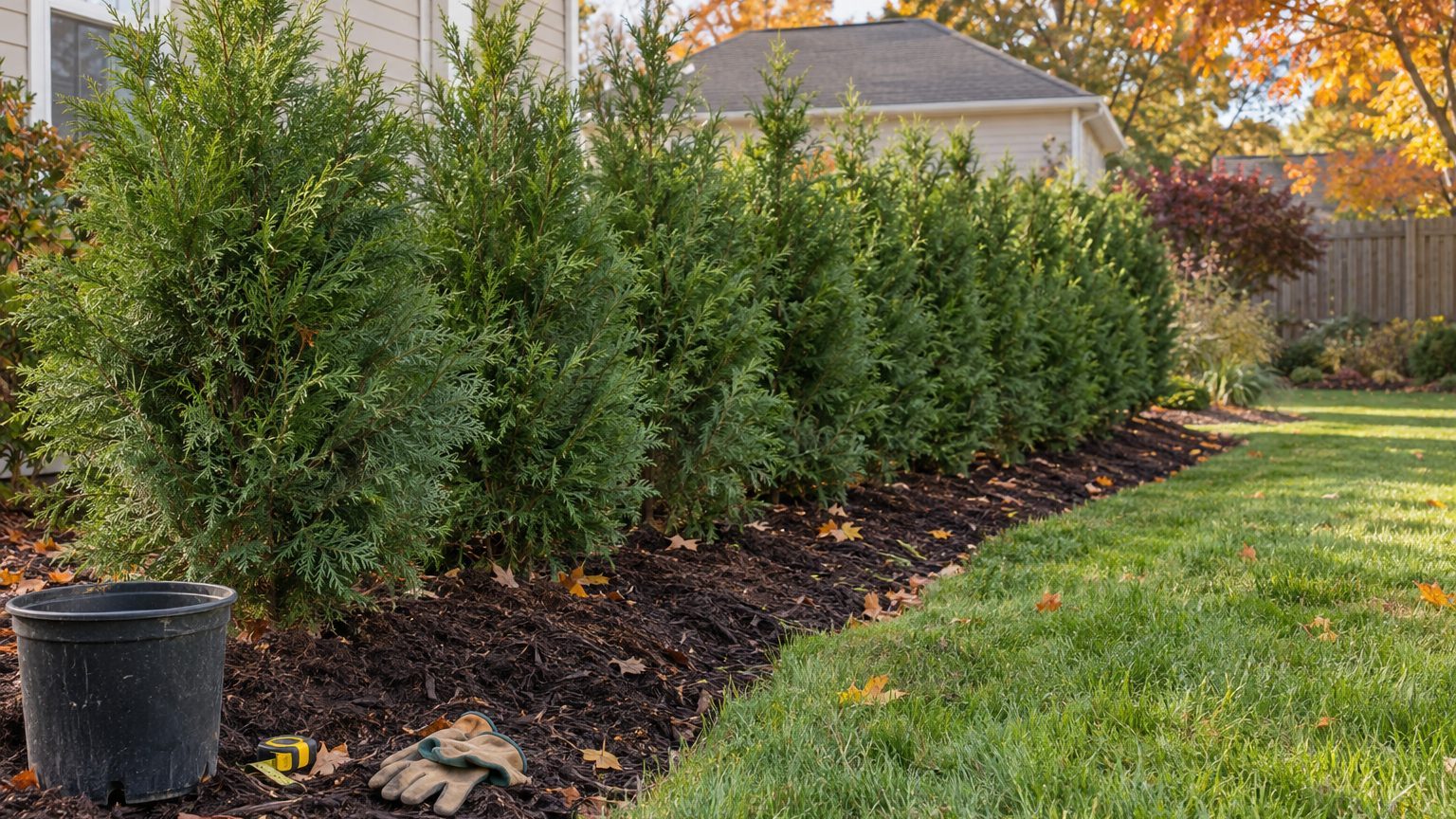

Plant Leyland cypress at half to two-thirds of the mature width printed on the tag of the cultivar you are buying. The type species can spread 10 to 15 feet if it is never clipped, but that is the most an unclipped plant does. Hedge cultivars are narrower and are kept narrower still by pruning.
How far apart to plant leyland cypress
Neighboring plants in a hedge need to meet edge to edge, not sit shoulder to shoulder. A plant’s mature width is the full spread of one plant, so spacing it at half that width means each plant’s foliage overlaps its neighbor’s by half. At two-thirds, the overlap is smaller and each plant keeps more of its own root space. Half closes a screen fast. Two-thirds keeps the plants healthy longest.
Start with the label. Nursery tags list a mature width for each cultivar, and that number is the only one that matters for your row. Say the tag reads 6 feet. Half of that is 3 feet, and two-thirds is 4 feet. For a hedge you want to last, aim for the upper end, so the shopping-list spacing is 3 to 4 feet between plants, measured from trunk to trunk. A 9-foot cultivar works the same way, giving 4.5 to 6 feet.
| Mature width on the tag | Half (fast screen) | Two-thirds (longest life) |
|---|---|---|
| 4 feet | 2 feet | about 2 2/3 feet |
| 6 feet | 3 feet | 4 feet |
| 9 feet | 4.5 feet | 6 feet |
Those widths are examples for the arithmetic. Your own cultivar’s tag sets the numbers. If the tag lists only a height, or none at all, ask the nursery for the cultivar’s mature spread before you dig. A bare “Leyland cypress” tag with no cultivar name is a warning sign, because you may be buying plants that want to grow wider than a clipped row allows.
The 10 to 15 feet figure for the unclipped type species works as an upper bound. Nobody should space a hedge at 10 feet just because that is what a wild-form tree does. A hedge is a row of plants that are trimmed to stay inside a chosen width, and spacing follows the width you intend to keep. Leyland cypress grows in USDA zones 6 to 10, and the same fraction applies in every one of them. Other evergreens follow the same arithmetic with their own labels, and Hedges covers the full range.
What planting them closer really buys you
A tighter row closes about a year sooner. That is the entire gain. Leyland cypress adds 3 to 4 feet a year, so the gap between a half-width and a two-thirds-width spacing disappears in roughly one growing season. The cost of that year shows up for the next twenty.
Crowded plants compete at the root for water and nutrients. Above ground they shade each other’s lower branches, and those shaded limbs drop their needles and thin out at the base. This species gives you no second chance there. It has no dormant buds under the bark, so a branch that goes brown and bare stays that way. Bare brown wood does not leaf out again, and the hedge ends up with a hollow bottom and a green top.
The same crowding holds damp, still air in the middle of the row. That is where Seiridium and Botryosphaeria cankers get started. Both kill whole limbs, and a stressed, shaded, poorly ventilated plant is the one they find first. A hedge planted at two-thirds of its width has air moving through it after every rain, and a hedge planted tight does not. Bagworms are the other pest to scout for, and they are easier to spot and pick off when you can see into the plants.
The patience pays off in a few specific ways:
- Green foliage all the way to the ground instead of a bare trunk line.
- Room for air to dry the interior after rain.
- Enough root space to carry the plants through a dry summer.
The no-regrowth rule also decides how you prune. Cut into the green growth, never through it. Once a shear passes the last green and hits brown wood, the hole is permanent. Do the clipping from late spring to midsummer, after the first flush of growth has started and well before late-season growth needs to harden off. Your local frost dates move that window by weeks, so check your county Cooperative Extension office for the timing in your area.
Even a well-spaced hedge has a limit. Leyland cypress reaches 15 to 25 feet as a screen, and the growth rate that sells it is the same one that makes it outgrow its place in ten years. Wider spacing slows the crowding. It does not slow the height, so pick the site with the full size in mind.
One row or two
A single row suits most yards. Spaced at half to two-thirds of the label width, one row of plants forms a solid wall, and it needs the least ground and the fewest plants. For a property line, a driveway edge, or a strip along a fence, a single row is the right call.
A staggered double row is a different tool. The plants in the back row sit behind the gaps in the front row, which closes the screen faster and blocks more of the view. It takes roughly twice the width of a single row and about twice the plants. On a 40-foot run with 4-foot spacing, a single row needs 11 plants, and a double row with the same spacing in each row needs 22 plants. Both rows have to be fed, watered, and given air, so the crowding rules still apply. Stagger them far enough apart that the rows do not shade each other’s bases.
The double row earns its place in a few situations. One is a wide, open lot where you want a tall, thick screen against a road or a neighboring building. Another is a new property with no existing cover, where a year or two of faster privacy matters. In both cases the extra width has to be available, and you have to be willing to maintain a thicker hedge. A double row left unclipped turns into a wide mass that is hard to reach and harder to cut back.
A narrow lot rules it out. So does any hedge you plan to keep formal and tightly clipped, because you cannot trim the inner row and you cannot reach into the middle if a canker takes a limb. When access is limited, plant one row at the wider end of the spacing and let it fill in at its own pace.
Working out how many plants you need
The arithmetic is plain. Divide the length of the run by your spacing, then add one. The extra plant is the one that finishes the end of the row, since a row of plants has one more plant than it has gaps.
Take a straight 48-foot run at 4-foot spacing. That is 12 gaps, so the order is 13 plants. If the division leaves a remainder, round the number of gaps up and then add one. You can also stretch the spacing a little to land on a whole number, as long as it stays within the half to two-thirds range for your cultivar.
A corner changes the count only if you treat the two legs separately. Measure the whole run as one continuous line around the corner and use the same formula. A 48-foot leg and a 24-foot leg make a 72-foot run, which at 4 feet is 18 gaps and 19 plants. If you count each leg on its own and add the totals, you will plant two at the corner and have one too many.
The second thing that changes the answer is the setback from the boundary. The plant will reach its full width whatever the plan says, so the distance from the property line to the trunk has to be at least half the mature width on the tag. Leave extra room for a person with a hedge trimmer to work along the side. On a 6-foot cultivar, that means the trunks sit at least 3 feet inside the line, and more is better. A hedge planted right on the boundary ends up leaning over the neighbor’s side, and you lose the ability to clip it.
Check local rules before you buy. Some towns and homeowner associations limit hedge height or require a setback from the property line, and your county extension office or town hall can tell you what applies. Price the plants locally, since cost depends on region and container size.
Common questions
Can I cut Leyland cypress back hard if it gets too tall?
No. It does not regrow from old wood, so a cut that goes past the green growth leaves a hole that stays open for good. Trim into the green, never through it, and do the work from late spring to midsummer. Your county Cooperative Extension office can give you the right window for your frost dates.
How fast does a Leyland cypress hedge grow?
It adds 3 to 4 feet a year, and as a screen it reaches 15 to 25 feet. That speed is why people choose it. It is also why many hedges outgrow their sites in about ten years, so plan for the full height before you plant.
Where will Leyland cypress grow?
It is hardy in USDA zones 6 to 10. Within that range, the plants stay healthiest with good air movement and the wider spacing, since canker diseases and bagworms are what kill them.
What if I want a slower hedge plant with different spacing?
The same method of using half to two-thirds of the label width applies to other evergreens. See How Far Apart to Plant Yew for a Hedge and How Far Apart to Plant Eastern hemlock for a Hedge for the numbers on each.
Sources : fieldreport.caes.uga.edu | gardenersworld.com | patuxentnursery.com