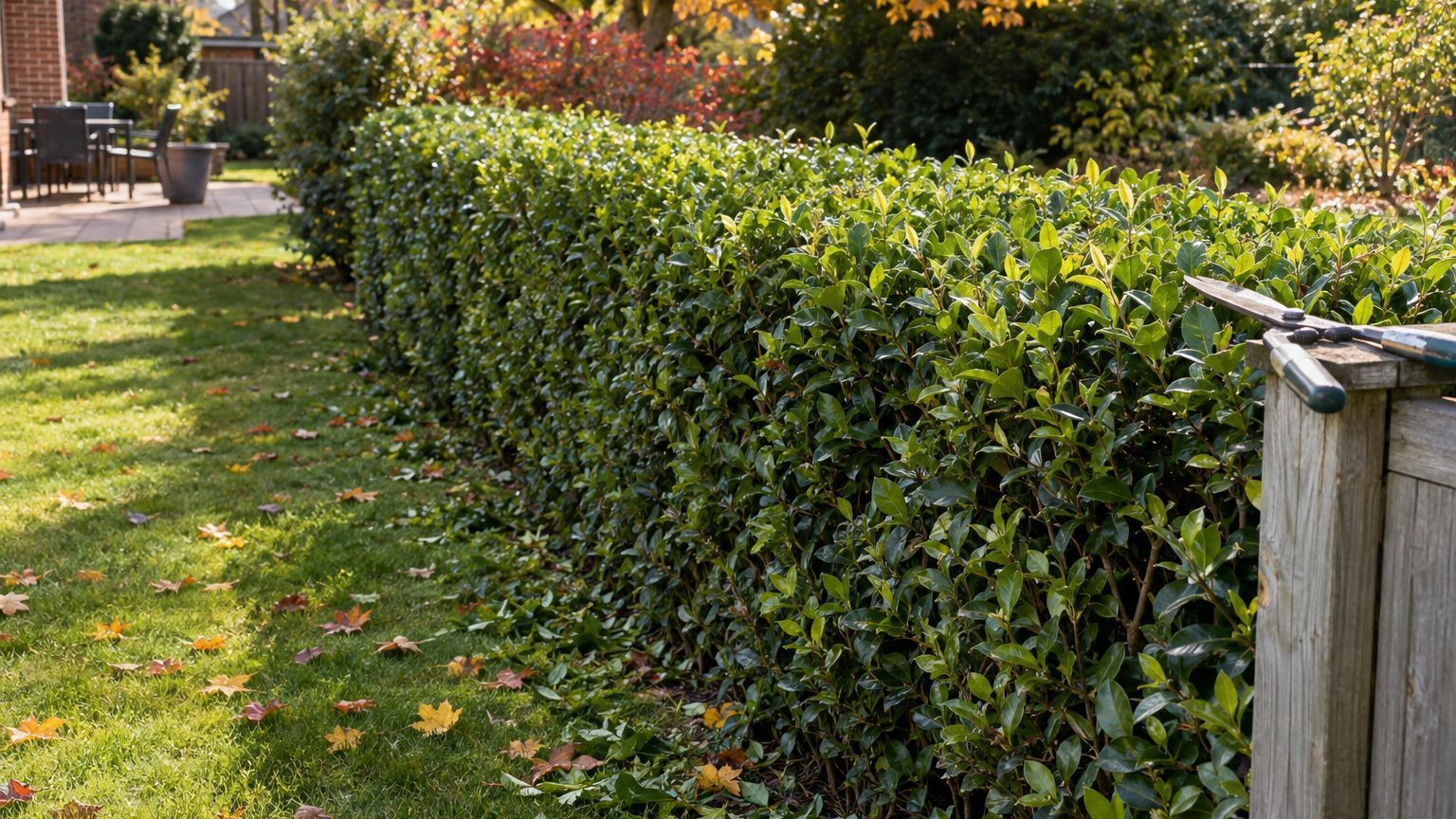

Trim privet lightly from late spring through late summer, and save hard cuts for late winter, while the plant is dormant and before buds swell. Established hedges tolerate being cut back to 12 inches or even lower, but a staged cut over two or three years is gentler on the plant and leaves your yard looking less like a lumberyard.
That is the short version. The details shift with your climate, the species you planted, and whether you care about the flowers, so the calendar below is worth a few minutes.
The yearly pruning calendar
Privet is one of the fastest-growing hedge plants sold in the US. Neglected, a hedge can add 2 to 3 feet of growth in a single season. That pace is why it works for privacy screens, and also why it needs a schedule rather than an annual haircut.
The first trim of the year comes in late spring, once the new shoots have grown 6 to 8 inches. In most of the country that means May or early June. Cut those shoots back by about half and you set off branching along the stems, which is what makes a privet hedge dense from the ground up instead of leafy on top and leggy below.
After that, plan on a light shearing every four to six weeks while the plant is actively growing. Formal hedges along a street or property line may need three or four passes between June and early September. A looser, informal screen can get by on two.
The last trim has a deadline. In cold regions, stop by mid to late August, roughly six to eight weeks before your average first frost. New growth triggered by a September trim has no time to harden, and the first hard freeze burns the tips brown. In the Deep South and along the Gulf Coast, where frost comes late or not at all, you can keep trimming into October.
Flowers, berries and the timing trade-off
Privet blooms in late spring to early summer, producing creamy white clusters with a heavy, sweet scent. Some people love it. Others find it cloying, and plenty of allergy sufferers find it miserable. If you shear in late spring, you remove most of the flower buds, and with them the dark berries that follow in fall.
That is a useful side effect, not a flaw. Birds spread privet seed widely, and Chinese privet (Ligustrum sinense) and glossy privet (Ligustrum lucidum) are considered invasive across much of the Southeast. If your hedge is one of these, regular shearing before bloom is good stewardship as well as good grooming. Check your state extension service or invasive plant council before planting more of either; several states discourage or restrict them, and alternatives are easy to find.
If you want blooms, wait until right after flowering to do your main trim. You get the scent for two or three weeks, then the hedge gets its haircut. The cost is a slightly shaggier look in early June.
Adjusting for your zone
Species matters here. California privet (Ligustrum ovalifolium) is the classic hedge in zones 5 through 8 and holds its leaves through mild winters. Amur privet (Ligustrum amurense) is tougher and handles zone 4 and some of zone 3. Japanese privet (Ligustrum japonicum) is a broadleaf evergreen for zones 7 through 10. European privet (Ligustrum vulgare) sits somewhere in between and is semi-evergreen.
In the colder end of their range, these hedges drop most of their leaves in winter, which actually makes late-winter structural work easier. You can see every branch. In the South, evergreen types keep their foliage, so you work by feel and by the shape of the silhouette.
How far back you can cut
Privet earns its reputation as a forgiving plant. It sprouts new growth from old wood, including bare, leafless stems, which most evergreen hedge plants will not do. That one trait decides most of the answer.
For routine maintenance, take off the new growth plus about an inch of last year’s wood. This keeps the hedge at roughly the same size and shape year after year. It is a shearing job, and hedge shears or a hedge trimmer handle it easily.
For a hedge that has gotten too wide or too tall, you can cut back by up to a third of its size in a single winter without drama. Do it in late winter, February or March in most regions, before the buds break. Healthy plants refill the space within one growing season.
For a truly overgrown hedge, the kind with a bare, woody interior and foliage only on the outer inch or two, a rejuvenation cut is the fix. Established privet usually resprouts even when cut to 6 to 12 inches above the ground, and some gardeners go lower. Hard cuts on a hedge that has had no care for years do carry some risk, though. Weak, stressed or diseased plants may not come back, and there is no undoing a cut at ground level.
The two-step approach that lowers the risk
A staged renovation is safer and also easier to live with. In the first late winter, cut one side of the hedge back hard, down to the main stems, and leave the other side alone. The untouched side keeps the screen in place and keeps the plant photosynthesizing while the cut side regrows. The next late winter, repeat on the other side.
Alternatively, take the top down by a third one year and the sides the next. Either way, you spread the shock over two seasons, and you keep some privacy while the plants recover.
Use loppers or a pruning saw for stems thicker than about an inch. Hedge shears crush thick wood instead of slicing it, and ragged cuts heal slowly. Make each cut just above a node or a side branch, angled slightly so water runs off.
Species differences matter
Privet recovers from hard cuts better than many other hedge plants. The When to Prune Cherry laurel, and How Far Back You Can Cut guide covers a plant that follows a different set of rules, and the When to Prune American hornbeam, and How Far Back You Can Cut page explains the schedule for a deciduous hedge that prefers a different timing. Don’t assume what works on one will work on another. If you are weighing several options for a new boundary, the main Hedges section lays out the choices side by side.
Shape, tools and aftercare
A hedge shaped with sides that lean slightly inward toward the top, wider at the base than at the crown, gets light on every leaf. A hedge with a wide top and a narrow base shades its own lower branches, and those branches thin out and die back. Aim for a gentle taper, with the base a few inches wider on each side than the top. Even a modest slope makes a visible difference within a season or two.
String lines help more than most people expect. Run a line between two stakes at your target height and cut to it. Eyeballing a 40-foot stretch usually leaves a wave that is obvious from the street.
Sharp blades matter. Dull ones tear leaves and leave brown, ragged edges that look like frost damage. Wipe blades with rubbing alcohol or a diluted bleach solution between plants if you spot any dieback or leaf spots, so you don’t carry disease along the row.
After a hard cut, treat the plant like a patient. Spread 2 to 3 inches of mulch around the base, keep it a few inches back from the stems, and water deeply when rainfall falls short of about an inch a week. A balanced slow-release fertilizer applied in early spring supports regrowth. Heavy nitrogen right after a major cut pushes soft growth faster than the roots can support, so go easy.
Expect new shoots within three to four weeks of warming weather. If a hard-pruned plant shows no green by early summer, scratch a stem with a fingernail. Green underneath means it is alive and just slow.
Mistakes and edge cases worth knowing
Nesting birds are the most overlooked constraint. Dense privet is prime real estate for robins, mockingbirds, cardinals and house finches, and active nests of most native species are protected under the federal Migratory Bird Treaty Act. Spring and early summer are exactly when you want to trim, so check the hedge before you start. If you find a nest with eggs or chicks, leave that section alone for a few weeks.
Topping the hedge in a single dramatic cut, especially in midsummer, is the other common error. The plant responds with a flush of thin vertical shoots (called water sprouts) that make the hedge look worse within weeks. If you need to lower height, do it in late winter and then follow with the normal spring shearing to rebuild the density.
Weather matters too. Avoid trimming in the hottest part of a summer day, or during a drought, because fresh cuts lose moisture and stress already thirsty plants. Cut on a cool, dry, overcast morning if you can. Wet foliage also spreads fungal spores more easily, so skip trimming right after rain.
If the hedge is a Chinese or glossy privet and you are thinking about removal instead of pruning, cutting alone will not kill it. Stumps resprout aggressively. Extension services generally recommend cutting and then treating fresh stump surfaces with a labeled herbicide, or repeatedly removing regrowth. Your state’s extension office can tell you what is approved locally.
One last practical note: the clippings. Privet leaves and berries are toxic to people, dogs, cats and horses if eaten in quantity, so keep trimmings away from pasture fences and paddocks. Horse owners in particular should bag clippings or haul them off instead of piling them near the fence line.