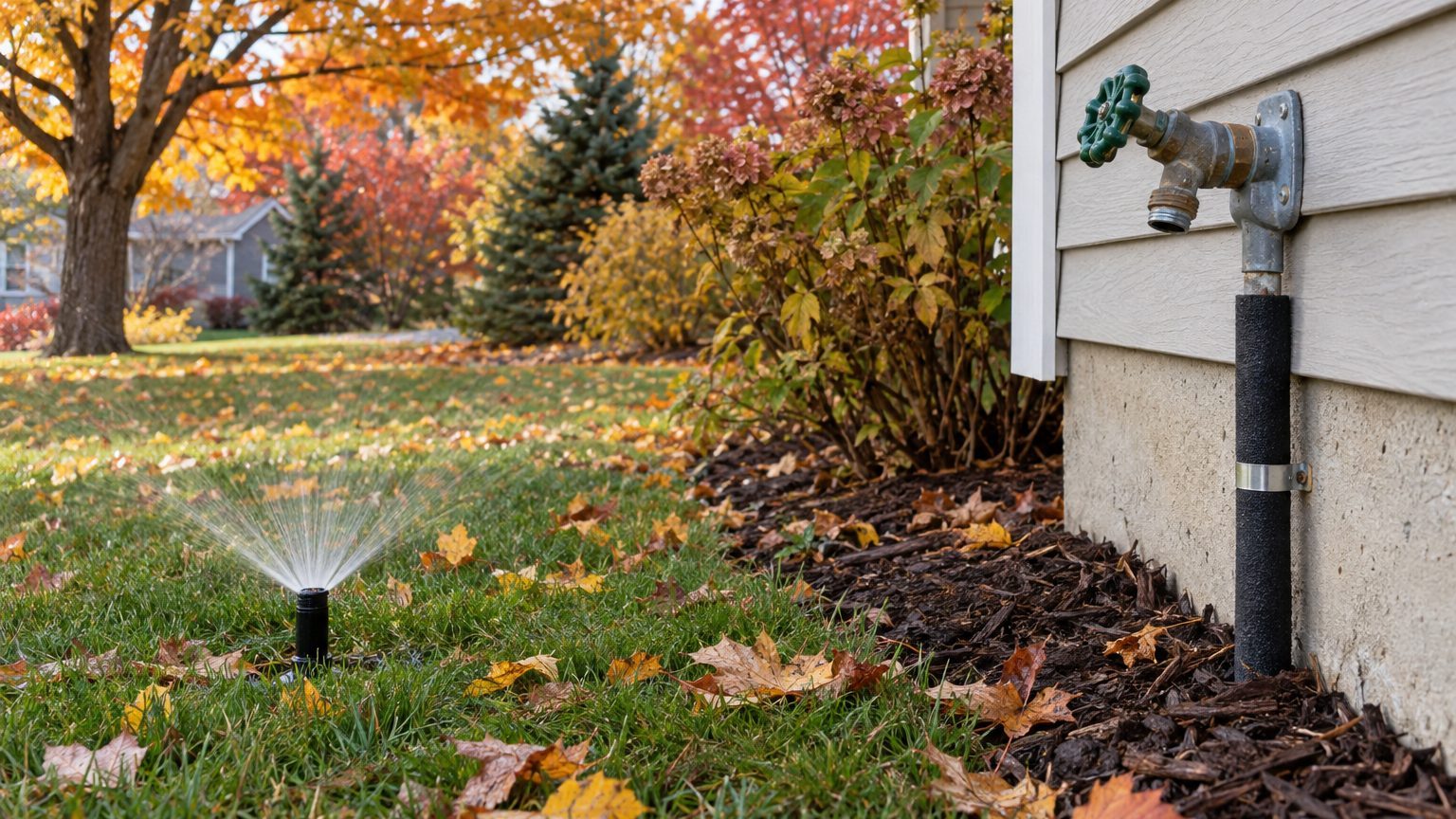

Start draining sprinkler lines and outdoor taps in Prince Edward Island in early October, and be done by mid-month. The average first fall frost at Charlottetown falls on October 17, and half of all years bring it sooner. Water left in buried pipe and valves is what splits them, so hoses come off, taps get drained, and sprinkler lines get blown out with compressed air. Colder districts away from Charlottetown should start earlier still.
When to do it in Prince Edward Island
Aim to finish between early October and about October 17, and follow one rule: before the first hard freeze, not after the first light one. A light frost on a clear night is a warning shot. A hard freeze, with temperatures holding below zero for hours, is what turns water in a buried line into ice.
The October 17 figure comes from Environment and Climate Change Canada’s Canadian Climate Normals for 1981-2010, measured at the Charlottetown A station. It is a mean date, not a deadline. In one year out of two the first frost arrives later than October 17, which also means that in the other half it arrives earlier. Treat mid-October as the midpoint of the window and never as a safe date. Today is October 10, 2026, so anyone reading this now is already inside the window.
Why the cold here leaves no shortcut
Some mild regions can skip the full shutdown. Prince Edward Island is not one of them. The same normals put the mean daily minimum of the coldest month at -12.1 °C (10.3 °F, for readers comparing against US weather maps). That is an average of the nightly lows, so individual nights run colder. Ground that stays frozen for months will crack any pipe that still holds water, and nothing about the winter here forgives a half-finished job.
Natural Resources Canada places Charlottetown in plant hardiness zone 5b, using 1991-2020 normals (Canada’s Plant Hardiness Site). That is the Canadian system, built on seven climate variables, and it does not convert to a USDA zone. It also describes the reference city, not the whole province. The two datasets here cover different periods (1981-2010 for the frost date, 1991-2020 for the zone), so use them as a general picture of the climate, not as exact guarantees.
Moving the window across the Island
The Charlottetown station is a single point on a long, thin province. Northern and upland districts run colder, and colder ground gets its first frost earlier. For those properties, the work moves earlier than the Charlottetown window. A homeowner there who waits for October 17 is likely to be late. If the forecast shows overnight lows approaching 0 °C before you have started, move the job up and do it that weekend. More seasonal timing for the Island is collected in the Prince Edward Island guides.
Sprinkler lines: drain or blow out
Water expands as it freezes. Inside a closed pipe, the ice forms a plug and pressure builds against the closed end or the nearest fitting. Something has to give, and it is usually a fitting, a valve body, a sprinkler head riser, or a length of buried pipe. Nothing looks wrong in fall. The damage shows up in spring, when the system is pressurized and water sprays out of a crack that has been waiting all winter.
Three ways to clear a system
Manual drain valves sit at the low points of the lines. You open them after shutting off the supply, and gravity empties the pipe. Automatic drain valves do the same job on their own: when line pressure drops, a small valve opens and lets the water out. Compressed-air blowout pushes water out through the sprinkler heads, zone by zone, with a compressor connected at a fitting near the shutoff.
| Method | How it works | Limit |
|---|---|---|
| Manual drain | You open low-point valves and gravity empties the lines | Only clears pipe that slopes toward a valve; pockets of water stay behind |
| Automatic drain | Valves open on their own when pressure drops | Depends on grade and on valves that are not clogged or stuck |
| Compressed-air blowout | Air pushes water out through the heads | Needs the right equipment and careful technique |
What this climate calls for
With a coldest-month mean minimum of -12.1 °C at Charlottetown, according to Environment and Climate Change Canada, drain valves alone are a gamble. Gravity clears only the water that has somewhere to run. Pipe that dips, valves that sit lower than the lines around them, and any trapped section will hold water through the winter. A compressed-air blowout, finished before the first hard freeze, is the decision to write down, with manual or automatic drains as a backup and not a replacement.
If you do it yourself, shut off the water supply first and open the drain valves. Work through the zones one at a time, and do not run air through any zone for long, because dry heads and fittings overheat and wear. Keep your face and body clear of heads and pipe while the system is under air. Cycle through the zones in more than one pass, until only mist comes out of the heads.
A professional is the sensible choice in a few situations. One is a large or multi-zone system. Another is a compressor that is not sized for the job, or a backflow preventer you are not sure how to drain safely. A third is any system where you cannot say with confidence what is under the lawn. A technician who does this every October also knows where the trapped water hides. A single cracked valve costs more to repair in spring than the visit costs now.
Outdoor faucets and hoses
The routine takes about ten minutes per tap, and it consists only of turning valves and unscrewing hoses. Disconnect every hose, splitter and hose-end attachment. Find the interior shutoff valve feeding the outside tap (it is usually in a basement, crawl space or utility area) and close it. Then go outside and open the tap fully, so whatever is left in the line runs out. Leave the outside tap open through winter so there is room for any trace of moisture to escape.
Why a frost-free faucet still fails with a hose on
A frost-free tap has a long stem that puts the seat, the point where water is actually shut off, inside the heated part of the wall. When the tap is closed, the water behind the seat is supposed to run out the spout and drain down the slight slope of the barrel. A hose left attached traps water in the barrel, because the nozzle end is blocked or the hose is full. That water sits in the cold part of the tap and freezes. The faucet that was designed to be safe ends up as the thing that cracks. More about how these fittings work is in the guide on Frost-Free Outdoor Taps, and the full routine is covered in Winterizing Outdoor Faucets Before the First Freeze.
Take every hose off between early October and mid-October, even if the tap is frost-free, and before nights approach 0 °C. The hose itself should go in too. Coil it, drain it, and store it indoors, since a hose left outside holds water and hardens in the cold.
The limit on all of this is plain. Turning a valve and removing a hose is homeowner work. If the interior shutoff does not exist, will not close, or leaks when you turn it, or if the tap keeps dripping after you close it, that is a plumber’s job. So is anything involving cutting, soldering or replacing a fitting. Do not try to improvise on pipes inside a wall.
What goes wrong here
The early cold snap
The most likely failure is also the simplest. A cold snap arrives before anyone has gotten to the job. Because October 17 is only the average first-frost date, roughly half of years bring frost earlier, and a plan that says “mid-October” can be a week or two late in a cold year. In spring, the evidence shows up as a zone that will not shut off, a head that leaks, or a damp patch on the lawn above a buried split. The fix is to set your own earlier deadline and not rely on the average.
The forgotten hose and the flooded valve box
A hose left on a tap can split the tap inside the wall. In spring, you turn on the water and nothing seems wrong outside. Then the basement ceiling or the wall under the tap starts to drip, because the crack is on the house side of the seat. Prevention is as simple as it sounds: before the first hard freeze, walk the whole exterior of the house, including the back and side taps you do not use often.
The valve box is the quiet failure. Sprinkler valves sit in a buried box, and if water gets into it and freezes, the valve body cracks. In spring the zone floods or will not close, and the box is full of water or silt. To prevent it, check each box in fall, clear it, make sure the lid is on, and be sure the valves themselves are drained. If a pipe inside the house does freeze, the steps in Frozen Pipes cover what to do. The lawn has its own fall to-do list, covered in Winterizing a Lawn. A useful habit is to set the plumbing reminder for between the start of October and about October 17 and group it with the lawn work, so one weekend covers both.
Common questions
Is October 17 the date to finish by?
It is the midpoint, not the cutoff. Environment and Climate Change Canada’s 1981-2010 normals for Charlottetown A give October 17 as the average first fall frost, which means half of years see it earlier. Finish before then, and sooner in colder northern or upland districts.
Is a light frost the signal to start?
No. By the time a light frost shows up, you should already be done or nearly done. The rule is before the first hard freeze, not after the first light one. A light frost is the last reminder, not the starting gun.
Can I rely on automatic drain valves alone?
With a coldest-month mean minimum of -12.1 °C, it is a risk. Automatic valves only clear the water that can flow to them, and a stuck or clogged valve fails silently. A compressed-air blowout is the safer choice, and a professional can do it if you do not have the equipment.
When do I turn everything back on?
The facts for this page give a fall frost date but no spring one, so there is no number to quote. The sensible approach is to wait until hard freezes are clearly behind you and the forecast no longer shows nights near 0 °C. Then restore the supply slowly and walk the property while the system fills, looking for leaks.