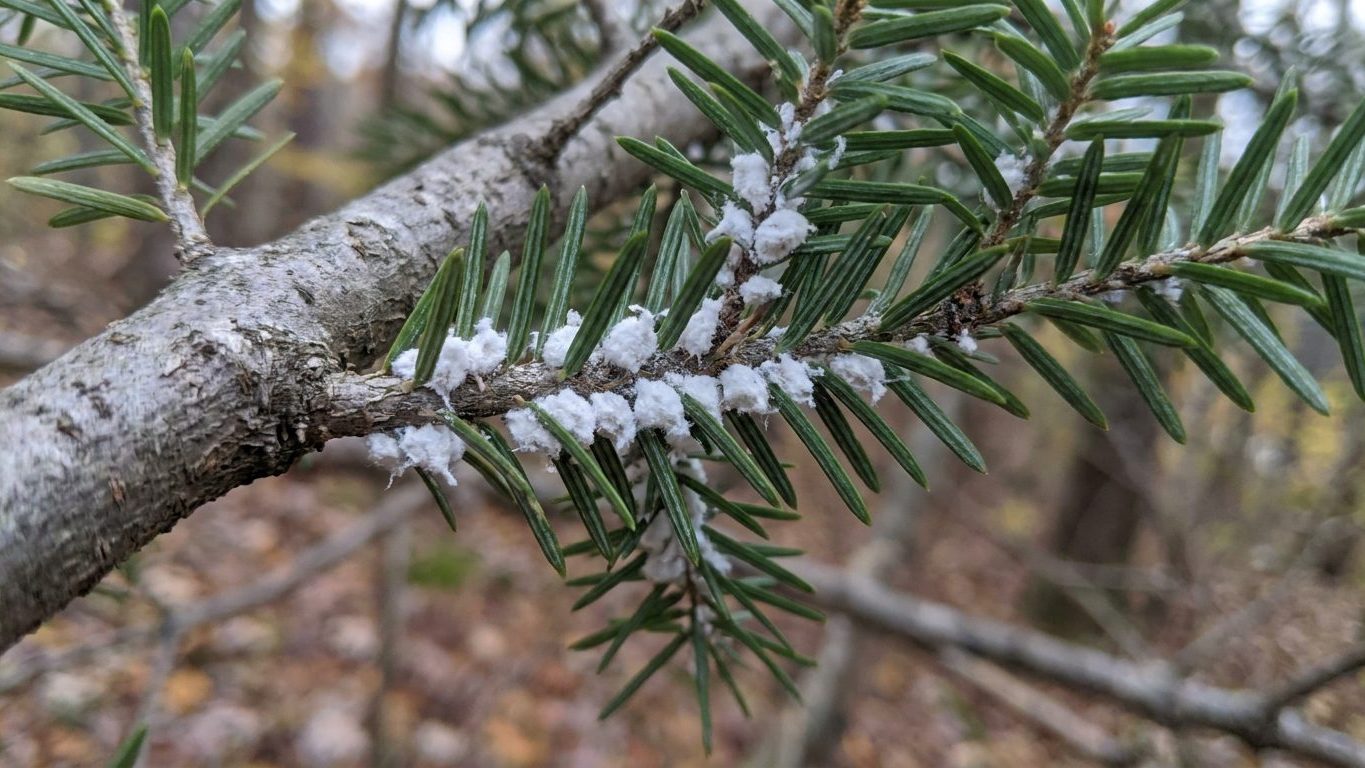

Eastern hemlock woolly adelgid is a tiny insect that coats the underside of hemlock needles in white, waxy fluff, feeding where each needle meets the twig until the branch starves and dies. It has killed hemlocks across most of the tree’s eastern range, and that’s the reason most extension services now advise against planting Eastern hemlock where the pest has established.
Telling apart what makes eastern hemlock woolly adelgid
Location on the branch is the first clue, and it does most of the work. Woolly adelgid feeds only at the base of the needle, on the underside of the twig, never on the top surface and rarely mid-needle. That single detail rules out several look-alikes before you even reach for a hand lens.
Timing narrows it further. The white, cottony ovisacs are most visible from fall through late spring, when the insect is dormant inside its waxy covering and hasn’t been washed off by summer storms. A hemlock that looks fine in July but shows tufts of white fuzz along the twigs by November is showing a pattern specific to this pest, not to heat stress or a nutrient problem.
What it is not
Spider mite damage shows up as stippling and a bronze cast on the top of the needle, worse in hot, dry summers, and it never produces wool. Elongate hemlock scale leaves flat, yellowish-brown bumps on the needle underside, not fluffy white masses, and those bumps don’t wipe off. Drought stress thins the crown evenly and turns needles a dull gray-green without any insect residue at all. None of these three match the location-and-season combination that woolly adelgid produces.
| Cause | Where on the branch | When most visible | What you actually see |
|---|---|---|---|
| Woolly adelgid | Needle base, underside of twig | Fall through late spring | White, cotton-like tufts |
| Spider mites | Top of needle | Hot, dry summer | Stippling, bronze cast, fine webbing |
| Elongate hemlock scale | Needle underside | Year-round | Flat brown-yellow bumps, no wool |
| Drought stress | Whole crown, evenly | Late summer | Dull gray-green needles, no residue |
The test you can run today takes thirty seconds. Pick a twig near the trunk, turn it over, and look at the needle bases: white, cotton-like tufts sitting right where the needle joins the stem confirm adelgid, and nothing else on this list produces that exact combination of color, texture, and position.
Will it come back?
Yes, a hemlock branch that has browned out can regrow, because Eastern hemlock carries dormant buds under its bark and resprouts from old, bare wood the way many broadleaf hedges do, something most conifers simply cannot manage. That trait is why hemlock has historically been forgiving of hard pruning, in a way that arborvitae or spruce never will be.
But that capacity depends on the buds still being alive. Woolly adelgid doesn’t just discolor needles, it drains the twig tissue that feeds those dormant buds, and a twig that has been girdled by a sustained infestation loses its resprouting ability along with its needles. A section that browns out from a light, recent infestation may still carry live buds under the bark. A section that has been infested for several seasons, with needle drop and visible dieback at the tips, usually has not.
Why the mechanism matters beyond one hedge
This is the detail that transfers to any hemlock, anywhere in its USDA zones 3 to 7 range. The rule isn’t about the specific hedge in front of you, it’s about whether the cause has been active long enough to kill the cambium and the buds underneath it, not just the foliage on top. A homeowner checking a different hemlock, in a different state, can apply the same logic: fresh damage with a green cambium layer under the bark still has a shot at regrowth, while gray, dry, brittle wood does not.
Waiting doesn’t buy time here, it spends it. Every season the adelgid stays active is another season of dormant buds dying along with the twigs they sit in, which is why the order of operations matters: diagnose the cause, stop it, and only then decide how hard to cut back. Cutting into infested wood before the insect is addressed just gives it fresh tissue to keep feeding on.
Stopping the cause
Watering and spacing don’t kill the insect, but they change how much damage it does. Hemlocks under drought stress or planted too close together, with poor air movement around the foliage, tend to decline faster once adelgid is present, because the tree has fewer resources to compensate for the feeding damage. Consistent moisture during dry stretches and enough spacing for air to move through the hedge won’t cure an infestation, but they slow the collapse.
Sanitation is the piece that actually interrupts the pest’s spread. Cutting out heavily infested branches and removing that material from the property, rather than leaving it in a brush pile near the remaining hedge, reduces the population feeding the rest of the plant. Pruning itself should stay light and land in late spring only, since Eastern hemlock’s pruning window follows its growth flush, not a fixed date, and your local frost pattern sets exactly when that flush happens. A state extension service is the right place to confirm that local timing, and it’s also the right place to send a sample or a photo for confirmed identification before deciding on any treatment.
What the tree does and doesn’t respond to
- Responds to: consistent watering during drought, adequate spacing for airflow, prompt removal of heavily infested wood
- Does not respond to: pruning alone, fertilizer, or waiting out the infestation
- Requires professional input: confirmed identification and any treatment decision, both handled through a state extension service
Hemlock woolly adelgid has killed hemlocks across the eastern range and is the reason many extension services no longer recommend planting it, and that fact should shape the urgency here. Managing air movement and moisture buys time. It doesn’t substitute for identifying the pest and getting extension-backed guidance on whether treatment is realistic for that particular hedge and location.
What to do with what is left
Living with it is an option only where an extension-confirmed treatment plan is already in place and the infestation is caught early, and even then it means ongoing monitoring, not a one-time fix. This path suits a homeowner willing to check the undersides of twigs every season and act at the first sign of new wool.
Renovating a hedge back from bare wood only makes sense where the buds are still alive and the cause has genuinely been stopped first. Given the growth rate of 12 to 24 inches a year, a hemlock hedge cut back hard in late spring can refill over a couple of growing seasons, reaching back toward its typical 10 to 20 foot hedge height over time. That timeline only holds if the adelgid isn’t still feeding on the regrowth.
Interplanting works as a transition strategy in areas where adelgid is established nearby but hasn’t yet reached a given hedge, mixing in a non-host species now so the hedge line doesn’t go bare all at once if the hemlock eventually declines. It buys flexibility, not protection.
Replacement is the honest answer in counties where the pest is already widespread and confirmed, and extension services in those regions increasingly say so directly rather than recommending repeated treatment cycles on a species with no natural resistance. Choosing a resistant species now costs one planting season; choosing to keep replanting hemlock in an infested area costs every season after that, in monitoring, in treatment, and eventually in the same decision made later with a bigger gap to fill.
Common questions
Can eastern hemlock survive a woolly adelgid infestation without treatment?
Untreated hemlocks in infested areas typically decline over successive seasons as the insect keeps feeding at the needle base, and this is the core reason the species has been killed off across large parts of its eastern range.
Is it safe to plant eastern hemlock as a new hedge?
In counties where the pest is already established, most extension services advise against it, since a newly planted hemlock carries the same vulnerability as an established one and offers no resistance advantage.
What does hemlock woolly adelgid look like up close?
Small white, cotton-like tufts sitting at the base of each needle on the underside of the twig, most visible from fall through late spring when the insect is dormant inside its waxy covering.
How is hemlock woolly adelgid confirmed by extension services?
A state extension service can identify the insect from a twig sample or clear photos of the needle base, and that identification is the step that should come before any decision on treatment, pruning, or replacement.