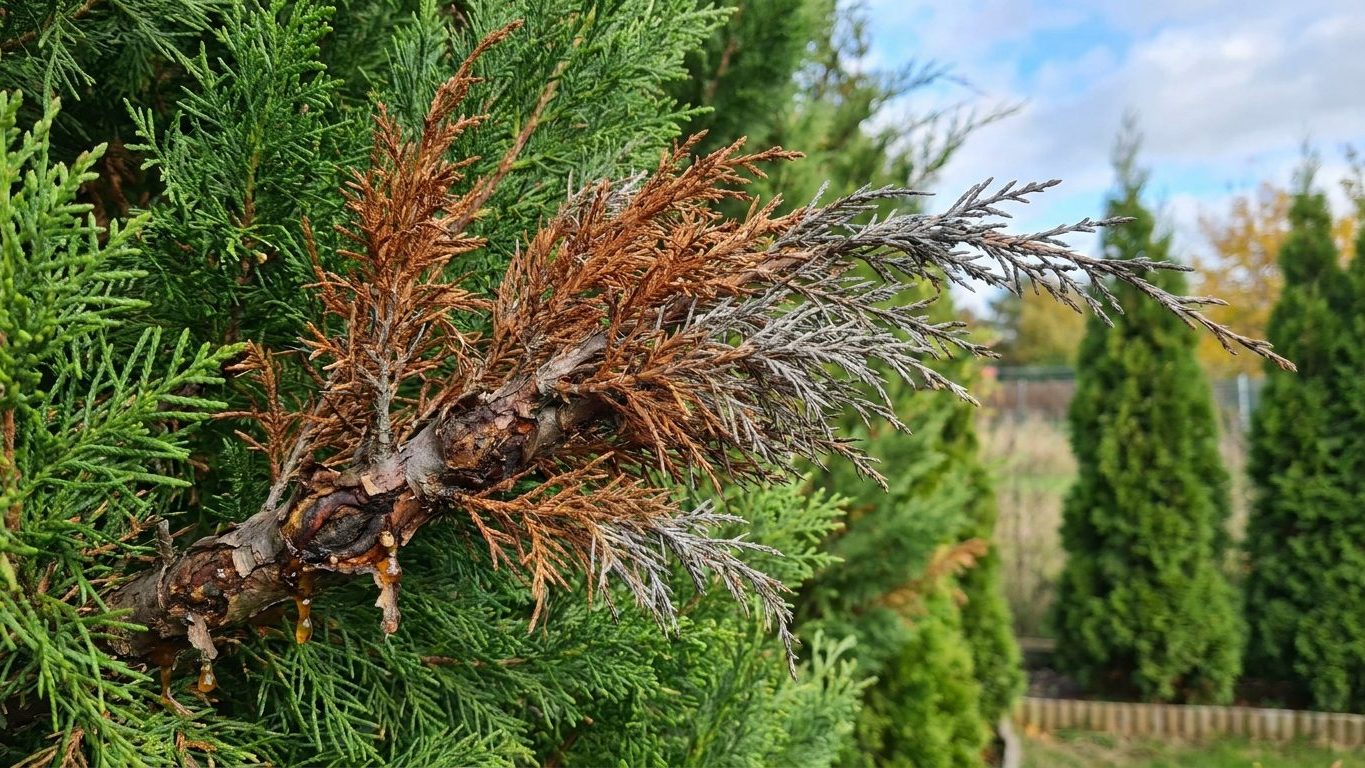

Whole limbs turning rust-brown while the rest of the tree stays green points almost always to canker disease, not a watering problem or a fertilizer gap. Seiridium and Botryosphaeria cankers kill Leyland cypress limb by limb, entering through wounds on trees already stressed by drought or crowding. The brown wood will not turn green again. What matters now is telling the cause apart from the look-alikes, then deciding what happens to the rest of the row.
Telling apart what makes leyland cypress dying
Canker damage on Leyland cypress shows up as single branches dying scattered through the canopy, not as a uniform wave of browning. One limb goes rust-colored while its neighbors stay green. Look at the base of a dying branch and you’ll often find a sunken, discolored patch of bark, sometimes weeping resin. That sunken spot is the canker itself, a dead zone in the bark and the wood just under it. The needles on that limb pass through a color sequence: green, then dull yellow, then reddish-brown, and finally ash-gray, all while staying attached to the branch instead of dropping right away.
Bagworm damage looks different. Instead of scattered dead limbs, you see spindle-shaped bags hanging from the foliage, usually starting at the top of the tree and working down as the larvae feed. Drought stress reads differently again: browning starts at the branch tips and spreads inward evenly across the whole plant, rather than picking off one limb while its neighbor stays untouched. Spider mite damage shows as fine stippling and pale, dusty-looking foliage, often with faint webbing between the needles, most noticeable during hot, dry stretches.
A test you can run today: pick a branch that’s just starting to brown and scratch a small patch of bark near where it meets the healthy wood. Live tissue underneath is pale and moist. Canker-killed tissue is discolored and often streaked dark brown or black beneath the surface, a sign the wound has already girdled that section. If several branches scattered through the hedge show that streaking, canker is the working diagnosis.
| Cause | Pattern | Season most visible |
|---|---|---|
| Seiridium/Botryosphaeria canker | Scattered single limbs, sunken bark, resin at the wound | Year-round, worse after drought stress |
| Bagworms | Top-down defoliation, visible bags on foliage | Late summer through fall |
| Drought stress | Uniform browning starting at branch tips | Mid to late summer |
| Spider mites | Stippled, dusty foliage, fine webbing | Hot, dry weather |
A state extension plant disease clinic can confirm which fungus is involved, but the field pattern above usually tells you enough to know whether to expect regrowth or not.
Will it come back?
No, the limb that’s already brown will not come back. Leyland cypress does not regrow from bare brown wood. There are no dormant buds hiding under the bark waiting for a chance to sprout, the way there are on many broadleaf hedge shrubs. Once a section of foliage has died back past the green, living growth, that spot on the plant is done for good. This is the single fact that decides how you handle the whole tree: cut into the green, never through it, because anything trimmed back into bare wood leaves a hole in the hedge that stays open permanently.
The mechanism is simple once you see it. Leyland cypress produces new growth only from actively growing shoot tips and the green foliage close behind them. Cut a branch back to a bare, brown stub and there’s no living bud left to push new growth from that point. This is different from plants like boxwood or privet that can be cut hard and flush out from old wood. With Leyland cypress, a hedge grown too tall or too wide can’t be cut back into the woody interior to reset its shape, the way it can with more forgiving species. That growth rate of 3 to 4 feet a year, the same trait that makes it popular as a fast screen, is also why so many hedges get cut too hard once they’ve outgrown their space, and why that mistake can’t be undone.
If the tissue is confirmed dead by the scratch test, the honest expectation is a permanent gap at that spot, not a slow recovery. Waiting to see if it “greens back up” costs another growing season while the canker keeps spreading into adjacent wood, so the decision to remove a dead limb cleanly is better made early than late. What can still be saved is everything that hasn’t been touched by canker yet, and that’s where the next steps matter more than mourning the section that’s already gone.
Stopping the cause
Watering habits change how fast canker spreads more than almost anything else. Seiridium and Botryosphaeria cankers enter through wounds and stressed tissue, and drought-stressed trees offer far more entry points than well-hydrated ones. Deep, infrequent watering during dry stretches, soaking the root zone rather than misting the surface, reduces the stress that lets these fungi take hold. Spacing matters just as much. A hedge planted for a tight, immediate screen crowds root systems and blocks airflow between plants, and a row of trees growing 3 to 4 feet a year fills that gap fast, turning a reasonable planting distance into a crowded, humid tangle within a decade. That lack of air movement keeps foliage wet longer after rain or dew, which favors the fungus.
Sanitation is the one practice that actually slows an active outbreak. Remove cankered limbs as soon as you spot them, cutting well into green, living wood rather than leaving a brown stub, and disinfect pruning tools between cuts so you’re not carrying spores from an infected branch to a healthy one. Thinning out crowded interior growth to open the canopy to light and air also helps, though it won’t undo cankers already established deeper in the wood.
What doesn’t work is spraying your way out of it. There is no fungicide that cures an established canker once it’s girdled a branch. Extension guidance is consistent on this point: chemical treatments have not shown reliable control for these canker fungi on Leyland cypress, and the only intervention shown to help is removing infected wood and reducing plant stress. If you’re unsure whether what you’re seeing is canker, bagworms, or a site problem, your state’s cooperative extension office can identify the pathogen from a sample and tell you whether the die-back is likely to keep spreading through the row.
What to do with what is left
Living with a few dead limbs is the cheapest option and sometimes the right one, especially if the damage is limited to one or two branches on an otherwise full hedge and the cause has been addressed. It costs nothing but the labor of pruning out the dead wood and keeping an eye on new growth for signs the canker is still active.
Renovation pruning, the kind that resets an overgrown hedge by cutting back hard into old wood, is not an option for this species. Because Leyland cypress does not regrow from bare brown wood, a hard cutback meant to “start over” leaves permanent gaps instead of fresh growth. That route works for many broadleaf hedge plants. It does not work here.
Interplanting can mask isolated gaps if the canker has been controlled and only a handful of spots along a long run are affected. Given the 3 to 4 feet a year growth rate, a new plant tucked into a gap can visually close it within three to four growing seasons, but only if the disease pressure causing the original die-back has actually been addressed first. Interplanting into a hedge that’s still losing limbs to active canker just gives the fungus a fresh, unstressed plant to spread into next.
Replacement is the realistic call once canker has worked its way through multiple sections of a hedge, or once several trees in a row are showing scattered dead limbs at the same time. At that point, pruning out dead wood one branch at a time is chasing the disease rather than solving it. Removing and replacing the affected run costs the price and labor of new plants up front, but it resets the screen with wood free of established cankers rather than leaving a hedge that keeps losing limbs one season after another. A hedge already grown to its full 15 to 25 foot screening height, riddled with scattered dead sections, is rarely worth trying to save piecemeal.
Common questions
Can I cut a Leyland cypress back hard to fix dead patches?
No. Leyland cypress does not regrow from bare brown wood, so cutting back past the green growth leaves a permanent gap rather than triggering fresh shoots. Prune only into living green tissue.
What does canker damage look like on Leyland cypress?
Single branches scattered through the canopy turn rust-brown while neighboring limbs stay green. Look for a sunken, discolored patch of bark at the base of the dying branch, sometimes with resin seeping out.
Is drought stress or disease killing my Leyland cypress?
Drought stress usually browns branch tips evenly across the whole plant. Canker disease kills individual limbs scattered through the canopy while the rest stays green, and it typically enters through wounds on trees already weakened by drought.
How do I stop canker from spreading down the row?
Remove infected limbs promptly by cutting into healthy green wood, disinfect pruning tools between cuts, water deeply during dry spells to reduce stress, and thin crowded growth to improve airflow. No fungicide reverses an established canker.