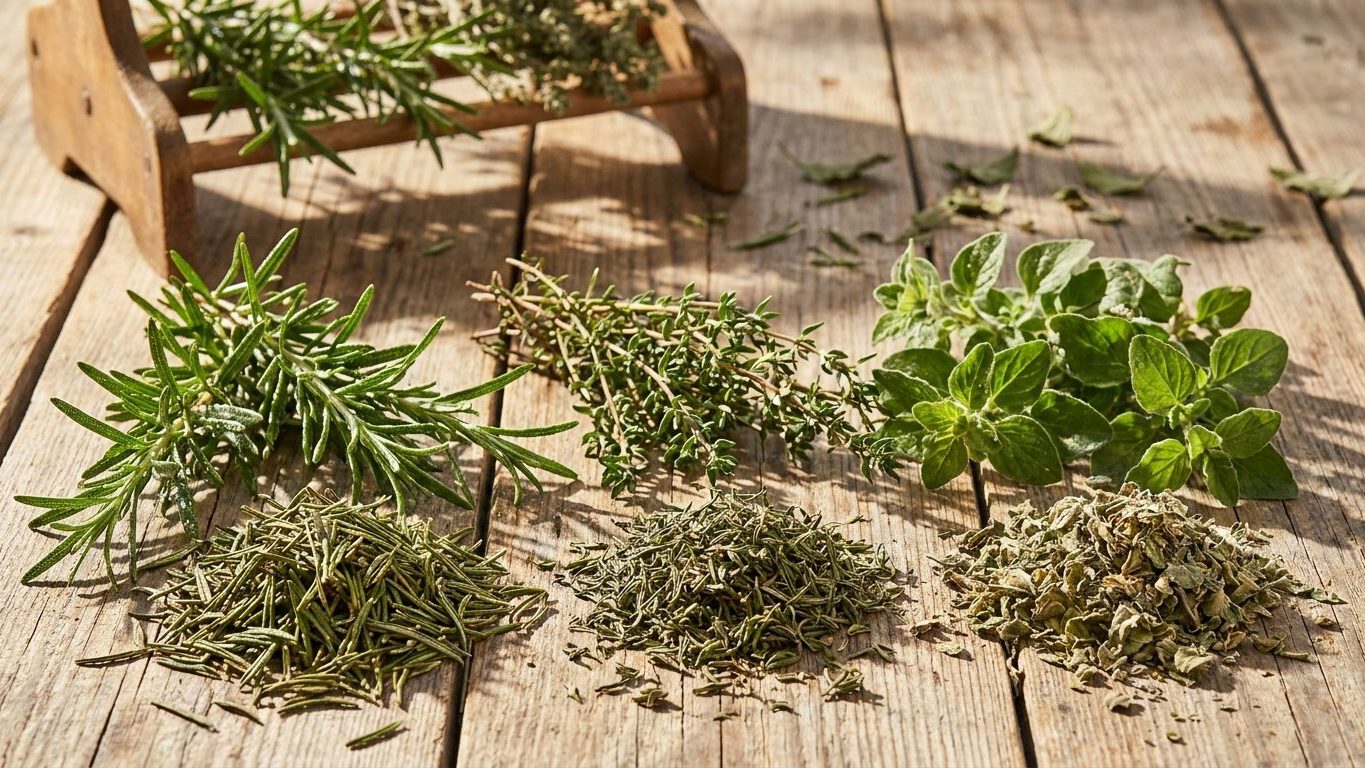

Some herbs come out of a dehydrator tasting almost as bright as the day they were cut. Others turn to dust with barely any smell left. The difference isn’t really the drying method, it’s the herb itself, and knowing which category a plant falls into changes everything about how you handle it. Woody, oil-rich leaves survive drying well. Soft, water-heavy ones usually don’t.
What is actually going on

The thing to understand here is volatility. Herb aroma doesn’t live in the leaf tissue itself, it lives in tiny pockets of essential oil, stored in structures on or just under the leaf surface. Those oils are what give an herb its smell and taste, and they’re chemically restless. They evaporate at room temperature, they evaporate faster with heat, and they evaporate faster still when there’s a lot of surface area exposed to moving air, which is exactly the condition you create when you dry herbs.
Water leaves a leaf during drying, but it doesn’t leave alone. Some of the aromatic oil rides out with it, especially in leaves that are mostly water to begin with. A thin, soft leaf might be 90 percent water by weight, with a thin cuticle and shallow oil-storing cells close to the surface. As that water evaporates, the oil has almost no barrier keeping it in place, and a large share of it escapes right along with the steam.
A thick, waxy leaf tells a different story. Mediterranean woody herbs, the rosemary-thyme-oregano-sage type of plant, evolved in hot, dry climates where holding onto moisture and oil was a survival trait. Their leaves have a heavier cuticle, denser oil glands, and a lower water content relative to oil in the first place. When you dry them, there’s simply less water to lose and a sturdier structure protecting the oil that remains. That’s the entire reason the same drying rack can produce a jar of thyme that smells exactly like the fresh sprig, and a jar of basil that smells like lawn clippings.
Heat and light make this worse for every herb, just to different degrees. Volatile oils oxidize when exposed to warmth, and that oxidation changes the aroma compounds into duller, sometimes bitter versions of themselves. Light does something similar to chlorophyll and to some of the same aromatic molecules, which is part of why herbs dried in direct sun fade in color and in taste at the same time. Speed matters too, and it works in a slightly counterintuitive direction: a fast dry at gentle, controlled heat often preserves more aroma than a slow air-dry at room temperature, because the oils spend less total time sitting in a state where they can escape. A bundle of herbs hanging in a kitchen for two weeks loses oil the entire time it’s losing water.
None of this is about drying being a “worse” method than fresh use. It’s about matching the herb’s own chemistry to the process, instead of assuming one technique works the same way for every plant in the garden.
In the garden
Once you know why oil retention varies, deciding what to dry and what to skip gets a lot more predictable. The Mediterranean, woody-stemmed herbs are the reliable performers. The soft, high-water leafy herbs are where drying most often disappoints, and freezing or another preservation method usually serves the cook better.
| Herb type | Dries well? | What goes wrong if dried anyway | Better alternative |
|---|---|---|---|
| Woody Mediterranean types (rosemary, thyme, oregano, sage, savory) | Yes | Little goes wrong; over-drying at high heat can still dull the oil | Air-dry or low-heat dehydrate; whole sprigs hold flavor longer than crumbled leaf |
| Bay and other stiff, leathery leaves | Yes | Flavor turns papery if dried too fast at high heat | Slow air-dry away from direct light |
| Soft leafy herbs (basil, cilantro leaf, parsley, tarragon, chervil) | Poorly | Leaves turn dark, brittle, and largely flavorless; basil in particular can taste faintly like hay | Freeze chopped in a small amount of water or oil, or freeze whole leaves flat |
| Alliums grown as herbs (chives) | Poorly | Dried texture turns papery and the onion-family aroma fades fast | Freeze chopped in small portions |
| Mint types | Moderate | Dries fine structurally but loses much of its bright, cooling top note, leaving a duller, hay-like background flavor | Dry for tea-style use; freeze if a fresh, sharp flavor matters more |
| Dill | Poorly | Loses most of its aroma within weeks of drying, even stored well | Freeze fresh, ideally within a day of cutting |
Timing the cut matters as much as the drying method itself. Herb oil concentration in the leaf peaks right before the plant flowers, when the plant is putting its energy into leaf growth rather than seed production. Once flowering starts, a lot of that stored oil gets redirected toward the flowers and seeds, and leaves cut afterward taste noticeably flatter no matter how carefully they’re dried. Cutting in the early morning, after dew has dried on the leaves but before the day heats up, also helps, since afternoon heat is itself enough to start evaporating oil straight off the living plant. A gardener who waits until midsummer flowering, then cuts at 2 p.m. on a hot day, is starting the drying process with a plant that has already lost a meaningful share of its aroma, before any dehydrator or drying rack gets involved.
What it depends on where you are
How fast an herb dries, and how good it looks doing it, has a lot to do with the air around it, and that part of the equation is genuinely local. Humid summers slow evaporation and raise the risk of mold forming on leaves before they fully dry, especially with bundled air-drying methods where airflow between leaves is limited. Dry, low-humidity summers do the opposite, often drying herbs so fast that a distracted gardener misses the point where leaves are perfectly cured and instead lets them go brittle and faded.
Season length changes the picture too, in a different way. In a region with a long, warm growing season, an herb can put on a full flush of new growth after an early harvest, giving a second cutting before flowering sets in. In a region with a short season, that first cutting might be the only good window before cooler weather pushes the plant toward flowering and seed production out of self-preservation. Neither pattern is universal, and neither can be pinned to a specific place, because it depends on local rainfall patterns, humidity, and how the current season is running.
That’s the honest limit of a general guide like this one. The mechanism, why oils volatilize, why woody leaves hold flavor better than soft ones, why timing matters, works the same Everywhere. The calendar around it doesn’t. For that piece, the most reliable sources are the state-specific herb guides elsewhere on this site, and the county-level cooperative extension office serving the reader’s own area, since extension staff track local rainfall and heat patterns in a way no national article can.
The mistake that costs the most
The single costliest mistake isn’t a drying technique at all. It’s applying the same drying plan to every herb in the garden, especially drying the tender, high-water herbs that were never good candidates for it in the first place, and expecting the jar to taste anything like the fresh leaf did.
This mistake is easy to fall into because drying feels like the default preservation method, the one people reach for automatically, when in reality it’s the right call for maybe half the herbs in a typical garden bed. A gardener who spends a whole afternoon bundling basil, hanging it, and waiting two weeks ends up with a jar of dark, brittle leaves that add almost nothing to a winter sauce, and the natural conclusion is often “I guess dried herbs just aren’t as good as fresh,” when the real issue was choosing the wrong preservation method for that particular plant.
The fix costs nothing but a small shift in habit. Sort the harvest before deciding how to preserve it. Woody, low-water herbs, rosemary, thyme, oregano, sage, go to the drying rack or dehydrator. Soft, high-water herbs, basil, cilantro, parsley, tarragon, chives, dill, go into the freezer instead, chopped and packed into small portions, either plain or with a little water or oil to protect them from freezer burn. That one sorting step, done at harvest time rather than after a disappointing jar of dried basil, is what separates a pantry full of herbs that still taste like something from one that mostly tastes like dust with a vague memory of green.