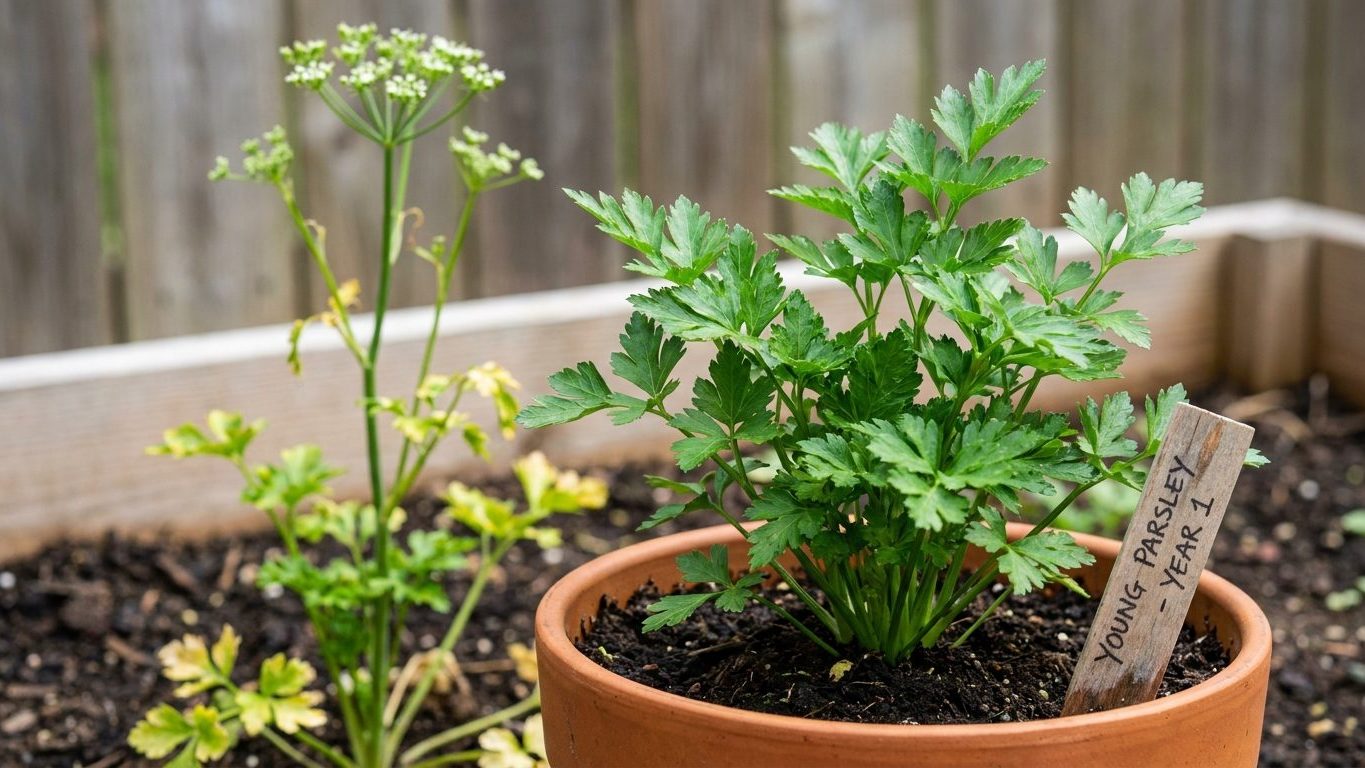

Parsley gets planted every spring like it’s starting from zero, but it isn’t an annual at all. It’s a biennial, and gardeners just never let it reach its second year on purpose. Understanding that one distinction explains almost every quirk this plant shows: why it bolts, why it comes back bitter, and why some gardeners swear by starting fresh each season instead of babying an overwintered plant.
What is actually going on

The thing to understand here is biennial: parsley makes leaves in its first year and flowers in its second, and once flowering starts, the plant is finished as a leaf crop. That’s the whole story of every “why did my parsley turn bitter” question. The plant isn’t malfunctioning. It’s doing exactly what a biennial does on schedule.
In year one, all the plant’s energy goes into building a rosette of leaves and a taproot. That’s the phase cooks and gardeners actually want, and it can last most of a growing season if the plant is kept from feeling threatened. In year two, the same plant shifts its whole strategy. It stops investing in leaf growth and starts pushing up a flower stalk, because its biological job now is to set seed before it dies. Leaves that do grow during this phase tend to be sparser, tougher, and more bitter, since the plant is diverting sugars and resources toward the flower stalk instead of leaf tissue.
A cold winter, or even a stretch of unusually cool weather in year one, can trick a first-year plant into acting like it’s already had its winter and jumping straight to flowering. This is called bolting, and it’s the single most common reason a parsley plant that looked fine in spring turns to seed by midsummer. The plant isn’t reading a calendar. It’s reading temperature cues, and a false winter is enough to flip the switch.
None of this makes parsley harder to grow than a true annual like basil. It just means the useful window is narrower than the plant’s actual lifespan, and gardeners who treat it as disposable and replant yearly are, in a practical sense, doing the smart thing rather than missing something.
Parsley also carries a long-standing reputation in folk medicine circles, tied to its concentration of certain plant compounds. This page doesn’t evaluate that reputation one way or another. It’s a garden and kitchen guide, not a health resource, and any medicinal claim about parsley belongs in a different conversation entirely.
In the garden
Most of the frustration with parsley traces back to one thing: it germinates slowly, and slowly is an understatement. Seeds can take two to four weeks to show any sign of life, sometimes longer in cool soil. Gardeners used to lettuce or radish sprouting in days often assume a failed batch and either resow on top of the first planting or give up. Soaking seed overnight before sowing can shave a few days off that wait, though it won’t turn parsley into a fast germinator.
There are two distinct leaf types on the market, flat-leaf and curly, and they behave the same way biologically even though they look nothing alike on a plate. Flat-leaf types tend to have a stronger, more assertive flavor and are the ones most often reached for in cooking. Curly types hold their shape better as a garnish and are slightly more tolerant of being crowded in a container, but neither type skips the slow-germination stage or the second-year bolt.
| Stage | What should happen | What goes wrong, and why |
|---|---|---|
| Sowing | Seeds sprout within 2 to 4 weeks | Gardener assumes failure and resows too early, ending up with a patchy double planting once the original seeds finally sprout |
| Early leaf growth | Rosette of leaves fills in over several weeks | Overcrowded seedlings compete for light and stay spindly; thinning gets skipped because every seedling looks precious after such a slow start |
| Midsummer heat | Leaf production slows but continues | Plant is mistaken for dying and pulled, when it’s simply pausing growth in high heat and would resume in cooler weather |
| Cool snap or true winter | Plant either goes dormant or reads it as its “winter” | Cold-triggered bolting sends the plant into flower production, and leaves left on the stalk turn bitter and sparse |
| Second year | Flower stalk emerges, plant sets seed | Gardener keeps harvesting from a bolting plant, gets less and less usable leaf, and blames “the variety” instead of the plant’s natural cycle |
Once bolting starts in earnest, there’s no reversing it by cutting the flower stalk back. The plant has already committed its resources to reproduction. The practical move at that point is to start a fresh sowing rather than nurse the old plant along, which is exactly why so many experienced gardeners treat parsley as a yearly replant regardless of what the plant is technically capable of doing.
What it depends on where you are
How long a parsley plant stays in its productive first-year phase has a lot to do with local conditions. Season length matters: a longer stretch of mild weather before the first hard freeze gives a first-year plant more time to build leaf mass before winter cues kick in. Summer heat matters too, since parsley slows down and can taste harsher in prolonged high temperatures, and how a plant handles that stress varies by region and by how much afternoon shade it gets.
Summer rainfall and humidity change the picture further. Areas with wet, humid summers tend to see more foliar disease pressure on parsley, while drier regions deal more with the plant simply drying out between waterings if it’s not mulched. Neither problem is universal, and neither is solved the same way everywhere.
Whether a parsley plant can survive outdoors into a second year at all, and whether that’s even worth attempting given the bolting risk, depends heavily on how cold winters get and how reliably that cold arrives on schedule rather than in unpredictable early or late snaps. In some regions, gardeners overwinter parsley outdoors as a matter of course. In others, the plant simply won’t make it through, and the point is moot.
For anything specific to a particular growing region, the state-level guides on this site cover the local timing questions this page deliberately leaves open. A local Cooperative Extension office is also worth a call, since extension agents track regional pest pressure, typical frost windows, and soil conditions with a level of local detail no national guide can match.
The mistake that costs the most
The single costliest mistake with parsley is harvesting the same plant into its second spring and expecting it to keep producing like it did the year before. It won’t. Once that plant starts pushing up a flower stalk, leaf production drops and what does grow turns bitter, and no amount of cutting back the flower stalk restores the plant to its first-year behavior. Gardeners who don’t recognize this spend weeks nursing a plant that has already moved on to a different biological job, wondering why last year’s reliable herb suddenly can’t keep up.
The fix isn’t a technique. It’s a mindset shift: treat parsley as a plant with a one-year productive window, full stop, regardless of how many seasons it might technically survive. That means sowing a new batch either late in the previous year’s growing season or early the following spring, timed so a fresh first-year plant is coming into leaf production right as the old one starts bolting. Staggering two sowings a few weeks apart smooths out the transition even further, since it means there’s always a plant in its productive phase rather than a hard cutoff followed by weeks of waiting for new seed to germinate.
This also means resisting the urge to keep a second-year plant around “just in case” it produces a few more usable leaves. It might, briefly, but the plant’s overall trajectory is set. The gardeners who get the most consistent parsley year after year aren’t the ones with some secret overwintering trick. They’re the ones who accepted early on that this herb’s useful life is shorter than its actual lifespan, and planned their sowing calendar around that fact instead of around what the seed packet’s silence on the subject implied.