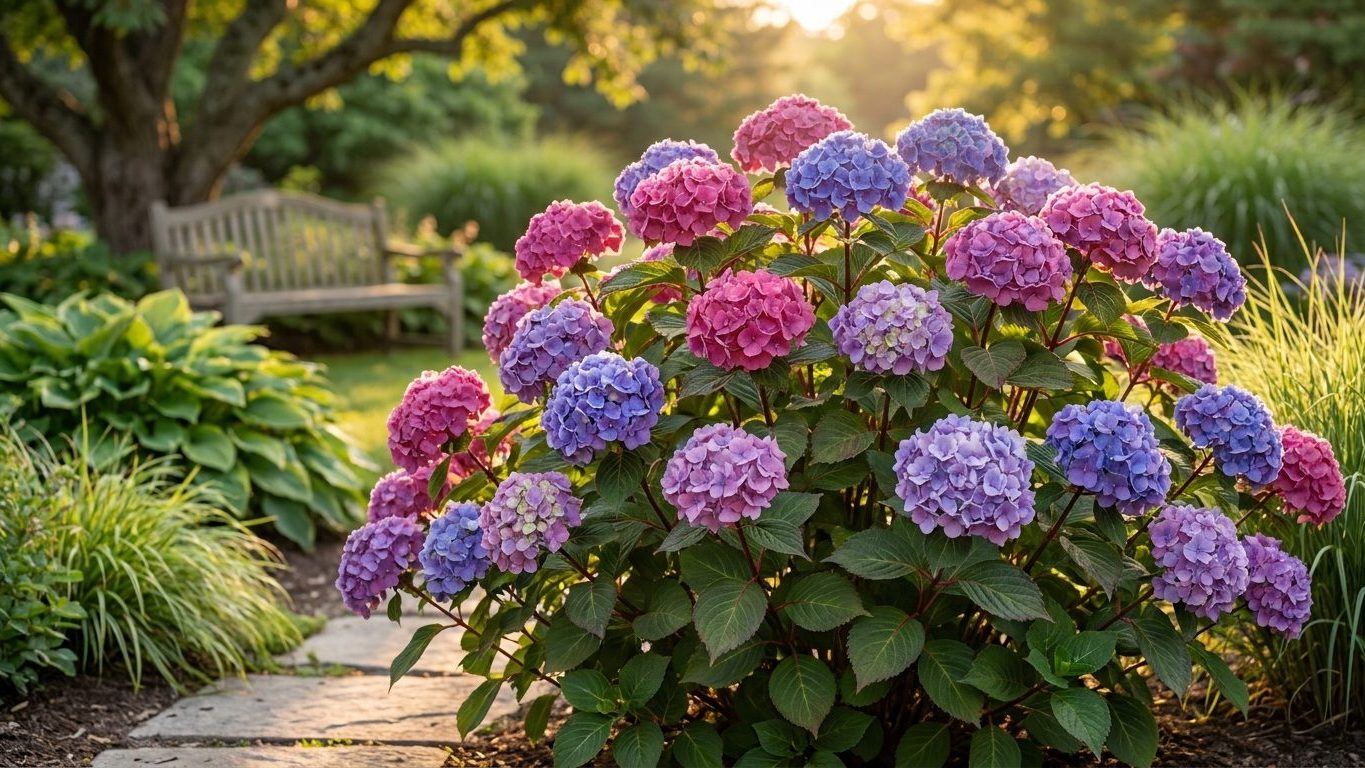

Bloomstruck is a bigleaf hydrangea from the Endless Summer series, hardy from USDA zone 6a through 11b, with red-tinged stems and mop-head flowers that shift from blue to pink depending on soil pH. It sets its buds on last year’s wood, but its reblooming habit lets it push a second flush on new growth if a late frost wipes out the first set. That reblooming trait is the real difference between Bloomstruck and older bigleaf cultivars, and it changes what a gardener in a marginal zone can honestly expect season to season.
What Bloomstruck actually is
Bloomstruck belongs to the bigleaf group (Hydrangea macrophylla), the mop-head type most people picture when they hear the word hydrangea. According to the North Carolina Extension Gardener Plant Toolbox, bigleaf Hydrangeas are hardy from USDA zone 6a through 11b, a wider southern range than most of the genus but a firm limit in the north: below 6a, flower buds routinely fail to survive winter even where the shrub itself lives on.
Habit and space: bigleaf hydrangeas reach 3 to 6 feet tall and wide, a mounding shrub that needs no staking but does need room.
Bloomstruck is registered under the code ‘PIIHM-II’ in the Endless Summer series, but the selling name is the one to use in a garden center or a search bar. Its stems and leaf veins run reddish, a cosmetic marker shared with its series siblings. Unlike a straight bigleaf that flowers once, Bloomstruck is remontant: it blooms on last year’s wood first, then again on new growth through the season.
What Bloomstruck is good for

Bloomstruck isn’t grown for a harvest, it’s grown for color that holds through the season without a single bloom period to plan around. That reblooming mechanism matters more than the flower itself: because new growth can flower on its own timetable, a gardener who loses the first flush to a cold snap in May isn’t looking at a blank shrub until next year. There’s a second and sometimes a third round waiting on stems that haven’t even formed yet in spring.
That makes Bloomstruck a better fit than an older bigleaf cultivar for borderline zones (6a and 6b), where a late frost after bud break is common enough to plan for rather than hope against. In warmer zones, from 7 through 9a, the reblooming trait is less of a rescue and more of a bonus: both wood ages usually survive, so the shrub simply blooms longer.
The color itself is the other reason people plant it. Below roughly pH 5.5 the flowers run blue, above roughly 6.5 they run pink, and the range between produces the mauve-purple that gives the cultivar part of its name. That shift is genuine chemistry: acidic soil makes aluminum available to the plant, and it’s the aluminum, not the acidity itself, that turns the pigment blue. Gardeners who add coffee grounds or citrus peel hoping for the same effect are usually disappointed, because the pH shift from kitchen scraps is small and slow, while what actually moves the color is aluminum sulfate applied with intent, or lime if the goal runs the other way.
One caution belongs here: only bigleaf hydrangea is documented toxic, and Bloomstruck is bigleaf. Large quantities of bark, flowers, leaves, or stems can cause nausea, stomach pain, vomiting, and sweating in people, and the same risk applies to cats, dogs, and horses. It takes a real quantity to matter, but a homeowner with a grazing horse or a chewing puppy should know the shrub isn’t inert.
Where it ripens in time, and where it is a gamble
“Ripens” for a hydrangea means something different than it does for a vegetable: there’s no fruit to race against frost, but there is a bud that has to survive winter to open at all. Because Bloomstruck sets its first flowers on wood grown the previous summer, the question that decides success in any given yard isn’t whether the shrub will live, it’s whether last year’s buds made it through the cold intact.
Zone 6a and 6b sit at the edge of that margin. The shrub itself is rated hardy there, but a hard late frost that arrives after the buds have started to swell can take the entire first flush with it. This is exactly where Bloomstruck’s reblooming trait earns its keep: even a bud-killing frost in April doesn’t erase the season, it just shifts the show to the new-wood flowers that come later in summer. A straight, non-remontant bigleaf in the same spot has no such fallback.
Move into zone 7 through 9a and the arithmetic gets more forgiving. Winters are mild enough that old-wood buds usually clear dormancy without incident, and the growing season is long enough that new-wood flowering has time to build on top of the first flush rather than replace it. This is the range where Bloomstruck performs closest to the catalog description, blooming from late spring through the first frost with minimal winter loss.
At the warm end, zone 9b through 11b, winter cold stops being the limiting factor altogether. The trade-off there is heat and light rather than frost: bigleaf hydrangeas want dappled sun or partial to deep shade, and need real protection from afternoon sun, which becomes non-negotiable once summer temperatures climb in the Gulf states or inland Florida.
None of this substitutes for a zone-specific verdict. Bud survival depends on the exact timing of a region’s last hard freeze relative to when the shrub breaks dormancy, and that’s a local calculation, not a national one. A gardener in coastal North Carolina and a gardener in the Blue Ridge foothills can both be nominally in zone 6b and still have very different outcomes with the same plant.
The two ways a season goes wrong
A wide hardiness range on paper doesn’t mean the shrub performs the same everywhere inside it, and Bloomstruck fails for opposite reasons at opposite ends of its zone map.
In the north, the failure is timing, not survival. The plant lives through winter in zone 6a without much drama, but the flower buds that formed the previous summer are more fragile than the wood carrying them. A frost that arrives after those buds have started to swell, even a late, minor one, can strip the first flush entirely. Because Bloomstruck reblooms on new growth, this loss is a setback rather than a lost season, but it does mean color arrives later in the year than the catalog description implies, and some years the early show simply doesn’t happen.
In the south, the failure is exposure, not cold. Bigleaf hydrangeas want dappled sun or partial to deep shade and specifically need protection from afternoon sun. In zone 9b through 11b, an afternoon-facing bed that would be fine for a panicle hydrangea (the one type in the genus that tolerates full sun) will scorch a bigleaf’s foliage and stress its shallow roots through the hottest weeks of summer.
For Bloomstruck specifically, the southern exposure problem matters more year to year. The northern frost issue is intermittent, softened further by the reblooming habit. Afternoon sun in a hot zone is a constant, present every single summer regardless of what winter did.
What it resists, and what it does not
The NC State Extension source names three diseases affecting hydrangeas in general: leaf spot, bacterial wilt, and powdery mildew. No source in this guide grades Bloomstruck’s resistance to any of them individually, so treat it as any bigleaf hydrangea would be treated: watch for spotted or powdery leaves in humid weather and improve airflow around the plant rather than assuming it’s protected.
On pests, the same source lists aphids, scales, nematodes, and mites as occasional problems, describing them as “rarely a problem” for the genus as a whole. Deer are a different story. The source lists deer both as a damage agent and, elsewhere on the same genus page, under resistance to challenges, which is a contradiction worth flagging rather than repeating. What’s actually observed is that hydrangeas get browsed by deer, so fencing or repellent is a real consideration in areas with pressure.
Beyond those two categories, this cultivar carries no documented resistance to anything else in the source. That absence is worth stating plainly: no claim of disease resistance means no disease resistance to rely on.
Growing it without the usual mistakes
The single most common mistake with any bigleaf hydrangea, Bloomstruck included, is pruning at the wrong point in the year. Because the first flush of flowers comes from buds set the previous summer, cutting the shrub back at the wrong time removes next year’s show before it has a chance to open. The safe window is right after the current flowers fade, before the plant starts forming next year’s buds. The exact calendar month for that window shifts by region, and that’s a question for a state-specific growing page rather than a blanket date here.
Bigleaf hydrangeas are shallow-rooted, and mulch does real work: it keeps roots cooler in summer and buffers moisture swings that stress a shallow root system faster than a deep-rooted shrub would notice.
Color management is a feeding decision as much as a soil one. Aluminum sulfate acidifies soil and makes aluminum available, pushing flowers blue; lime raises pH and pushes them pink. A high-phosphorus fertilizer works against a blue goal specifically, because phosphorus locks aluminum up in the soil chemically, nudging color toward pink no matter what the pH reads.
Feed lightly and stop by late summer so new growth has time to firm up before cold weather, and skip the fall pruning pass entirely, since anything cut back late removes wood that hasn’t yet had a chance to set next year’s buds.
One overlooked step for wildlife: if hollow stems get cut back at all, leave them standing at 12 to 24 inches rather than removing them. Native bees nest in that hollow wood over winter, and the stems only need to be cleared once they’ve disintegrated on their own.
Common questions
Does Bloomstruck hydrangea bloom on old wood or new wood?
Both. It sets its first flush on wood grown the previous summer, like any bigleaf hydrangea, but its reblooming trait lets it also flower on new growth through the season, which is what sets it apart from older bigleaf cultivars.
What USDA zones can grow Bloomstruck?
It’s rated for USDA zones 6a through 11b, the standard hardiness range for bigleaf hydrangeas. Zones 6a and 6b sit at the frost-risk edge for flower buds specifically, even though the shrub itself survives there.
Does Bloomstruck hydrangea actually change color?
Yes. Soil pH below about 5.5 produces blue flowers, above about 6.5 produces pink, and the range between produces the mauve-purple in between. This applies to Bloomstruck because it’s bigleaf; panicle, smooth, oakleaf, and climbing hydrangeas don’t respond to pH the same way.
Is Bloomstruck hydrangea toxic to pets?
Bigleaf hydrangea, the type Bloomstruck belongs to, is documented toxic if large quantities of bark, flowers, leaves, or stems are eaten, causing nausea, stomach pain, vomiting, and sweating. The same risk applies to cats, dogs, and horses, so it’s worth siting away from grazing or heavy chewing without treating it as an emergency plant.