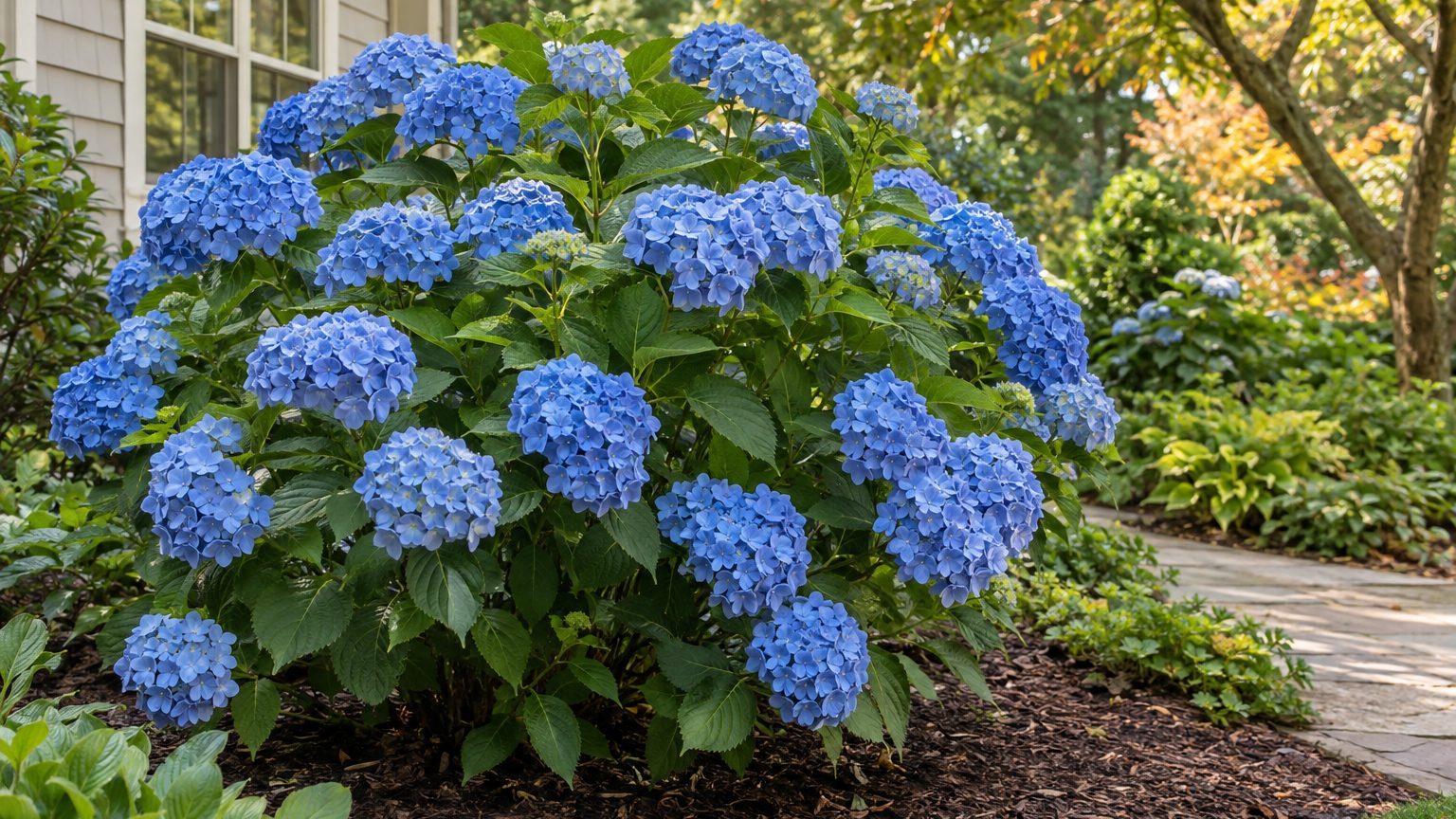

Nikko Blue is a classic blue mophead, a bigleaf hydrangea (Hydrangea macrophylla) hardy from USDA zone 6a through 11b. It flowers only on last year’s wood, meaning the buds that open this June were actually formed the previous summer. So whether it blooms where you garden comes down to two dates: how cold your late frosts run, and when you last picked up the pruning shears.
What Nikko Blue actually is
Nikko Blue belongs to the bigleaf group, the mophead and lacecap side of the hydrangea family, and it carries that group’s defining trait: it sets its flower buds on last year’s wood, not on the growth it puts out this spring. Those buds form the previous summer and sit dormant through winter, which is why a hard prune in March, or a late freeze that catches the buds after they’ve swollen, can erase a season’s flowers even on a perfectly healthy plant.
The plant itself grows 3 to 6 feet tall and wide, a rapid grower for the genus, and it wants dappled sun or partial to deep shade, protected from direct afternoon sun. Its roots are shallow, so a layer of mulch matters more than it would for a deep-rooted shrub, both to hold moisture and to buffer soil temperature around those buds. One detail rarely mentioned: bigleaf hydrangea carries low flammability, a point that matters to anyone planting near a structure in a fire-prone region. All of this comes from the North Carolina State Extension Gardener Plant Toolbox, the reference for every figure on this page.
What Nikko Blue is good for

The obvious draw is color, and it’s a genuine one: below roughly pH 5.5 the flowers turn true blue, above roughly pH 6.5 they shift pink, and the range between produces purple. That shift comes from aluminum availability in the soil, which acidity unlocks, so the plant works as a living pH indicator as much as a landscape shrub. Add its low flammability rating and Nikko Blue earns a place in defensible-space plantings around homes in dry-summer regions, something few gardeners think to ask about when picking a foundation shrub.
It’s a low-maintenance plant once established, which suits gardeners who want reliable color without a demanding routine, and cut stems hold up well indoors, a bonus for anyone who likes fresh arrangements. Where it isn’t good is the kitchen. Only H. macrophylla, the exact species Nikko Blue belongs to, is documented as toxic if a large enough quantity is eaten: bark, flowers, leaves and stems all carry cyanogenic compounds, and the result is nausea, stomach pain, vomiting and sweating. That risk extends to cats, dogs and horses, so it’s not a shrub to plant right where a curious dog or grazing horse can reach it in quantity, even though a nibble is unlikely to cause real harm.
On the wildlife side, there’s a genuine upside. Native bees nest in old hollow stems, so if you cut the plant back to 12 to 24 inches rather than to the ground, and leave those stems standing until they naturally break down, you’re offering nesting habitat most gardeners throw away with the yard waste.
Where it ripens in time, and where it is a gamble
Bigleaf hydrangea doesn’t “ripen” the way a fruiting plant does, but it faces the same kind of timing math: buds have to survive winter and open before anything cuts them short. Nikko Blue’s hardiness range, 6a through 11b, is wide, but the risk isn’t spread evenly across it. At the cold edge of that range, in zone 6a, the danger isn’t a hard winter freeze that the plant is rated to survive; it’s a warm spell that coaxes the buds to swell early, followed by a late frost that catches them exposed. The shrub itself lives, but that year’s flowers don’t.
Further into the range, zones 7 through 9, the margin is more comfortable: winters are cold enough to keep buds properly dormant, but late frosts severe enough to kill swollen buds are less common. At the warm end, zones 10 and 11b, freeze risk drops close to zero, but the trade shifts toward heat and drainage, since a shallow-rooted shrub in a mild-winter, hot-summer climate depends more on mulch and consistent moisture than on frost protection.
The exact date your local buds are vulnerable, and the exact zone verdict for your address, isn’t a number this national page can responsibly hand you. That answer depends on your specific zone and, just as much, on making sure you actually have a bigleaf hydrangea and not one of its cousins, since the rules differ sharply by type.
| Type | Hardiness zones | Flowers on | Height |
|---|---|---|---|
| Bigleaf (Nikko Blue) | 6a-11b | Last year’s wood | 3-6 ft |
| Panicle | 3a-8b | Current season’s growth | 8-25 ft |
| Smooth (e.g. Annabelle) | Hardiest of the genus | New wood | Varies |
| Oakleaf | Not specified here | Old wood | To about 5 ft |
| Mountain | Not specified here | Old wood, more frost-tolerant buds | Varies |
| Climbing | Not specified here | Old wood | 15 ft and more |
Notice that panicle hydrangea is the one genuinely cold-hardy substitute where bigleaf struggles, since it flowers on new growth and can be cut back hard every winter without losing a single bloom the following season.
The two ways a season goes wrong
For a plant that flowers on old wood, failure comes down to two separate mistakes, and they don’t punish the same gardeners equally. The first is climatic: a late spring frost that arrives after the buds have started to swell. This is the classic zone 6a problem, where winters are technically survivable for the shrub but a warm early spring followed by a cold snap wipes out the flowers for the year, even though the plant leafs out fine.
The second is entirely self-inflicted: pruning at the wrong time. Because the flower buds for next year form on this year’s growth right after blooming, a gardener who prunes in spring to “tidy up,” or who prunes any time after roughly the start of August, is cutting off next year’s flowers before they’ve even fully formed. This is the more common failure across most of Nikko Blue’s range, because most of that range, zones 7 through 11b, doesn’t get frosts severe enough to be the real threat. The plant’s own habit, not the weather, is usually what costs the bloom.
Given how wide and warm-leaning Nikko Blue’s hardiness range runs, the pruning mistake deserves more attention from most gardeners than frost does. The exact safe pruning window still depends on your zone and local frost pattern, which is why that specific date belongs on your state’s page rather than here.
What it resists, and what it does not
The source names three diseases affecting hydrangea broadly: leaf spot, bacterial wilt and powdery mildew. None of these come with a resistance rating for Nikko Blue specifically, so the honest statement is that the catalogue lists no disease resistance for this cultivar at all. Assuming otherwise, and skipping basic sanitation or air circulation, is how a healthy-looking shrub ends up with mildewed leaves by August.
On the pest side, the news is better. Aphids, scales, nematodes and mites are all listed as pests of hydrangea, but the source describes them as “rarely a problem,” which is a meaningfully different statement from “resistant.” Deer are the one pest worth flagging clearly, because the source contradicts itself here in a useful way: deer appear both as a damage agent and, separately, under a general resistance list for the genus. When a single source disagrees with itself, the safer read is the one grounded in observed behavior: Hydrangeas get browsed by deer. Treat Nikko Blue as unprotected from deer pressure, not as resistant to it.
The one risk that’s not about disease at all is toxicity. As a bigleaf hydrangea, Nikko Blue’s bark, flowers, leaves and stems carry cyanogenic compounds that cause real illness, nausea, vomiting, sweating, if eaten in quantity by a person, a dog, a cat or a horse. That’s a fact worth passing on to anyone with grazing animals or a plant-chewing puppy, without turning it into a reason to avoid the shrub entirely.
Growing it without the usual mistakes
Because Nikko Blue flowers on old wood, the single most important habit to build is pruning right after flowering ends, and stopping well before new buds start forming for the next season, generally understood to mean before the plant’s late-summer bud-set window closes. The exact calendar date for that cutoff shifts by zone, so check your state’s page rather than guess. What doesn’t shift: a spring “shape-up” prune is the fastest way to lose a year of blooms on this cultivar.
Because its roots run shallow, a steady layer of mulch does double duty, holding soil moisture through summer heat and buffering root temperature through winter cold snaps, which matters more at the cooler edge of its zone 6a-11b range. Feeding decisions carry a second, less obvious consequence here: a high-phosphorus fertilizer locks aluminum out of reach in the soil, and since aluminum availability is what actually drives blue coloring, that fertilizer choice can nudge blue flowers toward pink even if the soil pH itself hasn’t moved. If you want to shift color deliberately, aluminum sulfate acidifies soil toward blue (below about pH 5.5) and lime pushes it alkaline toward pink (above about pH 6.5). Kitchen remedies like coffee grounds or citrus peel are a widely repeated fix, but the pH shift they produce is small, and color depends on available aluminum more than on a fractional pH change, which is exactly why that remedy so often disappoints.
Last habit: when you do your seasonal cutback, leave stems standing at 12 to 24 inches rather than cutting to the ground. Native bees nest inside those hollow stems, and letting them disintegrate naturally over a year or two turns routine yard maintenance into small-scale habitat.
Common questions
Does Nikko Blue always turn blue?
No. Color follows soil pH and, available aluminum: acidic soil below about pH 5.5 produces blue, alkaline soil above about pH 6.5 produces pink, and a high-phosphorus fertilizer can push color toward pink even without a pH change.
Can I prune Nikko Blue hard in spring to control its size?
No. It flowers on last year’s wood, and the buds for this year’s bloom already formed last summer. A spring prune removes them before they open.
Is Nikko Blue hardy enough for a zone 5 garden?
The documented hardiness range for bigleaf hydrangea, Nikko Blue’s type, is 6a through 11b, which doesn’t include zone 5. Panicle hydrangea, hardy to 3a, is named specifically as a substitute where bigleaf hydrangea isn’t winter hardy.
Is Nikko Blue dangerous to pets?
Only if eaten in large quantity. Bark, flowers, leaves and stems contain cyanogenic compounds that can cause nausea, vomiting and sweating in cats, dogs and horses, though a casual nibble is unlikely to cause serious harm.