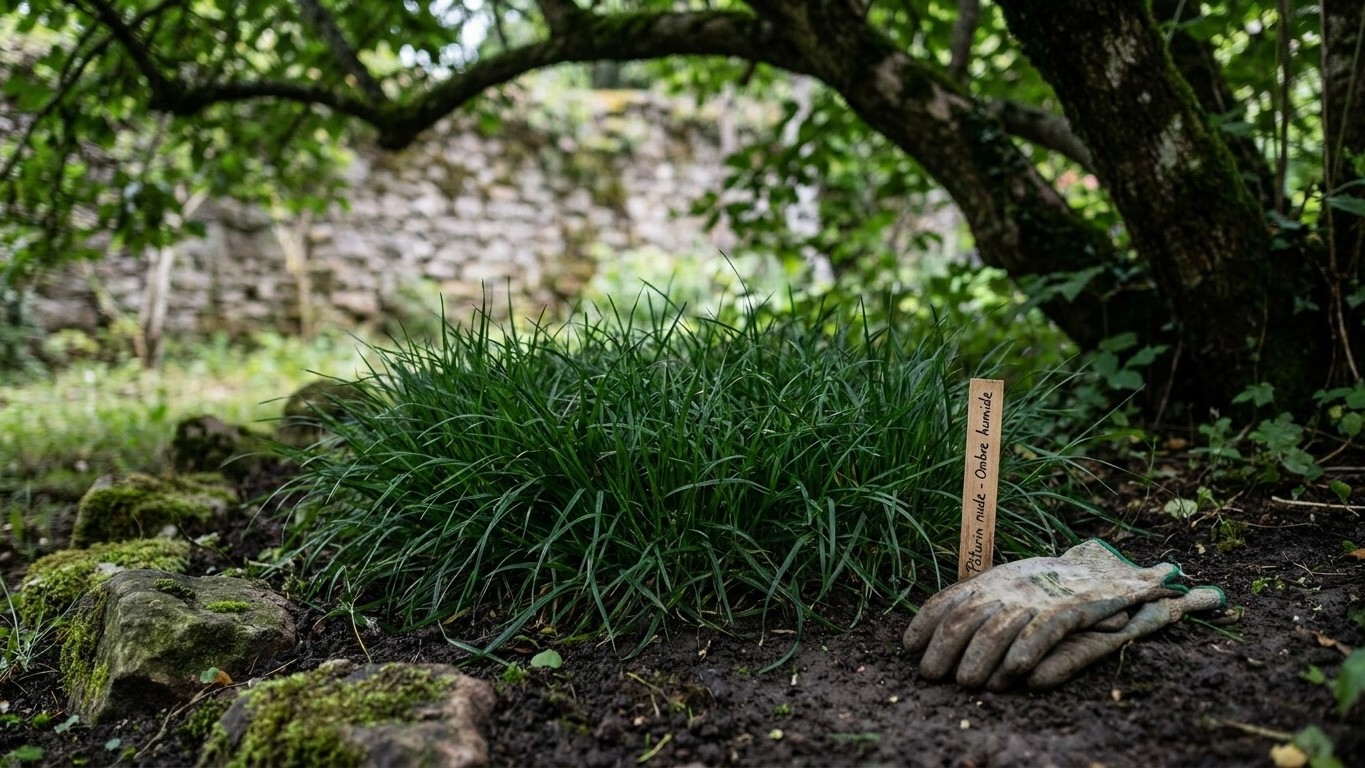

Rough bluegrass is a cool-season turfgrass for moist, shady ground, and you establish it from seed. Extension services are split on it: some call it a weed, while others still list it for the shadiest ground. Before you buy a bag, find your state in the territory lists below and check whether summers there run on the cool side.
What Rough Bluegrass actually is

University of Georgia Extension lists rough bluegrass in the table of cool-season turfgrasses in Lawns in Georgia: Selection and Species. The same publication says cool-season grasses grow well during the cool months of spring and fall, when temperatures average 60 to 75 °F, and may become stressed, dormant, or injured during the hot months of summer. Spring and fall are its growing seasons, and midsummer is when it struggles. If you have not yet sorted cool-season from warm-season species, the Grass Types overview is the place to start.
How it grows
NC State Extension Gardener Plant Toolbox describes a grass that spreads by creeping stolons and has shallow roots that form a loose sod. The same entry says it does not tolerate foot traffic, heat, or drought very well. Penn State Extension adds that the runners let it spread horizontally and creep over desirable grasses, forming roughly circular patches. On the leaf, Penn State Extension says the underside of Poa trivialis is glossy, whereas Kentucky bluegrass leaf surfaces are not glossy or shiny.
A weed and a turfgrass
Extension services describe it both ways. NC State Extension Gardener Plant Toolbox says rough bluegrass is often considered a weed in lawns and golf courses, and lists it as an invasive species in Virginia, Pennsylvania and Alaska. Yet the same entry concludes that, despite those negatives, it is useful as a turfgrass for moist and shady areas that are difficult to cover. Penn State Extension, in its lawn weeds series, calls roughstalk bluegrass (the same grass) an invasive perennial grass weed that thrives in moist soils and in lawns and parks with heavy to moderate shade from trees and buildings. Penn State Extension’s seeding table still lists rough bluegrass for fully shaded areas. Extension services call it both a weed and a turfgrass.
Where it works, and where it fails
The figures below are NOAA’s 1991-2020 climate normals from NCEI, taken at each state’s reference city. A state is not a zone, so the far ends of a large state can fall in the neighboring group. The grouping into first choice, transition and will-not-hold is The Homestead Post’s own reading of those figures, not a ruling by any extension service.
First choice
| Territory | Days at 90F or more | Coldest month, average low |
|---|---|---|
| Nebraska | 28 | 15F |
| Iowa | 18 | 14F |
| Delaware | 18 | 26F |
| West Virginia | 16 | 26F |
| Ohio | 15 | 22F |
| Indiana | 15 | 21F |
| Illinois | 14 | 19F |
| South Dakota | 14 | 8F |
| New York | 12 | 28F |
| North Dakota | 12 | 0F |
| New Hampshire | 11 | 17F |
| Minnesota | 11 | 9F |
| Wyoming | 10 | 18F |
| Michigan | 10 | 19F |
NC State Extension Gardener Plant Toolbox says rough bluegrass prefers cool climates and does not tolerate hot summers or drought. Penn State Extension says that in non-irrigated turf, during periods of high-temperature stress or drought in summer, Poa trivialis begins to decline.
Transition
In the transition band, rough bluegrass is a compromise and no grass excels. NOAA’s 1991-2020 normals put Oklahoma at 71 days at 90F or more with a coldest-month average low of 27F, and Kansas at 58 days and 22F. Utah shows 52 days and 24F, Idaho 48 days and 25F, and New Mexico 42 days and 26F. Tennessee records 40 days and 30F, Colorado 40 days and 18F, and Kentucky 37 days and 28F. If you garden here, the page on tall fescue covers another cool-season option to weigh against it.
Will not hold
NOAA’s 1991-2020 normals give Arizona 169 days at 90F or more with a coldest-month average low of 45F, and Nevada 131 days and 40F. Texas logs 102 days and 44F, Florida 73 days and 43F, Mississippi 71 days and 37F, and Louisiana 71 days and 46F. In these territories a warm-season grass is the choice. Warm-season and cool-season grasses grow in opposite halves of the year and are seeded in opposite seasons, so you cannot swap one for the other without changing your whole calendar. Start with bermudagrass, bahiagrass or seashore paspalum.
Even in the South, University of Georgia Extension lists rough bluegrass with the ryegrasses as a temporary cool-season turfgrass for Georgia. It is used there as a winter cover on new lawns or to overseed warm-season grasses for winter.
Shade, drought, traffic: what it will take

University of Georgia Extension gives the ratings in Lawns in Georgia: Selection and Species, Table 1 (cool-season turfgrasses for Georgia lawns), column “Rough Bluegrass”. Another state’s extension may rate the same grass differently, so treat these as one service’s reading. The table sets each rating beside what other bodies say on the same quality.
| Quality | University of Georgia Extension, Table 1 | Another body on the same quality |
|---|---|---|
| Shade tolerance | Very good to good (a lawn under a maple) | NC State: does best in moist, well-drained soil in partial shade |
| Drought resistance | Poor | NC State: does not tolerate drought very well. Penn State: declines in summer drought in non-irrigated turf |
| Wear tolerance | Good to fair (a path cut across a yard) | NC State: does not tolerate foot traffic very well |
| Cold hardiness | Excellent to very good | NC State: prefers cool climates |
| Heat hardiness | Fair to poor | NC State: does not tolerate heat or hot summers very well |
| Establishment rate | Medium | No other figure |
Drought is its weakest rating, at poor. NC State Extension Gardener Plant Toolbox also warns that in full sun it can become an aggressive spreader and crowd out other grasses.
Against fine fescue
Penn State Extension’s seed mixtures page (Turfgrass Seed and Seed Mixtures) lists fine fescues for heavy shade on well-drained soils and rough bluegrass (Poa trivialis) alone for heavy shade on poorly drained soils. Virginia Cooperative Extension says fine fescues generally do not fare well in persistently wet soils. That is the gap where rough bluegrass is used: shade plus wet ground. Penn State Extension’s weed page adds that it thrives in moist soils.
Seeding or sodding it
University of Georgia Extension marks rough bluegrass as a grass that can be seeded in Table 1 of Lawns in Georgia: Selection and Species. The same table rates its establishment rate as medium.
The seeding rate
The range across the sources is 2 to 3 lb per 1,000 square feet, and each source states its own conditions. Penn State Extension’s Lawn Establishment page gives 2 to 3 lb for fully shaded areas. Penn State Extension’s Seed and Seed Mixtures page gives 2 to 3 lb for heavy shade on poorly drained soils. Both rates apply to shade, not to a sunny lawn. For a sunny site, check your own state’s extension office.
When to sow
Virginia Cooperative Extension says that for cool-season grasses, spring establishment is possible but fall is the preferred time for planting. Use fall if you can.
University of Georgia Extension also lists rough bluegrass with the ryegrasses as a temporary cool-season turfgrass, used as a winter cover on new lawns or to overseed warm-season grasses for winter. If you live where warm-season grass carries the lawn, this is the role the grass plays there, and it does not replace the permanent lawn.
Mowing and keeping it

Height
Published heights run from 1 to 3 inches, and each source has its own figure. NC State Extension Gardener Plant Toolbox gives 1.5 to 2 inches, slightly higher in summer. UC IPM (University of California) gives 1 to 2.5 inches. University of Georgia Extension gives 1 to 3 inches.
Whatever height you pick, follow the one-third rule. NC State Extension says to cut often enough that less than one-third of the total leaf surface is removed. University of Illinois Extension says no more than one-third of the leaf blade should be removed in any one cutting.
What it asks of you
- Watch the edges of established patches. Penn State Extension says the stolons creep over desirable grasses and form roughly circular patches.
- Expect summer decline in non-irrigated turf during high-temperature stress or drought (Penn State Extension).
- Do not plan on a traffic lane across it. NC State Extension Gardener Plant Toolbox says it does not tolerate foot traffic very well.
- Expect a loose sod. NC State Extension Gardener Plant Toolbox says the roots are shallow.
Because it is a cool-season grass, University of Georgia Extension’s note applies: it may become stressed, dormant, or injured during the hot months of summer. For anything beyond that, such as fertilizer or thatch, your state’s extension office is the place to ask.
Common questions
Is rough bluegrass the same as roughstalk bluegrass?
Yes. Penn State Extension uses roughstalk bluegrass for Poa trivialis, the same grass that NC State Extension Gardener Plant Toolbox and University of Georgia Extension call rough bluegrass.
Is rough bluegrass a weed or a lawn grass?
Both, depending on who you ask. NC State Extension Gardener Plant Toolbox says it is often considered a weed in lawns and golf courses but useful for moist, shady areas that are hard to cover. Penn State Extension calls it an invasive perennial grass weed in its weed series, while its seeding tables still list it for heavy shade.
Can I plant rough bluegrass in spring?
You can, but fall is better. Virginia Cooperative Extension says spring establishment is possible for cool-season grasses, and that fall is the preferred time.
Will rough bluegrass grow in full sun?
It can, but the result may not be what you want. NC State Extension Gardener Plant Toolbox says it does best in partial shade and can become an aggressive spreader in full sun and crowd out other grasses. Its heat and drought ratings from University of Georgia Extension are fair to poor and poor.