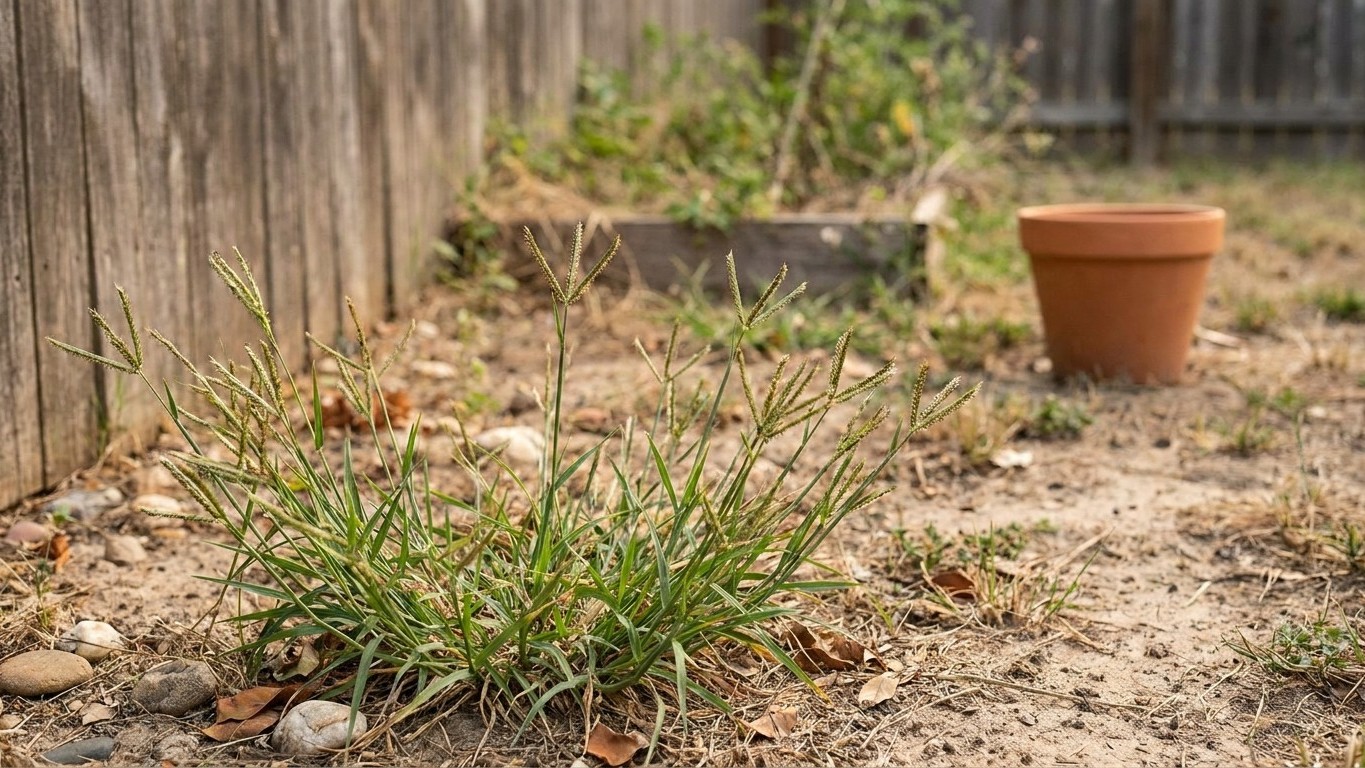

That wishbone seed stalk poking up a day after mowing is the first sign bahiagrass isn’t behaving like the lawn you pictured. You planted it for the poor soil and the summers with no hose in sight, not for a tight, carpet-like sod — and it was never built to give you one. Bahiagrass spreads in loose clumps from short rhizomes, trading density for the drought toughness that made it worth choosing over anything greener and thirstier.
What Bahiagrass actually is

Bahiagrass is a warm-season grass, according to Clemson Cooperative Extension’s HGIC 1214 grass selection guide. That single fact decides its whole calendar: it greens up as soil warms in spring, grows hardest through the heat of summer, and goes dormant and straw-brown at the first hard frost. A cool-season lawn such as tall fescue runs the opposite calendar, growing through fall and spring and struggling in the same summer heat bahiagrass thrives on. Mixing up those two calendars is the most common mistake in choosing or renovating a Southern lawn.
You can pick bahiagrass out of an existing lawn by its coarse, open blades and its seed stalk, a tall stem that forks into two narrow spikes, often described as a V or a wishbone, rising well above the mowed turf within a day or two of cutting. The turf grows in a loose, clumping habit from short rhizomes rather than the tight sod other grasses form, so it never packs as dense underfoot. Clemson Cooperative Extension rates its drought tolerance excellent, its wear tolerance good, its shade tolerance poor, and its cold hardiness poor. Those four ratings decide whether it belongs in your yard, and each one looks different on the ground.
Where it works, and where it fails
Clemson Cooperative Extension places bahiagrass in the lower South, and the climate figures behind that line explain why. In warm, humid states with long stretches of heat and winters that rarely freeze hard, bahiagrass holds a lawn together on rainfall alone. Push it north into a state with a cold, hard winter, and it thins, then dies out in patches, because its rhizomes cannot survive prolonged freezing.
| State | Days at 90°F or more | Coldest month average low | Bahiagrass fit |
|---|---|---|---|
| Texas | 102 | 43°F | First choice |
| Florida | 73 | 41°F | First choice |
| Mississippi | 71 | 35°F | First choice |
| Louisiana | 71 | 45°F | First choice |
| Arkansas | 69 | 31°F | First choice, cooler edge |
| Alabama | 58 | 32°F | First choice |
| South Carolina | 55 | 38°F | First choice |
| Oklahoma | 71 | 29°F | Transition, compromise |
| Tennessee | 40 | 28°F | Transition, compromise |
| Kentucky | 37 | 27°F | Transition, compromise |
| Nebraska | 28 | 14°F | Will not hold |
| Iowa | 18 | 14°F | Will not hold |
| Delaware | 18 | 25°F | Will not hold |
| West Virginia | 16 | 26°F | Will not hold |
| Ohio | 15 | 23°F | Will not hold |
| Indiana | 15 | 20°F | Will not hold |
In Texas, Florida, Mississippi, Louisiana, Alabama and South Carolina, the figures line up: enough summer heat to keep bahiagrass growing hard, and a coldest month that rarely drops far below freezing. These are the states where bahiagrass earns its reputation as the lawn you can walk away from for a summer and still have a lawn when you get back. Arkansas sits at the cooler edge of that group. A coldest-month average low of 31°F is close enough to the freeze line that a hard winter will burn back more top growth there than it does further south.
Move into Oklahoma, Tennessee or Kentucky and bahiagrass becomes a compromise rather than a first choice. These transition-zone states get real summer heat but also real winter cold, and no single grass excels there. Bahiagrass can hold on, but expect more winterkill in a hard year than a Deep South lawn ever sees. A grower in this band might weigh it against the same heat-versus-cold trade covered in Bermudagrass: Takes the Traffic, Refuses the Shade and Zoysiagrass: Shade and Cold Both, and Slow to Establish.
Further north, in Nebraska, Iowa, Delaware, West Virginia, Ohio or Indiana, the numbers rule bahiagrass out entirely. Coldest-month lows in the teens and low twenties Fahrenheit kill it outright rather than simply browning it for winter. A lawn in any of these states needs a cool-season grass instead, such as Kentucky bluegrass or tall fescue, seeded on the opposite calendar bahiagrass runs on. For the full range of warm-season and cool-season options, and how to tell which half of the calendar you’re working with, Grass Types lays out the rest of the field.
Shade, drought, traffic: what it will take

Clemson Cooperative Extension rates bahiagrass drought tolerance excellent, and in practice that means a lawn that stays green longer through a normal Southern dry spell without supplemental watering, on the strength of a root system that runs deeper than most other lawn grasses manage. That’s the whole reason it got planted along highway medians and pasture edges across the lower South in the first place. It was selected for sandy, low-fertility soil that holds almost no water, and it does the job on rainfall alone.
Shade tolerance is rated poor by the same source, and on the ground that means a stand of bahiagrass thins out fast under a mature oak or along a fence line shaded most of the day. Where bermudagrass at least struggles along in part shade, bahiagrass tends to give up sooner, opening bare soil that then fills with weeds rather than more turf. If your yard has real shade for a good part of the day, this is not the grass to fight that fight with.
Wear and winter
Wear tolerance is rated good, which plays out as a lawn that can take a swing set, a badminton net and a dog running the fence line without turning to dirt, though not at the level of a grass bred for foot traffic first. Cold hardiness is rated poor, and that is the rating that draws the map above: a hard freeze doesn’t just brown the top growth the way an ordinary winter dormancy would, it can kill the crown outright if the cold is severe or sustained enough. That is why bahiagrass stays confined to the lower South rather than pushing into the transition zone with any confidence.
A bahiagrass lawn goes straw-brown after the first hard frost, and that browning is normal dormancy, not death. The grass is warm-season, so it shuts down growth and pulls color out of the leaf, the same way a cool-season grass would go dormant and brown in a summer drought instead. Green returns on its own once the soil warms back up in spring. The distinction matters because a homeowner who reseeds or resods a merely dormant lawn in late winter is spending money on a lawn that was never dead.
Seeding or sodding it
Bahiagrass is established by seed or sod, according to Clemson Cooperative Extension’s HGIC 1214 grass selection guide, and the choice between them is really a choice between time and money. Sod gives you a finished lawn in a weekend, at several times the cost per square foot of seed. Seed costs far less up front but needs a full growing season, sometimes two, to close in completely, and bare soil between plants stays open ground for weeds during that time.
Timing the sowing
Warm-season grasses, bahiagrass among them, go into the ground around May, while cool-season grasses are sown in mid to late September instead, according to Clemson Cooperative Extension’s HGIC 1203 planting guide. That six-month gap is not a minor scheduling detail. Sow a warm-season grass on a cool-season calendar and it sits in cold soil without germinating, or germinates too late to establish before its own dormancy sets in. If you are converting an existing cool-season lawn to bahiagrass, or filling bare patches in one already established, the spring window is the one to work toward.
Seed should be worked into bare, loosened soil rather than scattered on top of existing turf or thatch, since bahiagrass seed needs firm soil contact to germinate reliably, and its hard seed coat already makes germination slower and less even than most other lawn grasses. Keep the seedbed consistently damp, not soaked, until seedlings are up and growing, and expect the stand to look thin and uneven through its first summer even when it is establishing correctly. Sod skips all of that uncertainty by rooting an already-mature grass directly into your soil, which is why it is the choice for anyone who needs a finished lawn immediately rather than one that can afford to fill in over a season.
Mowing and keeping it

Clemson Cooperative Extension puts the mowing height for bahiagrass at 3 to 4 inches, taller than most other warm-season lawn grasses are cut. That height matters: cut bahiagrass shorter and you expose the crown of a grass that already grows in an open, clumping habit rather than a tight sod, and bare soil shows through between plants. The taller cut also shades out the low weeds that move into the gaps a thin stand leaves behind.
The one-third rule still applies here the same as it does to every other lawn grass: never remove more than a third of the blade length in a single mowing. Let a bahiagrass lawn grow to 5 or 6 inches before cutting it back to 4, rather than letting it get away to 8 inches and scalping it back down in one pass, which stresses the crown and can open the same bare patches poor mowing and shade cause on their own.
What surprises new growers
- The seed stalk shoots up its forked head within a day or two of mowing, all through the growing season, so a bahiagrass lawn never looks as uniformly clipped as bermudagrass right after cutting.
- The rhizomes spread outward into bare soil, gravel drives and unedged garden beds faster than most homeowners expect, so an unedged bed border will have runners in the mulch by midsummer.
- Thatch builds up more slowly than in denser grasses, since the same open habit that hurts its looks also keeps organic matter from piling up at the soil surface.
Dethatching a bahiagrass lawn on the same schedule as a bermudagrass one is usually unnecessary. Check for a spongy feel underfoot before assuming the job needs doing at all, and reserve the effort for the mowing height, the edging and the patience to let a thin first-year stand fill in on its own timeline.
Common questions
Will bahiagrass fill in bare spots on its own?
Slowly, yes. Its rhizomes spread outward and will eventually close small bare patches without reseeding, but because the growth habit is open and clumping rather than a tight sod, fill-in takes longer than it would with a denser grass, often a full growing season for anything larger than a few inches across.
Can I overseed bahiagrass with ryegrass for winter color?
You can, but weigh it against the reason bahiagrass got planted in the first place: it was chosen for low input. Overseeding adds a second grass with its own watering and mowing needs through the very months bahiagrass would otherwise spend resting. Many lower-South lawns skip it and accept the winter brown.
Why does my bahiagrass lawn look ragged even when it’s healthy?
That’s the growth habit, not a problem. Bahiagrass grows in an open, clumping pattern rather than the dense sod of bermudagrass or zoysiagrass, and its forked seed stalks shoot up between mowings all season, which gives even a well-kept lawn a rougher look than a tighter-growing grass would.
Is bahiagrass the same thing as pasture grass?
It’s the same species used for cattle forage across much of the lower South, which is part of why it tolerates poor, sandy soil and low fertility so well as a lawn grass. Lawn-grade seed is usually a finer-bladed selection than pasture-grade seed, so check the bag label rather than assuming any bahiagrass seed is equivalent.