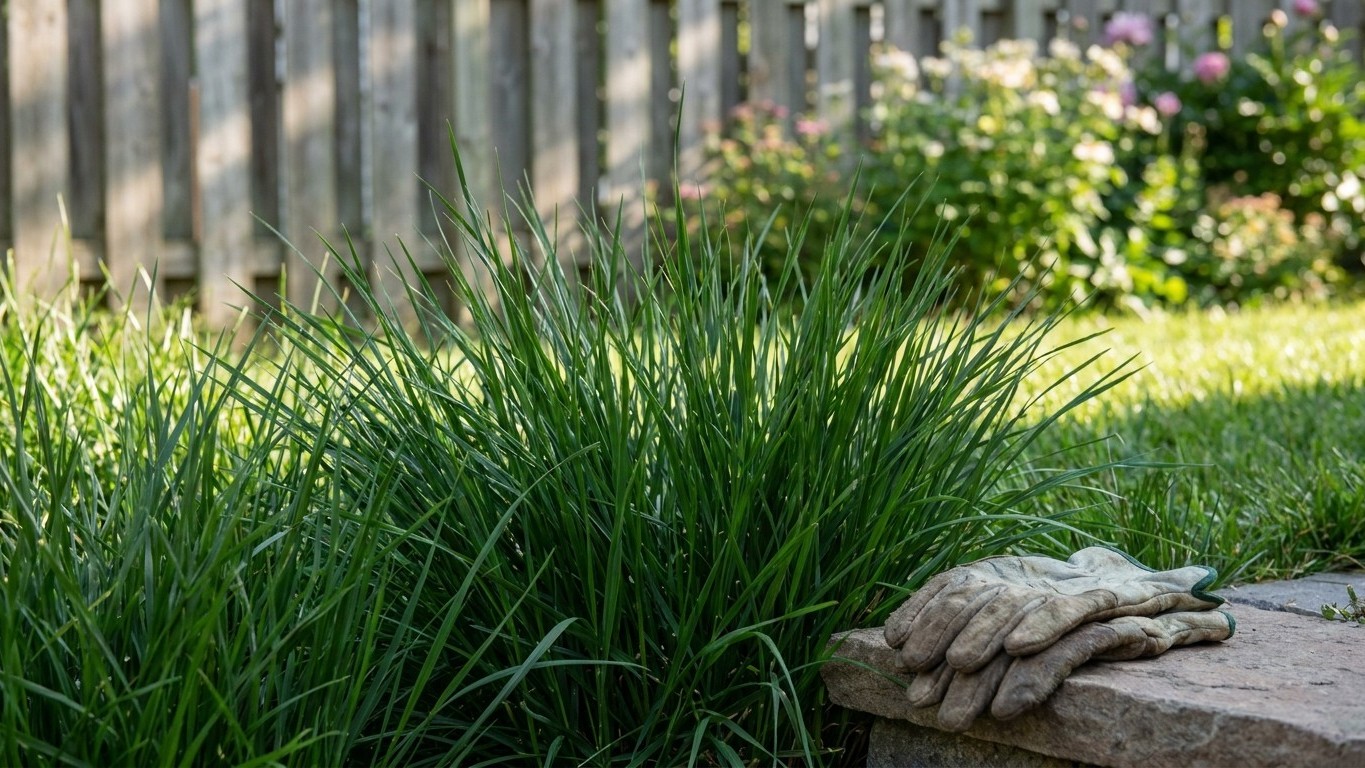

Tall fescue planted on a hot, low-elevation lot in the South typically thins during summer, and crabgrass and other weeds move into the gaps. In the upper Piedmont and mountains of the Southeast it can remain green all year. Whether it holds depends on where you live, so check your state against the three groups below, and in the Southeast check your elevation, before you buy a bag of seed.
What Tall Fescue actually is

University of Georgia Extension lists tall fescue in its table of cool-season turfgrasses (Lawns in Georgia: Selection and Species). The same publication says cool-season grasses grow well during the cool months of spring and fall, when temperatures average 60 to 75 °F, and may become stressed, dormant, or injured during the hot months of summer. A cool-season grass does its growing in the half of the year that a warm-season grass spends resting, and the reverse.
How it grows
Virginia Cooperative Extension says tall fescue is managed as a bunch (clump) grass, although some of the latest cultivars are touted for their rhizomatous (below-ground stem) growth habit. University of Georgia Extension gives the same picture in its own words. It calls tall fescue a bunching, generally bunch-type grass, but adds that it is botanically considered weakly rhizomatous. Either way, plan on a lawn made of clumps rather than a creeping mat.
Virginia Cooperative Extension says the seed germinates quickly, in 10 to 14 days, and that sod is readily available around Virginia. It also notes that tall fescue has the deepest root system of the cool-season grasses. University of Georgia Extension’s Table 1 rates its establishment rate as fast. For sun, Virginia Cooperative Extension says it performs best in full sun to moderate shade.
What sets it apart in summer
Here is our own arithmetic on one table. In University of Georgia Extension’s Table 1, the tall fescue column has the highest heat-hardiness rating of the five cool-season columns. It reads Very Good to Good, against Good to Fair for the ryegrasses and Fair to Poor for the fine fescues, Kentucky bluegrass and rough bluegrass. That is a comparison inside one table, for Georgia lawns, and not a promise about your yard. The same publication adds that although the canopy may thin in summer, tall fescue can remain green all year.
Where it works, and where it fails
The figures below are NOAA’s 1991-2020 climate normals, taken at each state’s reference city. A state is not a zone, so the far ends of a large state can sit in the neighboring group. The grouping into first choice, transition and will-not-hold is The Homestead Post’s own reading of those numbers, not a ruling by any extension service.
| Group | State | Days at 90F or more | Coldest-month average low |
|---|---|---|---|
| First choice | Michigan | 10 | 19F |
| First choice | Minnesota | 11 | 9F |
| First choice | North Dakota | 12 | 0F |
| First choice | Ohio | 15 | 22F |
| First choice | Nebraska | 28 | 15F |
| Transition | Kentucky | 37 | 28F |
| Transition | Tennessee | 40 | 30F |
| Transition | Kansas | 58 | 22F |
| Transition | Oklahoma | 71 | 27F |
| Will not hold | Louisiana | 71 | 46F |
| Will not hold | Florida | 73 | 43F |
| Will not hold | Texas | 102 | 44F |
| Will not hold | Arizona | 169 | 45F |
First choice
The other first-choice states are Iowa, Delaware, West Virginia, Indiana, Illinois, South Dakota, New Hampshire and Wyoming. Counting all fourteen, NOAA’s normals put the reference cities at 10 to 28 days of 90F or more, and only Nebraska goes above 18. These are the states where summer heat is short enough that a cool-season grass is working with the climate. For the wider field of choices, see our overview of grass types.
Transition
Utah, Idaho, New Mexico and Colorado join Kentucky, Tennessee, Kansas and Oklahoma here. NOAA’s normals give these reference cities 37 to 71 days at 90F or more. In this band tall fescue is a compromise and no grass excels.
Will not hold
Arizona, Nevada, Texas, Florida, Mississippi and Louisiana fall here, with the reference cities running from 71 to 169 days at 90F or more. A warm-season grass is the choice in these states. Bermudagrass, bahiagrass and carpetgrass are warm-season pages on this site. Swapping means swapping seasons too, because warm-season grasses grow in the opposite half of the year and are planted then.
The Southeast, by elevation
Clemson Cooperative Extension (HGIC 1214) says heat stress eliminates most cool-season grasses as permanent southern lawns, with the exception of tall fescue in the upper Piedmont and Mountain regions, above 800 ft elevation. At lower elevations, Clemson says fescue typically thins during summer, letting crabgrass and other weeds invade. It also says to expect summer disease problems, especially brown patch, and to plan to re-seed periodically during the fall. University of Georgia Extension calls tall fescue best adapted to Georgia’s Piedmont and puts its southern boundary at Griffin, Georgia. NC State Extension says it is best adapted to the North Carolina mountains and piedmont, and will not perform well in full sun in the coastal plain, especially on sandy soil.
Shade, drought, traffic: what it will take

The two published tables
Two extension tables rate this grass, and they do not always agree. University of Georgia Extension’s Table 1 (cool-season turfgrasses for Georgia lawns) uses its ‘Tall Fescues’ column. Clemson Cooperative Extension’s HGIC 1214, Selecting a Lawn Grass, uses its ‘Tall Fescue’ column, which covers the Piedmont and mountains of South Carolina only. Another state’s extension may rate the same grass differently again.
| Quality | University of Georgia Extension, Table 1 | Clemson, HGIC 1214 |
|---|---|---|
| Shade tolerance | Good | Good |
| Drought | Good (drought resistance) | Fair (drought tolerance) |
| Wear tolerance | Good | Fair |
| Cold | Very good (cold hardiness) | Good (cold tolerance) |
Drought and wear are where the tables split. University of Georgia Extension says good for both, the rating you would apply to a dry stretch in July or a well-trodden path to the back door. Clemson says fair for both. Shade matches at good in both tables, the rating that covers a lawn under a tree. Cold is very good in Georgia’s table and good in Clemson’s.
What other lines add
Heat comes from University of Georgia Extension alone: very good to good, with the note that the canopy may thin in summer. Its table also rates establishment as fast. On sun and shade, Virginia Cooperative Extension says tall fescue performs best in full sun to moderate shade. NC State Extension says it thrives in sun or medium shade in the North Carolina mountains and piedmont. Clemson’s caution is narrower. Fescue provides year-round green color if watered during summer, but will not withstand open, sunny conditions for long periods at elevations below about 800 ft unless the site is slightly shaded or on a north- or northeast-facing slope.
On drought, NC State Extension says tall fescue may turn brown but often survives short periods of drought. Under certain circumstances some may be lost if a drought exceeds three weeks, so it advises irrigating during drought if possible. Brown does not always mean dead.
Seeding or sodding it
Seed or sod
University of Georgia Extension’s Table 1 lists tall fescue as established by seed or sod, and marks the column ‘Can be seeded’. NC State Extension calls it easily started from seed. Virginia Cooperative Extension says seed germinates quickly, in 10 to 14 days, and that sod is readily available around Virginia. If you choose sod, our page on laying sod covers the work. Soil preparation has its own page: soil testing.
Seeding rate by source
The range that covers the sources is 6 to 8 lb per 1,000 square feet for a new lawn. Each gives its own figure:
- Penn State Extension (Lawn Establishment): 6 to 8 lb per 1,000 square feet.
- University of Maryland Extension: 6 to 8 lb per 1,000 square feet.
- NC State Extension (Extension Gardener Handbook): 6 lb per 1,000 square feet.
When to sow
Virginia Cooperative Extension says that for cool-season grasses, spring establishment is possible but fall is the preferred time for planting. That fits the calendar from University of Georgia Extension, which puts cool-season growth in the cool months of spring and fall at 60 to 75 °F average temperatures.
Fall seeding is not a one-time job in the warmer margins. Clemson says to plan to re-seed periodically during the fall where fescue thins at lower elevations, and University of Georgia Extension says established tall fescue lawns tend to thin and become clumpy and may need periodic reseeding every few years.
Mowing and keeping it

Mowing height by source
The range that covers the sources is 2 to 4 inches, and each source gives its own figure.
| Source | Mowing height | Note |
|---|---|---|
| Clemson Cooperative Extension (HGIC 1214) | 2.5 to 3.5 inches | South Carolina |
| NC State Extension (Extension Gardener Handbook) | 2.5 to 3.5 inches | Best at 3.5, never shorter than 2.5 |
| University of Illinois Extension | 2.5 to 3.5 inches | |
| University of Missouri Extension | 3 to 4 inches | |
| University of Georgia Extension | 2 to 3 inches | |
| Virginia Cooperative Extension | 2 to 3 inches |
NC State Extension says to cut often enough that less than one-third of the total leaf surface is removed. University of Illinois Extension puts it as no more than one-third of the leaf blade removed in any one cutting. Both agree on the one-third rule, whichever height your state uses.
What the grass asks of you
Because it is a bunch grass, NC State Extension says damaged or bare areas need to be re-seeded. The grass will not creep in from the edges to fill them. University of Georgia Extension says the same thing in its note on thinning, clumpy lawns that need reseeding every few years.
Brown patch is the disease to know. Penn State Extension (Turfgrass Diseases: Brown Patch) names perennial ryegrass, creeping and colonial bentgrasses, and tall fescue as particularly susceptible, whereas Kentucky bluegrass and the fine fescues are less likely to develop symptoms. Clemson flags brown patch as a summer problem at lower elevations. Our page on what goes wrong with lawns covers the wider list of troubles to look for. In dry spells, NC State Extension says to irrigate during drought if possible, as some tall fescue may be lost past three weeks.
Common questions
Will tall fescue stay green all summer?
It can, but the canopy may thin. University of Georgia Extension says tall fescue can remain green all year although the canopy may thin in summer. Clemson says it provides year-round green color if watered during summer. At lower elevations, Clemson says it typically thins in summer and lets crabgrass and other weeds in.
Can I grow tall fescue in Florida or Texas?
Our reading of NOAA’s 1991-2020 normals puts both in the will-not-hold group. The reference city in Florida logs 73 days at 90F or more with a coldest-month average low of 43F, and Texas logs 102 days with a low of 44F. A warm-season grass is the choice in both states. Check with your state’s extension office for a locally adapted pick.
Why is my tall fescue lawn clumpy with bare patches?
That is how a bunch grass ages. University of Georgia Extension says established tall fescue lawns tend to thin and become clumpy, and may need reseeding every few years. NC State Extension says damaged or bare areas need to be re-seeded because it is a bunch-type grass.
My tall fescue turned brown in a dry spell. Is it dead?
Not necessarily. NC State Extension says tall fescue may turn brown but often survives short periods of drought. It also says some may be lost if a drought exceeds three weeks, and advises irrigating during drought if possible. Re-seed any patches that do not recover, preferably in fall, which Virginia Cooperative Extension gives as the preferred planting time for cool-season grasses.