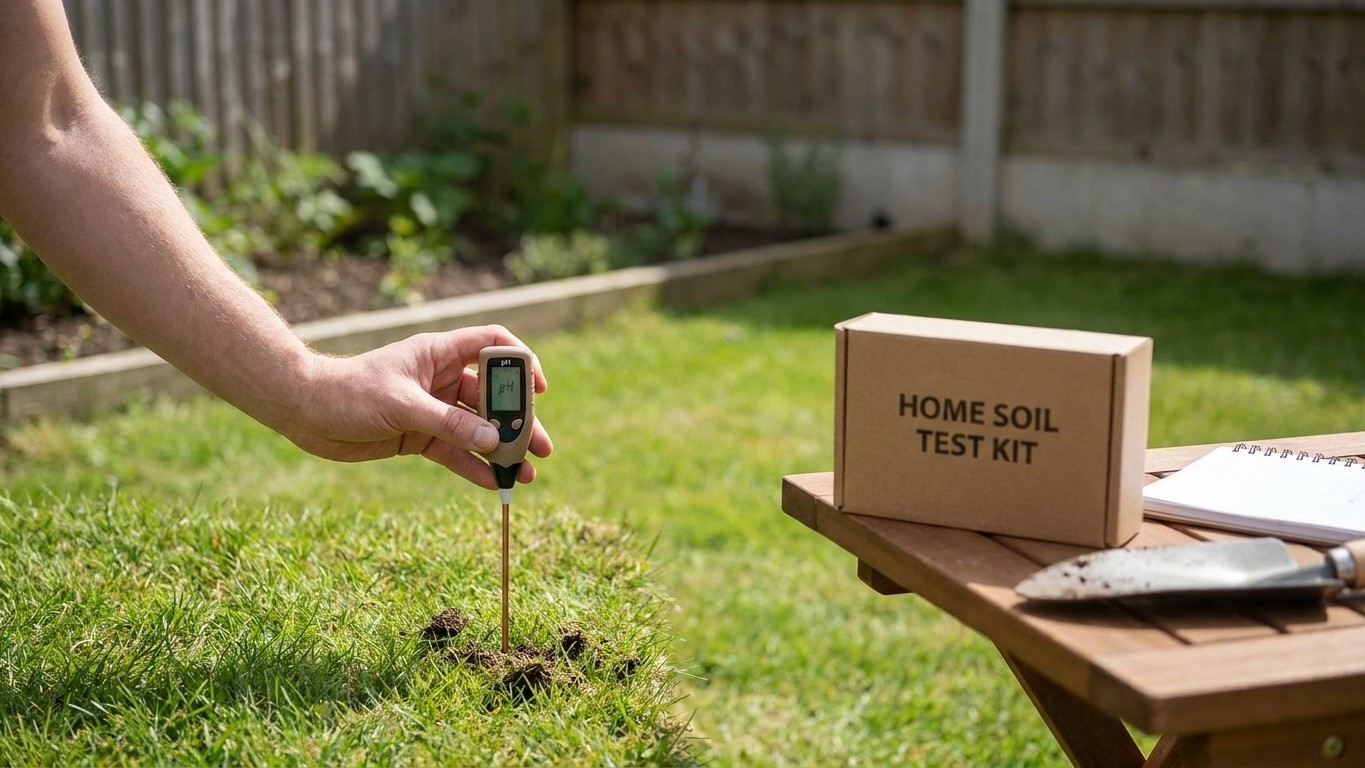

Your lawn‘s next bag of lime or fertilizer should be decided by a soil test, not a guess, because the wrong pH can lock nutrients out of reach no matter how much you spread. A few dollars and a report telling you exactly what your soil has and lacks will save you from buying what it doesn’t need and missing what it does. Before you put anything on the lawn this season, pull a dozen small plugs of soil from around the yard, mix them together, and send that sample off to be tested.
Why this matters
Guessing at a lawn’s needs is expensive twice over. You buy lime the soil didn’t need, or fertilizer the grass couldn’t use because the pH locked the nutrients out of reach. Turf doesn’t show a nutrient problem the day you spread it. A pH mismatch or a phosphorus deficiency shows up as thin, pale turf weeks later, after the growing season has already moved on, and by then you’ve lost the window to fix it before dormancy.
The chemistry decides which fertilizer actually works. Nitrogen, phosphorus and potassium sit in the soil at whatever concentration is already there, and a bag of fertilizer just adds to that pile without correcting the pH that governs how much of it the roots can actually pull in. If the pH is off, you can pour on nitrogen at any rate and the grass will still look starved, because the real bottleneck was never nitrogen. A test is the only way to find that bottleneck before you spend money guessing at it.
The other cost is the lawn itself. Over-liming pushes pH too high for a cool-season lawn to hold onto iron and manganese, and that shows up as yellowing that looks like a nitrogen problem but isn’t. Correcting the wrong problem wastes a full season, because lime moves through soil slowly and a bad correction can’t be undone with a second bag. Testing first, before you touch the lawn with anything, is what keeps that year from being wasted. The page on Liming a Lawn: Only After the Test Says So covers exactly why the order matters.
When to do it
Test according to your grass’s growing season, not the calendar on the wall. Cool-season grasses, Kentucky bluegrass, perennial ryegrass, tall fescue and the fine fescues among them, do their growing in spring and fall and go semi-dormant in summer heat. Warm-season grasses, bermudagrass, zoysiagrass, St. Augustinegrass, centipedegrass, bahiagrass, carpetgrass and seashore paspalum, do the opposite: they grow through summer and go dormant, not dead, once the ground cools. If you’re not sure which group your lawn falls into, the breakdown in Lawn Grass Types: Cool-Season and Warm-Season Compared sorts by mowing height and the traits that follow from each.
A soil sample makes sense any time the ground isn’t frozen or waterlogged, but the result is most useful pulled a season ahead of the work you plan to do with it. Test before the grass enters its main growing period, so the lab report is back in hand before you’d normally lime or fertilize anyway. For a cool-season lawn that means testing ahead of the spring or fall growth flush. For a warm-season lawn it means testing ahead of the summer growing season, while the grass is still shaking off dormancy.
Avoid testing right after you’ve already put down lime or fertilizer. Both linger in the top layer of soil for a while and will skew the reading toward whatever you just applied, which defeats the point of testing in the first place. If you’ve already limed this year, wait for that application to work through the soil before pulling a new sample. The maintenance calendars for centipedegrass, bermudagrass, zoysiagrass, St. Augustinegrass and tall fescue, published by HGIC, lay out a full season of tasks in order if you want to see where testing fits against everything else on the calendar.
How to do it

Pulling the sample
Pull the sample correctly and the rest of the test takes care of itself. Use a soil probe, a bulb planter or a clean spade, and take slices from a dozen or more spots scattered across the lawn, not just the spot that looks worst. Avoid the edges next to concrete, dog run areas, and any spot fertilized or limed recently, since those readings won’t represent the lawn as a whole.
- Pull 10 to 15 plugs from different areas of the same lawn
- Keep depth consistent, down to where the turf roots feed, on every plug
- Break up clay clumps and remove any grass, thatch or stones from each plug
- Mix all the plugs together in a clean plastic bucket, never a metal one
- Fill the sample box or bag from your state’s extension lab with the mixed soil, not from a single plug
Label the sample as lawn, not garden bed or crop, when you send it in. The lab uses a different calibration for turf than for vegetable soil, and a mislabeled sample comes back with a recommendation aimed at the wrong crop.
Reading the report
The report that comes back gives you a pH reading, plus levels of phosphorus, potassium and other nutrients, and it converts those numbers into an actual recommendation: how many pounds of lime or fertilizer per 1,000 square feet your specific soil needs, not a generic label rate. That’s the number that matters, because a bag rate on the shelf is calculated for an average lawn, and your lawn’s test result might call for twice that or none at all. Clemson’s HGIC 1201, Fertilizing Lawns, walks through how to read a nitrogen recommendation once you have it, and the liming page above does the same for a pH recommendation.
Mow before you sample, at whatever height your grass normally runs, so the probe doesn’t drag through unusually long or unusually short turf and skew the depth of each plug. Kentucky bluegrass and perennial ryegrass run 2 to 3 inches, tall fescue and the fine fescues run 2.5 to 3.5 inches, all per Penn State Extension. On the warm-season side, per Clemson’s HGIC 1214, bermudagrass and zoysiagrass are mowed as low as 0.75 inches, while St. Augustinegrass and bahiagrass are left as tall as 4 inches. None of that changes the test result, but a lawn mowed at its normal height is easier to sample evenly.
Once you have the report, apply only what it recommends, in the season that matches your grass’s growing period, and hold onto the paper copy. It’s the baseline you’ll compare against the next time you test.
What goes wrong
The most common mistake is treating a dormant lawn like a dead one. A cool-season lawn browning in summer heat or a warm-season lawn browning after the first frost isn’t necessarily short on nutrients, it’s just shut down for the season, and a soil test pulled in that state can still be accurate, but any fertilizer applied on top of it will sit unused until growth resumes. Applying nitrogen to a dormant lawn doesn’t wake it up early. It just sits in the soil until the grass is ready to use it, or washes away before then.
The second failure is sampling too soon after an application. Lime and fertilizer both sit in the top inch or two of soil for a while before they distribute evenly, and a sample pulled a few weeks after spreading either one comes back skewed toward whatever you just put down. That tells you what you added, not what the soil actually holds, and it can send you into a second round of correction that was never needed.
The third is applying a full lime recommendation in one pass on a lawn that’s badly off. A large correction moves the pH slowly, over more than one season, and dumping it all on at once can overshoot in the other direction by the time it fully reacts. The tell that catches this in time is testing again after a season, before doing a second round, rather than assuming the first application didn’t work and adding more.
The fourth is skipping the shaded or high-traffic parts of the lawn when sampling, then applying a single blanket recommendation to a lawn that actually has two or three different soil profiles under one roof. Damage from that shows up as one section of lawn thriving while another stays thin, usually visible by the next full growing season.
How this changes across the country
A cool-season lawn in Pennsylvania and a warm-season lawn in South Carolina are tested and treated on opposite clocks, because their growing seasons don’t overlap. Penn State Extension’s guidance for Kentucky bluegrass, perennial ryegrass, tall fescue and the fine fescues assumes a lawn that grows through spring and fall and rests in summer. Clemson Cooperative Extension’s HGIC 1214 covers a warm-season lineup, bermudagrass, zoysiagrass, St. Augustinegrass, centipedegrass, bahiagrass, carpetgrass and seashore paspalum, all of which grow through summer heat and go dormant once temperatures drop. Test and treat on whichever clock your grass runs, not the one your neighbor across a state line follows.
| Grass | Season | Mowing height | Drought tolerance |
|---|---|---|---|
| Kentucky Bluegrass | Cool-season | 2 to 3 in | Fair |
| Tall Fescue | Cool-season | 2.5 to 3.5 in | Fair |
| Bermudagrass | Warm-season | 0.75 to 1.5 in | Excellent |
| Zoysiagrass | Warm-season | 0.75 to 2 in | Good |
| St. Augustinegrass | Warm-season | 2.5 to 4 in | Good |
The transition zone, the band of states like Tennessee, North Carolina and Virginia where summers run hot enough to stress a cool-season lawn but winters run cold enough to stress a warm-season one, is where soil testing carries the most weight. Neither a purely cool-season nor a purely warm-season answer holds for a full year in that zone, and tall fescue, the cool-season grass Clemson’s HGIC 1214 still lists for the region, is often the compromise choice specifically because it tolerates that swing better than the others on the list. A test result doesn’t change with the zone: the pH and nutrient numbers mean the same thing everywhere. What changes is the season you act on them, so read your report against your own grass’s growing calendar, not a date on a bag.
Common questions
How much soil do I actually need to send in?
Fill the container your state extension lab sends or sells for soil testing to the line marked on it. The exact volume varies by lab, so follow the instructions printed on the kit rather than guessing at a scoop count.
Will a soil test tell me if I have grubs or a fungus problem?
No. A soil test measures chemistry, pH and nutrient levels, not pests or disease. A thinning patch caused by grubs or a fungal disease can sit right next to a spot with perfectly good soil chemistry, so a test that comes back clean doesn’t rule out either problem.
How long does it take to get results back?
It depends on the lab and the time of year. Spring is the busiest season for most extension soil labs, since that’s when most homeowners test, so a sample sent in then can take longer to turn around than one sent in during a quieter month. Check directly with your state’s extension office for their current turnaround.
Can I just use a cheap pH probe from the hardware store instead?
You can, but it won’t tell you as much. A hardware store probe gives a rough pH reading at best, and most are notoriously inconsistent between uses. A lab test also reports phosphorus, potassium and other nutrient levels the probe can’t measure at all, and those numbers are what the lime or fertilizer recommendation is actually built on.