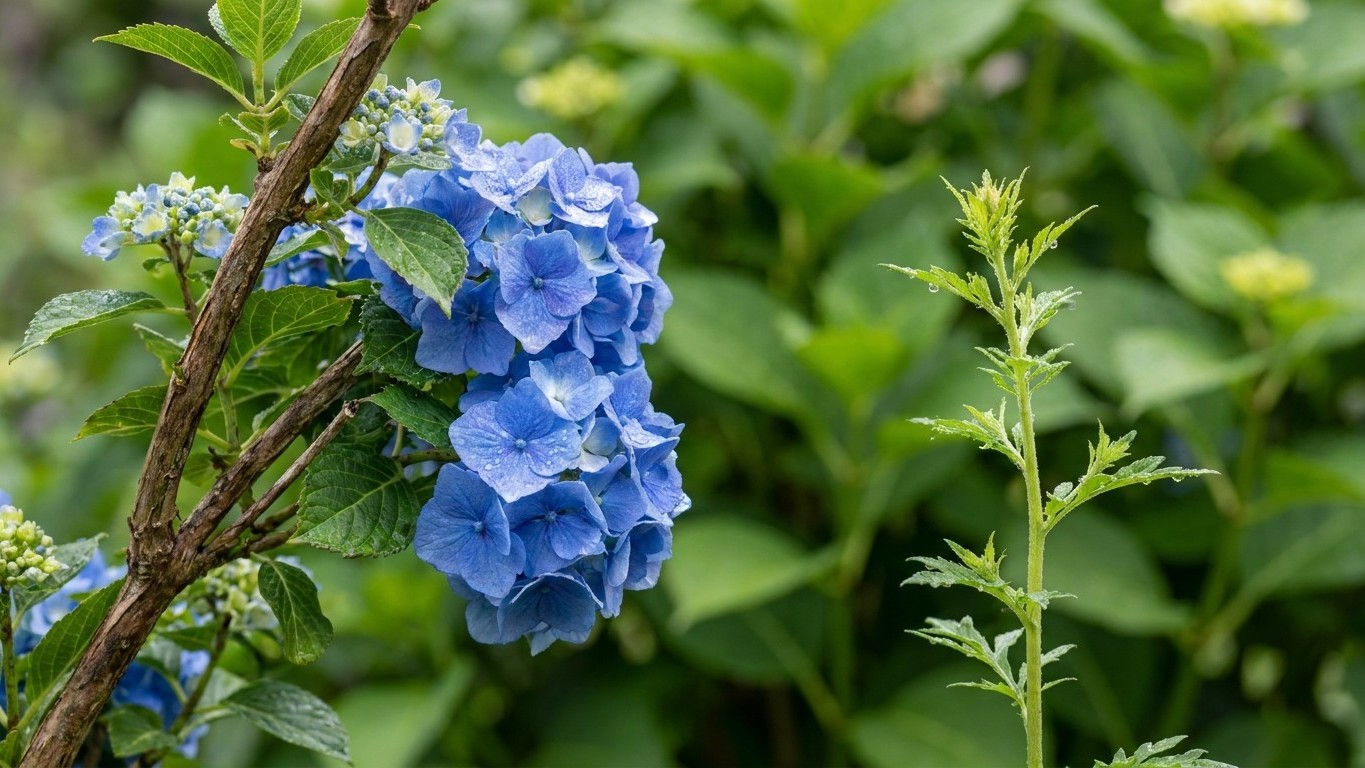

Pink hydrangeas in a Maine yard usually mean the roots can’t take up aluminum. The soil sits too close to neutral, or it has been sweetened by lime, wood ash, or concrete runoff. Blue comes from acidic soil, a low-phosphorus fertilizer, and patience. Only bigleaf and mountain hydrangeas respond at all, and a color shift often takes a full growing season. Here is how the chemistry works and how to move it.
What this comes down to in Maine

Hydrangea color is a soil-pH question, and the working window for changing it is the growing season between the last spring frost and the first fall frost. At Portland, the reference station for these dates, the last spring frost falls between April 22 and May 1, and the first fall frost between October 9 and October 21. Coastal Portland is the mild end of Maine, so inland and northern gardens get a shorter stretch and should start later.
Why does soil pH change hydrangea color?
The pigment in bigleaf hydrangea sepals (the showy “petals”) is naturally reddish-pink. When aluminum is available, the plant draws it up through the roots and it binds to the pigment, shifting the color to blue. Aluminum is abundant in most soils. The catch is that it dissolves only when the soil is acidic. As pH climbs toward neutral, aluminum locks into forms the roots cannot absorb, and the flowers stay pink.
| Soil pH | Typical flower color | What is happening |
|---|---|---|
| About 5.5 or lower | Blue | Aluminum dissolves and the plant takes it up |
| Roughly 5.5 to 6.5 | Purple, or blue and pink on one plant | Partial uptake, often uneven between blooms |
| About 6.5 or higher | Pink to red | Aluminum is locked in the soil |
Phosphorus adds a second push toward pink. A fertilizer high in phosphorus (the middle number on the bag) ties up aluminum, so a lawn-style or all-purpose feed can undo careful acidifying work.
Why do Maine yards so often end up pink?
Native soil varies a lot from one lot to the next, and the pink usually traces back to something added. Lawns in Maine are often limed to counter acidic ground, and that lime migrates into neighboring beds. Wood stoves are common here, and wood ash is strongly alkaline, so ash scattered on a garden raises pH quickly. A concrete foundation leaches lime into the soil beside it for decades, which is why a hydrangea against the house may be pink while one ten feet out is purple.
Nursery plants add another wrinkle. A hydrangea bought in bloom was grown in a potting mix whose pH was set for the grower’s needs, so the flower color it arrives with says little about your yard. Expect the next year’s blooms to reflect your soil instead.
Which hydrangeas can actually turn blue?
Bigleaf (Hydrangea macrophylla) and mountain (Hydrangea serrata) types respond to pH. Panicle, smooth, and oakleaf hydrangeas do not, and white hydrangeas of any kind stay white. Some deep red bigleaf cultivars have limited blue potential and turn a muddy purple instead. For the general picture of choosing and caring for these shrubs, see growing hydrangeas in Maine.
Working it out for your own garden
The method has four steps: read the plant, test the soil, choose a target pH, then amend and retest. It works the same in a warm year or a cold one, and it works after a move to a different yard.
How do you test the soil before changing anything?
Start with what the flowers already tell you. Pink means pH is likely above about 6.5. Purple means you are near the middle. Then confirm with a soil test, because guessing at amendments is how roots get damaged. Dig a few small samples from 4 to 6 inches deep, just beyond the drip line where the feeder roots are active, and mix them. A home kit gives a rough pH reading. For a more reliable number, your University of Maine Cooperative Extension office can explain how to submit a sample for lab analysis.
If the reading is above 6.5, you have a real gap to close. If it is already near 5.5 and the flowers are still pink, the cause is probably phosphorus or a cultivar with little blue potential, not pH.
How do you lower pH step by step?
Two products do most of the work. Aluminum sulfate acts fast, because it lowers pH and supplies aluminum at the same time, but it can burn roots if overapplied. Elemental sulfur is gentler and slower, since soil bacteria must convert it, so it needs months to take effect. Gardeners with a pink bed and a lot of patience often use sulfur in spring and add aluminum sulfate only if the color lags. Follow the label rate on whatever you buy, apply to soil that is already moist, and water it in well.
Timing follows the frost window. Wait until the ground has thawed and shoots are leafing out, which at Portland means after the last frost range of April 22 to May 1, so roughly the first half of May there. Inland and northern gardens should shift that later. Repeat at the label’s interval through early summer, then stop. A late dose near the first fall frost range of October 9 to October 21 does nothing for blooms and can stress the plant going into winter.
Switch to a low-phosphorus, higher-potassium fertilizer at the same time. Pine needle mulch and coffee grounds are often recommended, but their effect on soil pH is small, so treat them as a bonus.
Judge the result on the following summer’s flowers, and sometimes the one after. Retest the soil each spring and adjust. If the bed keeps drifting back to pink, a large container filled with an acidic mix is a reliable fallback.
What changes across the state
Maine spans USDA hardiness zones 3b to 6a, a spread built on one variable, the average annual extreme minimum temperature. The coast and the islands sit at the warm end. The western mountains and the northern interior sit at the cold end. That gap changes the color question in two ways.
The first is timing. Near the coast, spring comes sooner and fall frost arrives later, so the season for treating soil is longer. Inland, and especially in the north, shoots leaf out later and frost returns earlier. Start the first application later there, and expect less time for repeat doses.
The second is whether the plant blooms at all. Bigleaf hydrangeas set flower buds on the previous year’s stems, and in the colder zones those stems often die back in winter. A gardener in the north can have perfect soil chemistry and still see only green leaves. Where winters are severe, a mulch or cage helps, as covered in Protecting Hydrangeas Through a Maine Winter. Reblooming bigleaf types also flower on new growth, which gives colder gardens a better chance of seeing color.
Soil and water differ across the state too. Bedrock, glacial deposits, and well water chemistry change from valley to valley, and some towns have hard water. Test each bed separately rather than assuming one reading covers the property.
The mistakes this state punishes

Feeding too early is a common one. A warm spell in March or early April makes the ground feel ready, but the frost window still runs to the end of April or beyond, and in cold soil the amendment sits unused while new buds break and get hit by a late freeze. Wait for steady leaf-out.
Scattering wood ash is another. Stove owners often spread ash on beds as a free fertilizer, and on a hydrangea it pushes pH up and the flowers pink. Compost it elsewhere or use it on plants that like sweeter soil.
Overdosing is the third. More aluminum sulfate does not turn flowers bluer faster, and heavy applications can scorch roots, especially in dry soil. Stay on the label rate and spread doses across the season.
Planting too close to a foundation causes slow trouble. Lime leaching from concrete keeps raising pH nearby, so a bed against the house needs repeated correction. Moving the shrub a few feet out often does more than any amendment.
Pruning also costs blooms. Cutting back bigleaf stems in fall or early spring removes the buds already formed, so the soil work pays off in nothing. Check When to Prune Hydrangeas in Maine before you reach for the shears. And remember that white hydrangeas, and panicle and smooth types, will not change color however much sulfur you use.
Checking this against your county
The Portland dates above are a starting point. Your own last frost may come a couple of weeks later, and your soil may be nothing like a coastal city lot. Your county office of University of Maine Cooperative Extension can tell you what frost timing and soil conditions look like locally and how to get a soil test done. For the broader basics of siting, watering, and care, go back to growing hydrangeas in Maine.
Common questions
How long does it take to turn a pink hydrangea blue?
Plan on at least one full growing season, and often two. Flowers already open will not change much, and the new color shows up in blooms that develop after the soil pH and aluminum uptake have shifted. Sulfur works slowest, aluminum sulfate somewhat faster.
Can I turn a white or panicle hydrangea blue?
No. White hydrangeas lack the pigment that reacts to aluminum, and panicle, smooth, and oakleaf types do not respond to soil pH. Only bigleaf and mountain hydrangeas change. Panicle blooms may blush pink on their own as they age in fall, but that comes from the plant and has nothing to do with the soil.
Is it bad for hydrangeas if I leave them pink?
No. Pink flowers are just as healthy as blue ones. Soil with a pH near neutral suits many other garden plants, so leaving it alone is a sensible choice if you have a mixed bed. Acidifying only makes sense if you want blue.
Can I switch a blue hydrangea back to pink?
Yes, by raising the soil pH with garden lime, usually dolomitic lime, applied at the label rate and watered in. Use a fertilizer higher in phosphorus too. The color shifts over a season or more, just as it does in the other direction, and a soil test keeps you from overshooting.