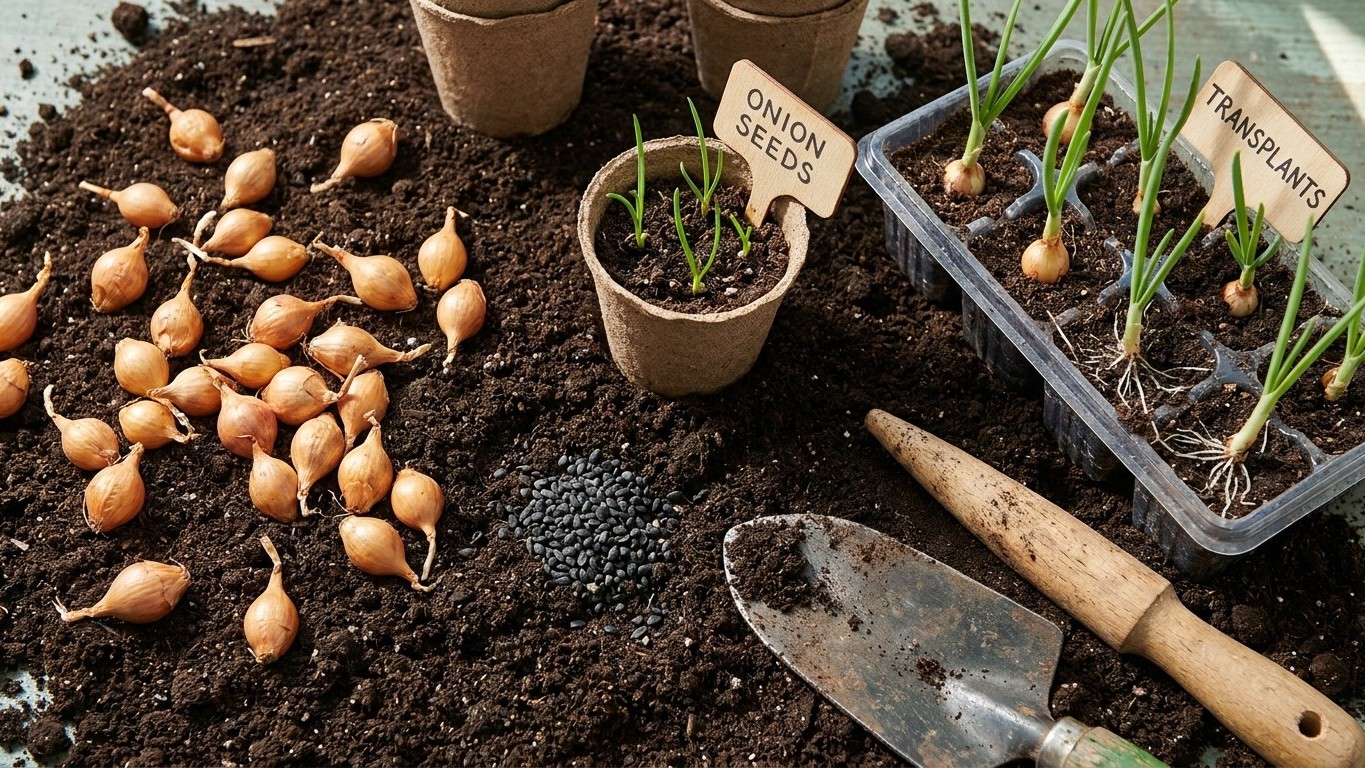

Three ways exist to start an onion this year, and they do not give the same result. Sets bolt more than seed does. Seed grows more slowly than transplants. Transplants cost more per bulb than either. Picking the right one for your garden means matching the method to what you actually want out of the crop, not just grabbing whatever’s stacked by the store entrance in March.
Onions from Seed, Sets or Plants

Sets are small bulbs held over from last year’s crop, sold dry and dormant, and they’re the easiest of the three to plant. Push one into the soil, root side down, and most of the work is done. That ease comes with a catch: a set has already lived through one cold season before you ever bought it. When it goes through another cold snap in early spring, the bulb reads that chill as a completed winter and responds the way a two-year-old onion would in the wild, by sending up a flower stalk instead of building a bulb. That’s the mechanism behind most bolting complaints gardeners bring to extension offices every spring. It’s not bad luck or a bad batch. It’s a bulb that’s already done its waiting.
Seed sidesteps that problem almost entirely, because a seedling has no chilled-bulb memory to trigger early flowering. Seed also opens up the full range of onion varieties, storage types, sweet types, colors, day-length categories, in a way sets never do, since set bins are usually limited to one or two common varieties. The tradeoff is time. Growing from seed means starting indoors under lights weeks before the last frost, then hardening off and transplanting, then waiting out a full season before harvest. It’s the slowest path from packet to plate.
Transplants, sold as bare-root bunches in early spring, split the difference. Someone else did the indoor seed-starting work, so you get a season’s head start without paying the chilled-bulb tax that sets carry. Variety choice is better than sets, though usually not as wide as full seed catalogs. Cost per plant runs higher than a packet of seed but the labor and the grow-light setup are somebody else’s problem.
One number matters no matter which path you choose: catalogue days-to-maturity figures are counted from transplant, not from the day seed goes into soil. A variety listed at a given number of days means that many days from the point a seedling, whether homegrown or bought as a bunch, goes into the garden bed. Gardeners starting from seed need to add the indoor growing period on top of that catalogue number when planning a harvest date, or the onions will come in weeks later than expected.
How to do it
- Decide what you’re optimizing for before you buy anything. If you want the earliest possible harvest and don’t mind higher bolting risk, sets win. If you want a specific variety or the lowest bolting risk, seed wins. If you want a head start without the bolting penalty, transplants win.
- If buying sets, sort them by size before planting. Bulbs larger than a dime are the ones most likely to bolt, since size signals the plant already stored enough energy to flower. Set those aside for green onions instead of bulb production, and plant only the smaller, dime-sized sets for storage bulbs.
- If starting from seed, count backward from your last frost date. Seed needs to go under lights indoors well before transplant time, so check your local extension office’s recommended indoor start window for your zone rather than guessing.
- If buying transplants, inspect the bunch before purchase. Look for firm white stems and roots that aren’t dried out or moldy. A bunch that’s been sitting too long at the store will have yellowing tops and mushy bases.
- Get everything into the ground as soon as soil can be worked. Onions of every type tolerate cold soil and light frost far better than heat, so early planting beats waiting for warm weather.
- Space and plant according to method. Sets go in root-down, tip barely covered. Transplants and homegrown seedlings go in a bit deeper, with roots straightened rather than balled up in the hole.
- Track your planting date against the catalogue days-to-maturity number. Since that count starts at transplant, mark your calendar from the day the plant actually goes into the bed, not the day you sowed seed indoors, so your harvest expectations line up with reality.
What goes wrong
- Bolting. A flower stalk shoots up from the center of the plant, usually on a set-grown onion, usually after a cold spell in early spring. Once you see the stalk, the bulb has stopped putting energy into growth and started putting it into seed production. Cut the stalk off as soon as it appears to slow the drain, and plan to harvest and use that onion soon rather than trying to store it, since bolted bulbs don’t keep well.
- Sets planted too large. The bulb splits or bolts because it was already carrying enough stored energy to flower. If you didn’t sort sets by size before planting and you’re now seeing splitting or early flower stalks, there’s no fix mid-season; pull and use those bulbs fresh, and sort by size next time before anything goes in the ground.
- Seedlings that never caught up. Homegrown seed starts that were sown too late, or under weak light, come out spindly and stay behind all season. If your seed-started onions look noticeably smaller than transplants planted the same week, they likely won’t close the gap. Harvest them as green onions instead of waiting for bulbs that may never size up.
- Transplants that wilted after planting. Bare-root bunches dry out fast between purchase and planting, and wilted transplants can go into shock. If leaves are limp a few days after planting, keep the soil consistently moist rather than letting it dry between waterings, and resist the urge to fertilize until new growth shows the plant has recovered.
- Miscalculated harvest date. Confusing the catalogue days-to-maturity number with days from seeding leads to onions pulled too early, still small and thin-skinned. If you realize partway through the season that your math was off, recalculate from the actual transplant date and adjust your expected harvest window accordingly rather than pulling bulbs on the original, incorrect schedule.