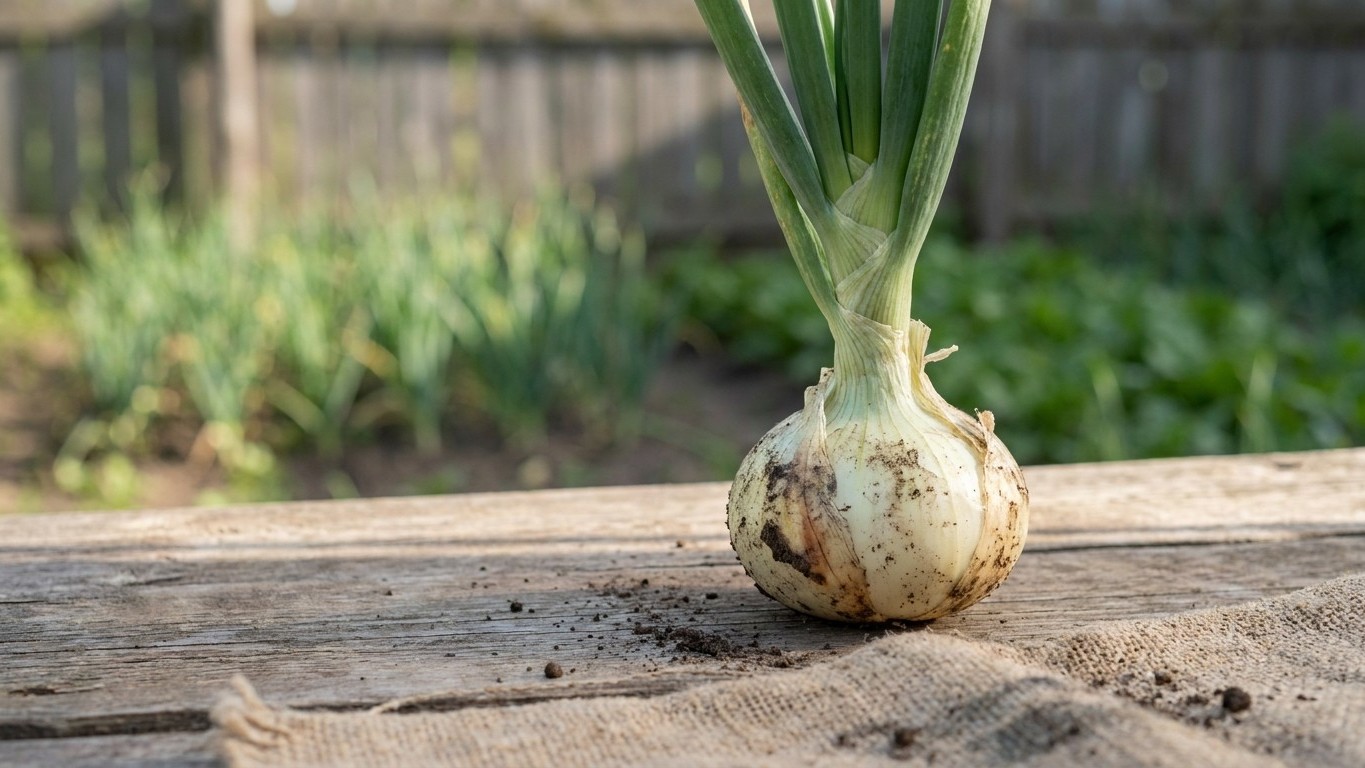

A bolted onion has shifted from growing a bulb to growing a flower stalk, and once that stalk shows up, the bulb is done getting bigger. The trigger is almost always a cold snap the plant reads as the end of winter. The good news: a bolted onion isn’t garbage. It’s just not going to store through February. Pull it, use it soon, and look at timing and set size before next season so it doesn’t happen again.
Why Onions Bolt, and What to Do With One That Has

Bolting is the onion sending up a flower stalk from the center of the bulb. Once that stalk appears, the plant’s energy goes into flowering and seed production instead of bulb growth, and the bulb itself stops sizing up. Worse for anyone hoping to store their harvest: a bolted onion will not keep. The core turns woody, a hollow channel forms where the stalk pushed through, and the layers around it start to break down faster than a normal bulb in storage.
The mechanism behind this is called vernalization. Onions are biennials by nature. In the wild, they’re built to grow a bulb the first year, sit through winter, then flower and set seed the second year. A stretch of cold weather is the plant’s cue that winter has happened. If that cold hits while the onion is small and young, it doesn’t respond. But if the plant already has some size and stored reserves in the bulb, the same cold spell can convince it that winter came and went, and it switches straight into flowering mode, even though it’s still the middle of the same growing season.
That’s why the classic cause of bolting is a set (the small bulb gardeners plant instead of seed) that was already large enough to have stored real reserves before a cold snap arrived. The bigger the set going in, the more reserves it’s carrying, and the more likely it is to read a cold spell as vernalization rather than just weather. A plant that goes into a cold stretch already sizeable, whether from a big set or from planting too early, is at meaningfully higher risk than one that’s still small and immature when the cold hits.
There’s no fixing a bolted onion once the stalk has appeared. All the effective levers sit upstream, before bolting starts: starting with a smaller set, planting at the right calendar moment for your region, and choosing a variety suited to your climate. Once you’re standing in the garden looking at a flower stalk, the only real decision left is what to do with the onion in front of you, not how to reverse what already happened.
How to do it
Once you’ve spotted a stalk, here’s the order of operations for handling it, from the moment you notice it to getting the onion used up before it goes soft.
- Cut the flower stalk as soon as you see it. This won’t undo the bolting or restart bulb growth, but it stops the plant from pouring any more energy into seed production, which buys you a little more time before the bulb declines further.
- Pull the bulb rather than leaving it in the ground. A bolted onion isn’t going to get bigger or better by staying in the soil. Leaving it in place just risks the core going hollow and soft while you wait.
- Check the neck and center before deciding what to do with it. Slice it in half lengthwise. If the core is still firm, the onion is fine to use fresh. If it’s already turned woody or fibrous in the middle, cut that section out and use what’s left around it.
- Use it within the next week or two, not months from now. A bolted onion belongs in the current week’s cooking, not the pantry basket. Soups, sautés, caramelizing, anything that uses the onion up close to harvest, works well.
- Do not put it in long-term storage with your keepers. Mixing a bolted onion into a braid or a mesh bag with sound bulbs is how one soft onion turns into a spot of rot spreading to its neighbors.
- Note which variety and set size bolted, and when. Jotting down the date of the cold snap and the size of the set you planted gives you something concrete to adjust next season, instead of guessing at what went wrong.
- Choose smaller sets and check regional planting windows before the next planting season. Since the fix is entirely upstream, this is the step that actually prevents a repeat, not anything you can do to the bolted plant itself.
What goes wrong
- The stalk gets missed until it’s tall and tough. By the time a thick, fibrous stalk is obvious, the bulb has usually already lost most of its storage quality. Once you see it, don’t wait for it to “finish” anything. Cut it, pull the bulb, and use it that week.
- A bolted onion gets stored alongside good ones. The hollow core and softer tissue in a bolted bulb break down faster than normal onions, and once it starts to go, it can spread rot to whatever’s touching it in a bag or braid. If you’ve already stored one by mistake, sort through the batch, pull it out, and check the bulbs it was in contact with for soft spots.
- The whole batch gets written off because a few bolted. Bolting usually hits the plants that happened to be biggest or most advanced when a cold spell rolled through, not every plant in the row. Check each bulb individually instead of assuming the worst. Plenty of the non-bolted onions nearby are likely still fine to cure and store normally.
- Gardeners try to “fix” it by cutting off the stalk and waiting for the bulb to keep growing. It won’t. Cutting the stalk stops further energy loss, but the bulb has already stopped sizing up for the season. Treat it as an eating onion now, not a project to salvage into a storage onion.
- The same size of set gets planted again the next year without adjusting timing. If a set was already large going into a cold snap last season, using the same size again under the same planting schedule sets up the same risk. Since there’s no fix once bolting starts, the only real correction is planting smaller sets or adjusting the planting date for your region the next time around.
- A woody, hollow core gets tossed instead of trimmed. Not all of a bolted onion is bad. If the outer layers are still firm and only the very center has gone fibrous, cut out that section and use the rest. Tossing the whole bulb wastes onion that’s still perfectly good for cooking.