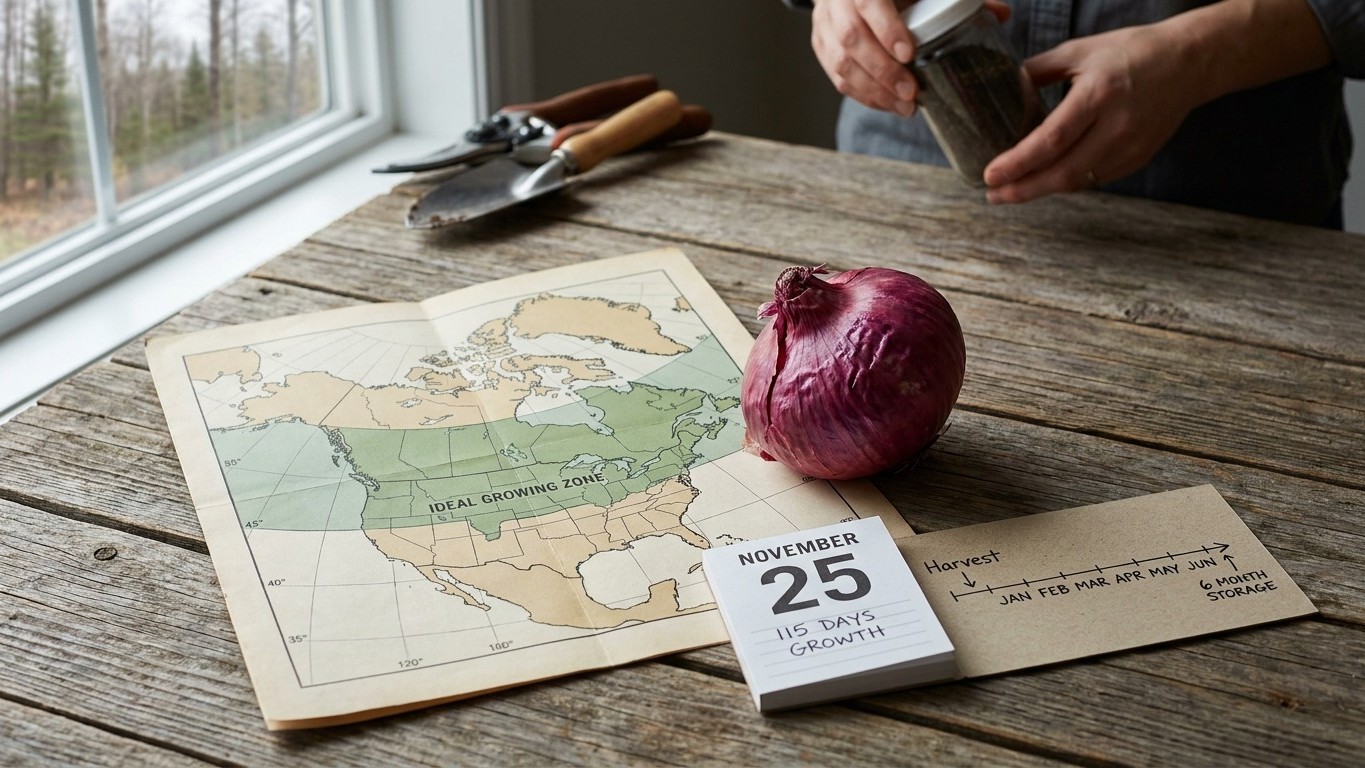

Blush is a long-day onion, which means it only forms a bulb between roughly 38 and 55 degrees north latitude. Get that part right and you’re looking at a red, sharp-flavored bulb that matures in 115 days and holds in storage for a full six months. Get it wrong, and you’ll grow leaves all summer and nothing else.
Will Blush bulb where you are

Blush belongs to the long-day group, and it bulbs correctly between 38 and 55 degrees north latitude. That band runs roughly from central Kansas and northern California up through the Canadian border states and into much of Canada. South of that line, this onion is not the right choice, no matter how good the soil or how much fertilizer goes down.
Here’s the part that trips up a lot of gardeners: an onion doesn’t bulb because the weather warms up. It bulbs because of how many hours of daylight it gets each day. Long-day onions need 14 to 16 hours of light before the plant switches from growing leaves to swelling a bulb. That’s why these varieties are matched to northern latitudes in the first place, not southern ones. Counterintuitive as it sounds, the far north actually receives more daylight during the growing season than the Gulf Coast does, thanks to the tilt of the earth and the long summer evenings up there. A Minnesota garden in June can see two more hours of daylight than one in South Texas.
That mechanism is also why there’s no such thing as a small, disappointing Blush onion grown too far south. Outside its range, the plant never gets the daylight trigger it’s waiting for. It keeps putting energy into leaves instead of a bulb, and by the time cold weather arrives, you’re left with skinny green stalks and no onion to dig. If you do force one into the ground anyway, whatever soft, immature bulb tissue forms tends to rot in storage rather than cure properly.
If your garden sits right at 37 or 38 degrees, or up near 55 and beyond, you’re in the blurred edge of the range rather than a clear yes or no. Growers in that zone sometimes get a workable harvest and sometimes don’t, depending on the particular summer’s day length and how early the transplants went in. Extension services in border states such as Missouri or southern Illinois are a reasonable next check for local performance before committing a whole bed to this variety. For general reference on how day length drives bulbing, Clemson’s Home & Garden Information Center covers the physiology in plain terms (hgic.clemson.edu).
What Blush is like
Assuming your latitude checks out, here’s what you’re actually growing. The catalogue data on Blush is straightforward, and it’s worth reading like a spec sheet rather than a sales pitch:
- Color: Red
- Days to maturity from transplant: 115
- Flavor: Sharp
- Storage life: 6 months
That flavor note deserves more than a passing glance, because it’s not a random detail. It’s tied directly to why this onion keeps as long as it does. The same sulfur compounds that give an onion its sting when you slice it raw are the compounds that protect the bulb tissue from breaking down in storage. A mild, sweet onion has less of that sulfur chemistry, which is exactly why it tastes gentle on a sandwich and also why it turns soft and spoils within weeks. Blush sits on the other end of that trade-off. It bites when eaten raw, and it’s built to last.
That means Blush isn’t the onion you reach for when you want something you can eat raw on a burger with no complaints. It’s a pantry onion, the kind that sits in a mesh bag in a cool closet and gets pulled out for soups, roasts, and stews from October clear through into spring. Cooking mellows that sharpness considerably, so the bite that makes it unpleasant sliced thin and raw disappears once it hits a hot pan. There’s no version of this variety that gives you both a sweet raw bite and a six-month shelf life. One trait exists at the expense of the other, and Blush has clearly chosen storage over sweetness.
When to plant it
Planting timing for onions isn’t a fixed date on a calendar. It follows the day-length group, and that group changes depending on where in the country you garden, which catches a lot of first-time growers off guard. Short-day onions go into the ground in autumn across the mild-winter South and get harvested the following late spring. Long-day types like Blush follow a different calendar entirely: they go in during late winter to early spring, timed so the plant has a full growing season ahead of it before the long days of early summer arrive.
For a northern grower, that usually means starting transplants or sets as soon as the soil can be worked, often four to six weeks before the last expected frost. The exact week shifts by state and by the particular spring’s weather, so a fixed date is less useful here than a different kind of test.
The size test that matters more than the date
What actually determines your final bulb size isn’t when you planted, it’s how big the plant’s top growth is at the moment day length triggers bulbing. Once that switch flips, the plant stops building leaves and starts pouring its stored energy into the bulb below ground. A plant with four or five leaves at that moment produces a bigger bulb than one with only two, because there’s simply more leaf tissue to fuel the swelling bulb.
That’s the real reason early planting matters for a long-day onion. It’s not about beating the frost. It’s about giving the plant enough weeks of growth to build substantial tops before the calendar forces bulbing to begin, ready or not. Plant too late in the season and the trigger still fires on schedule, but the plant hasn’t had time to grow, so it forms a small bulb no matter how well you tended it afterward.
Growing it well
Onions have a shallow, sparse root system, and that single fact explains most of what goes wrong in an onion bed. The roots don’t reach deep or spread wide, which means the plant loses out fast against anything competing for the same patch of topsoil. A bed left weedy for even a couple of weeks in early summer often shows up later as a harvest of smaller-than-expected bulbs, because those competing weeds were pulling moisture and nutrients the onion never got a chance to use. The same goes for drought stress: a dry stretch during bulb swell doesn’t just stunt the plant, it directly caps how large that bulb can grow, since there’s no second chance to make up the lost growth later in the season.
Keeping the bed clean and consistently watered through the bulbing stage is less about following a rulebook and more about protecting a plant that simply can’t fend for itself against competition.
Watch for bolting
Bolting is the other issue worth flagging. If an onion sends up a flower stalk before harvest, that plant has shifted its energy toward reproduction rather than bulb storage, and the bulb underneath will not keep well no matter how carefully it’s cured afterward. A bolted plant isn’t wasted, but it should go straight to the kitchen rather than into the storage bag. Eat those first, and save the properly cured, non-bolted bulbs for the pantry stretch.
Harvesting and keeping it
The signal that Blush is ready has nothing to do with a date circled on the calendar. The plant tells you itself: the green tops weaken at the neck and fall over on their own, usually in a scattered pattern across the bed rather than all at once. That collapse means the bulb has stopped drawing energy from the leaves and has finished sizing up. Pulling onions before that point, just because the calendar says 115 days have passed, risks harvesting bulbs that haven’t fully matured.
Curing comes next, and it’s the step most home gardeners either rush or skip entirely, which is exactly why so many stored onions rot within a month or two instead of lasting the season. The whole point of curing is to dry the neck down until it’s papery and tightly closed, sealing off the one entry point where moisture and rot organisms would otherwise get into the bulb during storage.
- Wait for the tops to fall over naturally, rather than harvesting on a fixed schedule.
- Pull the bulbs and set them somewhere warm, dry, and out of direct sun, with air moving around them, for two to three weeks.
- Check the neck of each bulb: it should feel dry and papery, not soft or fleshy, before moving on.
- Trim the dried tops and any loose roots, then store the bulbs somewhere cool, dark, and well-ventilated, such as a mesh bag in a closet or unheated room.
Done properly, that sequence is what unlocks the full six-month storage life this variety is capable of. An onion that keeps that long isn’t just a bonus, it changes how the harvest gets used. Six months of storage means bulbs pulled in midsummer are still sound enough to cook with in the following February or March, carrying a household through winter without a single grocery-store onion in between. Compare that to a variety rated for three months of storage, which is eaten out well before the holidays and leaves a gap the rest of the winter. That gap is exactly what a sharp, sulfur-heavy, long-keeping onion like Blush is built to close.