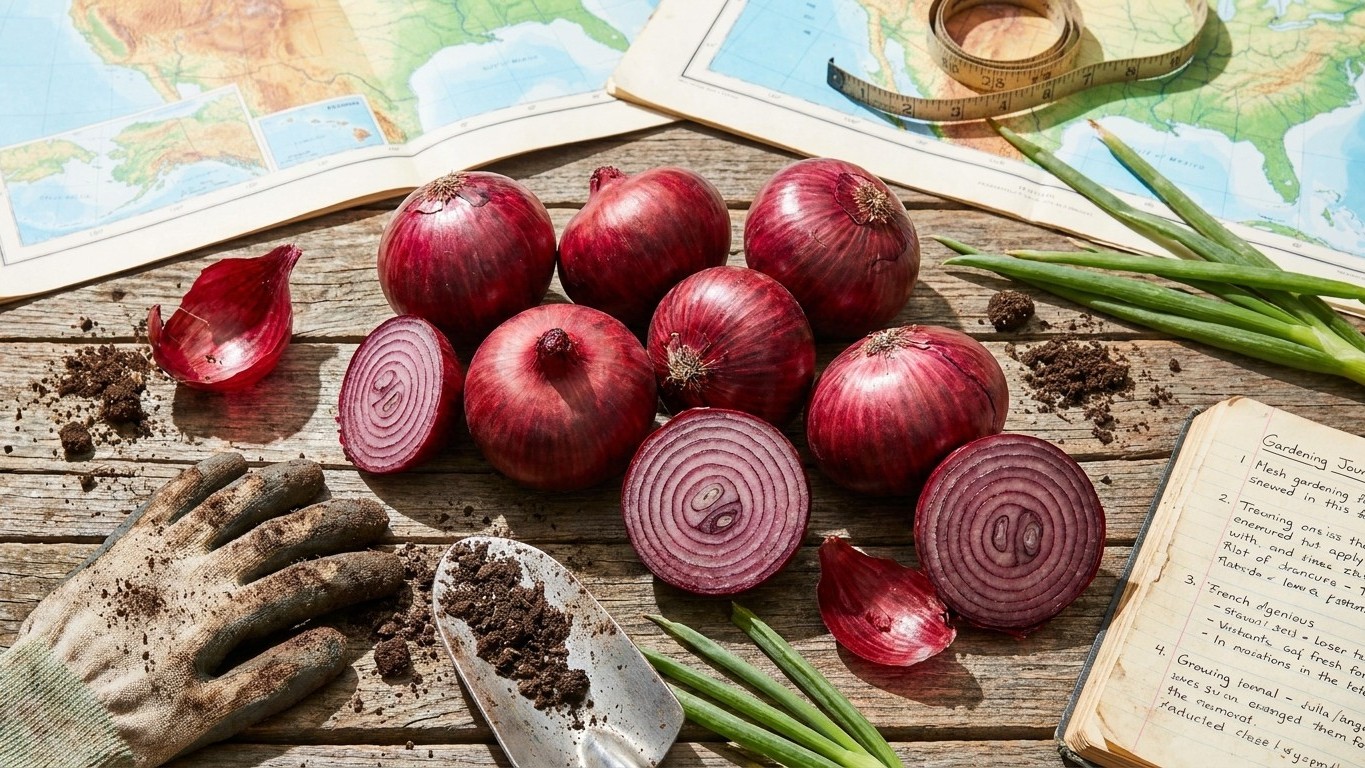

Cabernet is a red, intermediate-day onion that bulbs reliably between 35 and 45 degrees north latitude, reaches maturity around 100 days after transplant, and delivers a sharp, clean bite with deep red rings. It’s built for fresh eating, not for the root cellar all winter. Here’s what that means for your garden and your kitchen.
Will Cabernet bulb where you are

This is the question that decides everything else, so let’s settle it first. Cabernet belongs to the intermediate-day group, and it bulbs correctly between 35 and 45 degrees north latitude. That band runs roughly from the Tennessee-North Carolina line up through the Great Lakes states and into northern New England and the Pacific Northwest. If your garden sits inside that range, Cabernet has what it needs to form a bulb.
Outside that range, the outcome isn’t a smaller onion. It’s no onion at all. The plant keeps growing green tops, refuses to bulb, and when cold weather forces it into storage, it rots instead of curing. That surprises a lot of gardeners who assume a mismatched variety just underperforms a little. It doesn’t. Onion bulbing is an on-off switch triggered by day length, and an intermediate-day type flipped in the wrong latitude simply never gets the signal.
Why daylight, not heat, calls the shots
Here’s the part that runs against instinct: onions bulb because of how many hours of daylight they get, not because of temperature. A 90-degree heat wave in Texas does nothing to trigger bulbing if the day length isn’t right for that variety. This is also why long-day onions are grown in the far north and short-day onions in the Deep South. Northern summers, even with cooler air, deliver far more daylight hours than southern ones. An intermediate-day onion like Cabernet sits in the middle of that spectrum, which is exactly why its workable zone lands in the middle of the country’s latitudes rather than at either edge.
If you’re gardening near 35 degrees north (say, the Carolinas or Tennessee) or near 45 degrees north (Maine, northern Michigan, the Washington-Oregon interior), you’re near the edge of the range rather than solidly inside it. That’s a blurred zone, not a clear yes or no. Gardeners in those border areas sometimes get a workable bulb and sometimes don’t, depending on the season. If you’re well outside 35 to 45 degrees north, in Florida, southern Texas, or far northern Canada, for instance, look at a short-day or long-day variety instead. Matching day-length group to latitude is the single decision that determines whether you harvest onions or just a bed of green tops.
What Cabernet is like
Once the latitude question is settled, here’s what actually shows up in the garden and on the cutting board. Cabernet produces a red-skinned bulb with deep red interior rings, ready about 100 days after you set out transplants. That’s a full-season commitment, closer to a slow-cooked stew than a quick side dish, so gardeners plan the rest of the bed around it rather than squeezing it in as an afterthought.
The flavor is sharp and clean, which is the trait most people associate with a good slicing onion for salads, burgers, and salsas. That sharpness comes from sulfur compounds concentrated in the bulb’s flesh, and this is where the trade-off starts to matter.
Why sharp onions and long storage rarely go together
The same sulfur compounds responsible for that bite also act as a natural defense system, slowing down decay and discouraging the organisms that cause rot in storage. Sweet onions have less of this chemical armor, which is exactly why they taste mild but spoil fast. Sharp onions carry more of it, which protects them longer in a cool, dry pantry. Red onions, though, sit in an odd middle spot: many carry decent sharpness but still don’t store as well as yellow storage onions, largely because of thinner skins and higher moisture in the outer layers.
That’s the case with Cabernet. Its flavor is genuinely sharp and clean, and the color rewards anyone slicing it for a plate rather than a pot. Red onions in general keep less well than yellow ones, so treat this variety as a fresh-eating onion rather than a long-term keeper. The acidity that makes it snap in a raw salad softens once heat hits it, so raw preparations, thinly sliced on tacos, folded into a vinaigrette, layered on a sandwich, show off what this onion actually does best. Cooking it down for a slow caramelized dish wastes the trait that makes it worth growing in the first place.
When to plant it
Planting time follows the day-length group, not the calendar month by itself, and this trips up a lot of new gardeners who assume every onion goes in the ground at the same time everywhere. It doesn’t. Short-day onions get planted in fall across mild-winter regions of the South and are pulled the following late spring. Long-day onions go in during late winter to early spring across northern states, timed so they’re bulking up tops right as the long summer days arrive.
Cabernet, as an intermediate-day type, splits the difference and is typically set out in late winter to early spring across the mid-latitude band where it grows best, similar timing to long-day types but with more flexibility depending on regional frost dates. Local Cooperative Extension offices publish exact transplant windows for their specific climate, and checking with the one covering your county is worth the five minutes it takes.
The test that matters more than any date on a calendar
Here’s the detail that decides bulb size more than the planting date itself: the plant needs to build enough leaf mass before day length triggers bulbing. Onions size their bulbs in rough proportion to how many green leaves they’ve grown by the time the switch flips. A transplant that’s thin and small when daylight hours hit the trigger point will form a small bulb no matter how perfect the rest of the season goes, because the plant simply doesn’t have the leaf capacity to fill anything bigger.
That means the real goal of early planting isn’t hitting a specific week, it’s giving the plant enough weeks of growth before the trigger arrives. Transplants set out too late, or stunted early on by cold snaps, dry soil, or crowding, walk into bulbing season underbuilt and never catch up. Get transplants in the ground as soon as your local frost risk allows, and keep them growing steadily from day one.
Growing it well
Onions have shallow, sparse root systems, which makes them poor competitors against nearly everything else in the bed. A stand of weeds that a tomato plant would shrug off can quietly starve an onion of water and nutrients, and the result isn’t a dead plant, it’s a bulb that finishes at half the size it should have. Keep the area around the base of each plant clear, and check soil moisture more often than instinct suggests. Because the roots don’t reach deep, they also don’t reach far in the topsoil for water reserves. Inconsistent watering during bulb formation shows up later as smaller, irregularly shaped onions rather than any dramatic wilting in the moment.
Watching for bolting
Occasionally a plant will bolt, sending up a flower stalk instead of putting energy into the bulb. This tends to happen after a cold snap once plants are already established, or when transplants are stressed early in the season. A bolted onion redirects its stored energy into that flower stalk, and the bulb that forms underneath it will not store well no matter how good the curing process is afterward. Rather than trying to salvage it for the pantry, pull bolted plants and use them first, fresh, since they’re already on a shortened clock.
Beyond weed control, moisture, and watching for bolted stalks, this variety doesn’t demand anything unusual. It’s a straightforward grower once the day-length and timing questions are answered correctly, which circles back to why those two decisions matter more than any fertilizer schedule or spacing tweak.
Harvesting and keeping it
The onion itself tells you when it’s ready. Rather than counting to exactly 100 days and pulling on schedule, watch the tops. As the bulb finishes sizing, the green leaves yellow and eventually fall over on their own, flopping down at the base of the neck. That collapse is the signal, not a date circled on a calendar back in spring. Pulling too early, before the tops fall, means smaller bulbs and thinner skins that won’t hold up in storage anyway.
Curing before storing
Once pulled, the bulbs need to cure before they go anywhere near a pantry shelf or basket. This step gets skipped constantly, and it’s the single biggest reason home-grown onions turn soft and moldy within weeks of harvest. Curing means letting the onions sit in a warm, dry, well-ventilated spot, out of direct sun, until the outer skins papery over and the neck where the stalk met the bulb dries out completely. A moist neck is an open door for bacteria and rot once onions are piled together in storage. Give it the time it needs rather than rushing bulbs indoors after a single sunny afternoon.
Even cured properly, treat this one as an onion for the near term rather than the far future. Red onions in general keep less well than yellow storage types, and Cabernet’s profile fits that pattern. An onion that reliably keeps six months carries a household from harvest into spring; one that holds three months is better planned as something eaten steadily through fall and early winter rather than rationed out. Set this variety up to be used first among whatever else is in the harvest basket, sliced raw into salads and sandwiches while the flesh is still firm and the color is at its best.