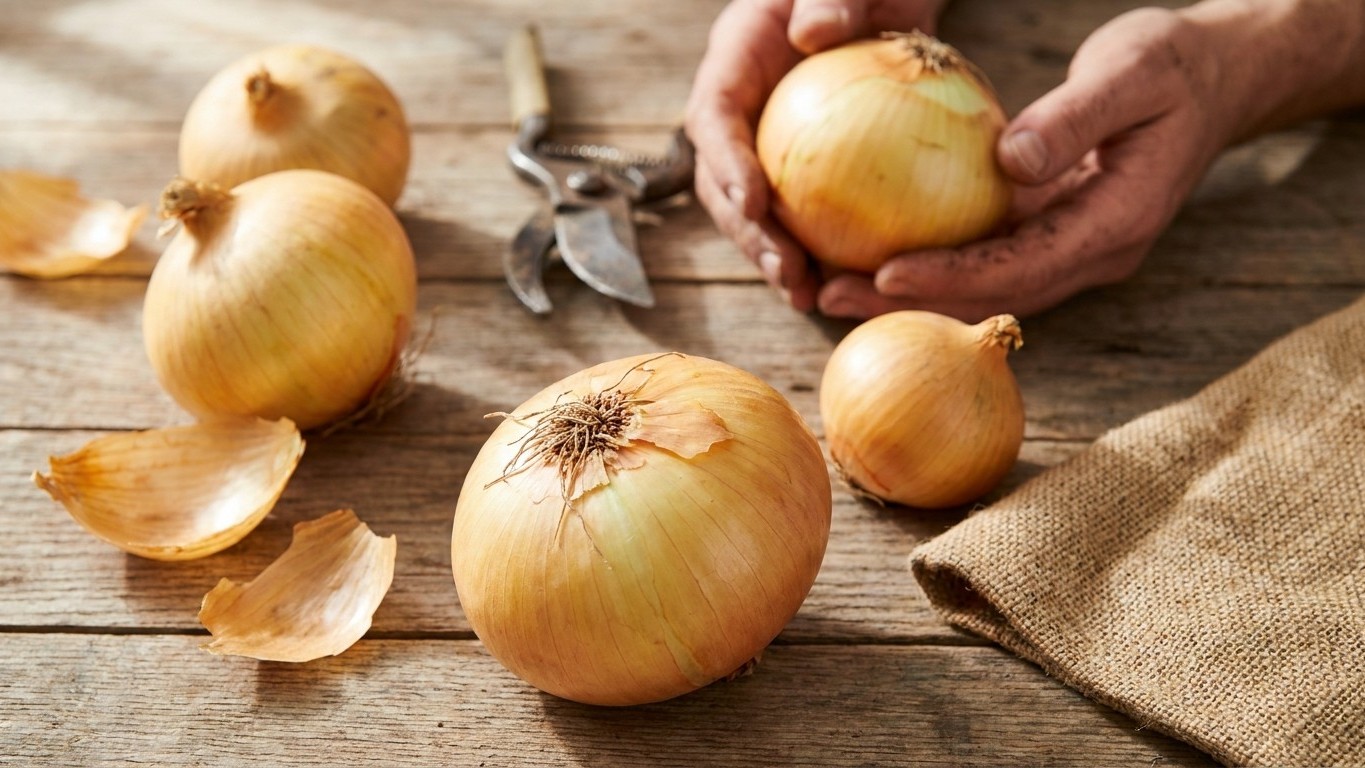

Powell onion is a long-day variety built for northern gardens, bulbing reliably between 43 and 47 degrees north latitude. It produces a yellow, 108-day bulb prized less for eating fresh and more for what it does after harvest: it keeps for six months or more, sharp flavor intact, long after sweeter onions have gone soft.
Will Powell bulb where you are

Powell is a long-day onion, and that single fact determines whether it will work in your garden before anything else matters. It bulbs correctly between 43 and 47 degrees north latitude, a band that runs roughly from the northern tier of the Corn Belt up through the Dakotas, Minnesota, northern New England, and into southern Canada. Outside that range, this variety does not simply make a smaller onion. It makes no bulb at all. The plant keeps growing leaves, season after season, and if you dig it up expecting a harvest, you get a swollen stem base at best and rot in storage at worst.
The mechanism behind this is one gardeners often get backwards. Onions bulb in response to hours of daylight, not temperature. A long-day onion needs roughly 14 to 16 hours of light before it will stop putting energy into leaves and start putting it into the bulb. That’s why the far north, counterintuitively, is friendlier to this variety than the Deep South: places near the Canadian border get far longer summer days than Georgia or Texas, even though they’re colder overall. Heat doesn’t trigger bulbing. Daylight does.
This is also why moving Powell south of its range doesn’t just shrink the harvest, it erases it. A gardener in Tennessee or North Carolina growing this variety will watch tall, healthy tops all summer and never see a proper bulb form, because the days never stretch long enough to flip the switch. The same logic works in reverse for short-day varieties planted too far north: they bulb too early, on tiny plants, and yield next to nothing.
If you garden close to the edges of that 43-47 degree band, you’re in a blurred zone rather than a clear pass or fail. Local microclimate, planting date, and the specific season’s daylight pattern all nudge the outcome one way or the other. A grower at 41 or 42 degrees north might get a decent crop in a favorable year and a disappointing one the next. Rather than treat the range as a hard line, treat it as a continuum: the closer you sit to the center, the more predictable the results, and the closer to the edge, the more you’re rolling the dice.
What Powell is like
Once conditions are right, Powell delivers a fairly standard-looking storage onion, though the details matter for anyone deciding whether it fits their kitchen.
- Color: Yellow skin, the classic look of a pantry onion.
- Size and shape: A globe-shaped bulb, typical of long-day storage varieties bred for uniformity rather than novelty.
- Days to maturity: 108 days from transplant, placing it solidly in the long-season category.
- Flavor: Sharp, with real bite raw or lightly cooked.
- Storage life: Six months or more under proper curing and conditions.
The flavor and the storage life aren’t two unrelated traits sitting side by side on a seed catalogue page. They’re the same trait, expressed two ways. The sulfur compounds responsible for an onion’s sharpness, the ones that make your eyes water when you slice it, are the same compounds that act as a natural preservative inside the bulb. They slow the biological processes that lead to softening and spoilage. A variety loaded with those compounds bites hard on the cutting board and shrugs off months in a cool, dry space.
Sweet onions work the opposite way. Breeders select for low sulfur content specifically because it produces that mild, almost fruity flavor people want to eat raw in a sandwich. But stripping out the sulfur strips out the built-in defense system too. That’s why sweet onions are famous for going soft, sprouting, or rotting within weeks of harvest, while a sharp variety like this one sits quietly in a mesh bag until spring. No onion variety does both well. If a seed description promises sweet flavor and long storage in the same breath, read it skeptically.
In practical kitchen terms, this means Powell isn’t the onion you want for a raw salad topping. It’s the onion you reach for in a stew, a roast, a caramelized base for soup, the kind of cooking where sharpness mellows into depth and where you’ll still have onions left in March.
When to plant it
Planting timing for onions isn’t fixed on a calendar the way it is for tomatoes or peppers. It shifts depending on the day-length group, and that surprises a lot of first-time onion growers who assume one planting rule applies everywhere.
Short-day varieties are planted in autumn across mild-winter regions, overwinter as small plants, and are harvested the following late spring, taking advantage of a long, gentle growing season before the short summer days there trigger bulbing early. Long-day varieties, which is where Powell belongs, follow a completely different rhythm. In the northern latitudes where this onion actually bulbs, planting happens in late winter to early spring, as soon as the ground can be worked, giving the plant a full stretch of the growing season to bulk up before the long days of June and July flip the bulbing switch.
The date on a calendar matters less here than a simpler test: is the plant big enough when day length triggers bulbing? Onions don’t keep growing top growth once bulbing starts. Whatever leaf mass the plant has built up at that moment is essentially locked in, and it directly sets how large the bulb can become. A plant that’s still small and spindly when the trigger hits will bulb anyway, because day length doesn’t wait, but the bulb will be small and disappointing.
That’s the real argument for planting Powell as early as soil conditions allow in late winter or early spring. Every extra week of leaf growth before the daylight threshold arrives translates into a bigger bulb later. Gardeners who plant late, waiting for warmer weather out of habit, often get onions that mature on schedule at 108 days but come out of the ground the size of golf balls, because the plant simply didn’t have enough time to build the top growth needed to support a bigger bulb.
A quick planting-timing comparison
| Day-length group | Typical planting window | Harvest timing |
|---|---|---|
| Short-day | Autumn, mild-winter regions | Late spring |
| Long-day (Powell) | Late winter to early spring, northern regions | Late summer to early fall |
Growing it well
Onions are shallow-rooted, with most of their working roots sitting in the top few inches of soil, and they compete poorly with anything else growing nearby. That’s not a minor detail. It’s the reason weeds cost you bulb size more directly with onions than with almost any other vegetable. A patch of grass or chickweed crowding an onion row doesn’t just look messy, it’s physically pulling water and nutrients away from roots that have nowhere else to reach. The same goes for drought stress: because the root system can’t dig deep to find moisture during a dry stretch, an onion that goes thirsty during bulb formation simply makes a smaller bulb. There’s no recovery phase later in the season the way there is with deeper-rooted crops.
Keeping the bed clean and consistently moist through the bulbing period, then, isn’t a nice-to-have. It’s the difference between the onion this variety is capable of and a disappointing one.
Bolting is the other issue to watch for. Occasionally a plant, usually one stressed by a cold snap early in the season or by inconsistent moisture, will send up a flower stalk instead of focusing on the bulb. Once an onion bolts, the bulb that forms around that stalk develops a tough, woody core and will not keep in storage no matter how well it’s cured. Bolted onions aren’t a loss, but they need to be treated differently: pull them and use them first, in the kitchen, within days or weeks. Don’t set them aside for winter storage with the rest of the harvest, because they’ll be the first to break down and can spread rot to onions stored nearby.
Harvesting and keeping it
The plant tells you when it’s ready, and that signal is more reliable than any date circled on a calendar. As the bulb finishes sizing up, the tops naturally weaken at the base and fall over on their own, usually across a large share of the bed within a few days of each other. That’s the cue to stop waiting and start harvesting, not a specific day count from planting.
Curing is the step most home gardeners skip, and it’s the single biggest reason home-stored onions rot in the pantry within weeks instead of lasting the six-plus months this variety is capable of. Curing means drying the onion, and specifically the neck where the leaves meet the bulb, until it’s fully closed and papery. A wet or fleshy neck is an open door for bacteria and mold; a dry, tight one seals the bulb the way it’s meant to be sealed.
- Watch for tops falling over across most of the bed, rather than picking a harvest date in advance.
- Lift the bulbs carefully, shaking off loose soil without bruising the skin.
- Spread them in a single layer somewhere warm, dry, and well-ventilated, out of direct sun, for two to three weeks.
- Check the necks: they should feel dry and papery, not soft or fleshy, before you consider the cure finished.
- Trim the dried tops and roots, then store the bulbs in a cool, dry space with good airflow, such as a mesh bag or slatted crate.
What that six-month keeping time means in practice is worth spelling out. An onion that only holds for two or three months gets eaten in season, more or less as a fresh vegetable, and any surplus is likely to spoil before it’s used. An onion that keeps six months or longer, like this one, functions as a genuine pantry staple: dig it in late summer, and it’s still sound enough to cook with well into the following spring, right up until the next season’s crop starts coming in. That’s the entire point of choosing a sharp, long-day storage onion over a sweet one in the first place.