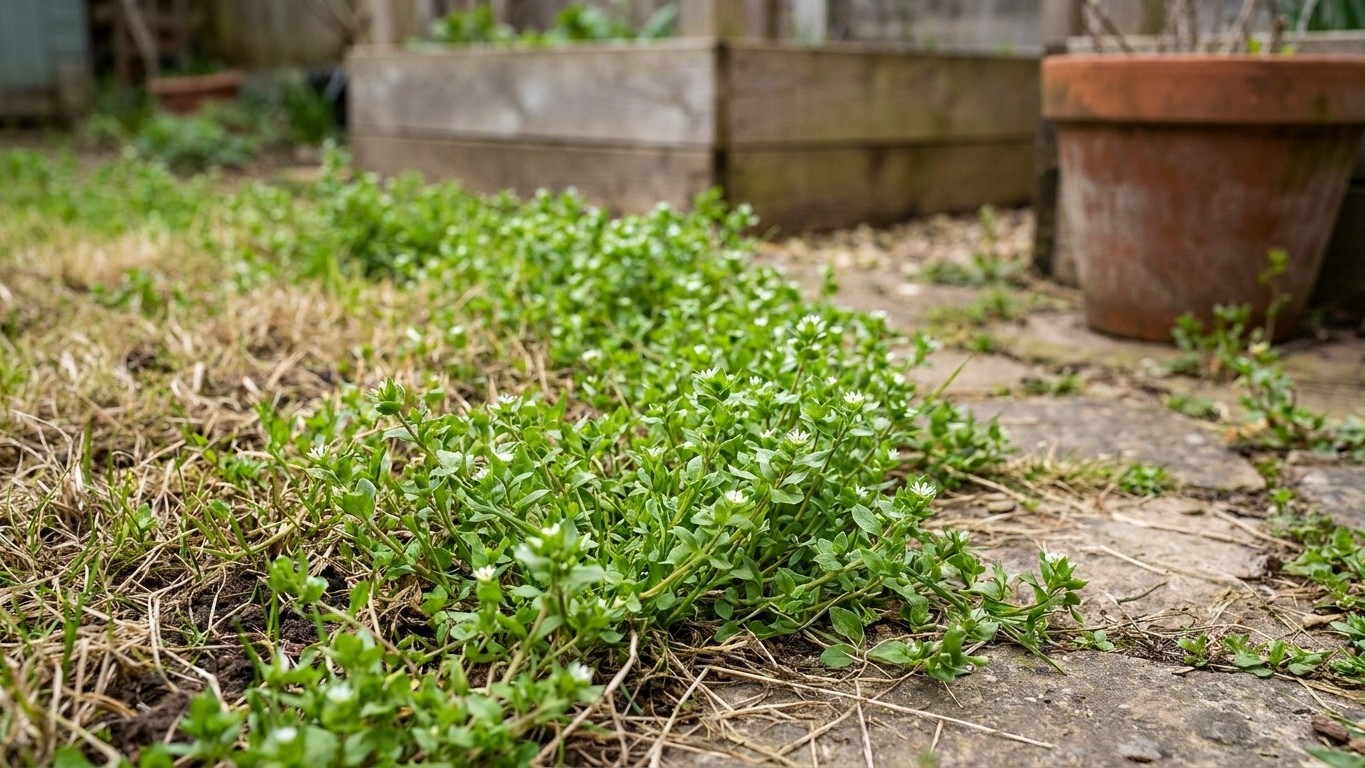

Chickweed beats your lawn to spring because it germinates in fall while cool-season turf is already slowing down, then keeps growing through any mild stretch of winter until it flowers and drops seed before the grass around it has even greened up. That head start is biological, not bad luck: this weed is built to grow at soil temperatures that stall lawn grass outright. Check the thin, low, or shaded patches of the lawn first. That is where chickweed gets its foothold before the rest of the turf wakes up at all.
How to be sure that is what you have

Common chickweed (Stellaria media) is what most people mean when they say chickweed. It grows low and sprawling, forming loose mats that root at the stem joints as they spread across bare or thin soil. The leaves sit in opposite pairs, oval, smooth-edged, and tapering to a small point. Run a fingernail down the stem and you can usually find a single line of fine hairs on one side only, which is the detail that separates it from several lookalikes in a lawn setting. In late winter and early spring it produces small white flowers, each with five petals so deeply notched they read as ten at a glance.
As a winter annual, chickweed follows a schedule most lawn grass does not. It germinates in fall, spends winter as a low, spreading rosette that may pause during hard freezes but resumes growth the moment things thaw, flowers in late winter to early spring, sets seed, and then dies back as the weather turns hot. By the time a cool-season lawn is fully green, a mature stand of chickweed may already be finished for the year and reseeding itself for the next one.
Quick checks before you treat anything
- Leaves in opposite pairs, oval, smooth margins, no teeth or lobes
- A single hairline running down one side of the round stem
- Small white flowers with five deeply notched petals
- Mats that root at stem joints where they touch soil
Two plants get mistaken for it constantly. Henbit (Lamium amplexicaule) has square stems and fuzzy, rounded, scalloped leaves, and its flowers are pink to purple and tubular rather than white and star-shaped. Mouse-ear chickweed (Cerastium fontanum) is a true relative but a perennial, and its leaves are densely hairy over the whole surface rather than carrying just that one line of hairs on the stem. If the plant in front of you has fuzzy leaves throughout and hangs on into summer, you are probably looking at mouse-ear chickweed, not the common kind.
Why it is in your lawn
Chickweed seed needs light to germinate, so it takes hold where the turf canopy is thin enough to let light reach bare soil. Thin, patchy turf is the single biggest invitation, whether that thinness comes from mowing too short, foot traffic, shade, or a lawn that was never seeded thickly enough to begin with. Compacted soil compounds the problem because it holds moisture near the surface, and chickweed’s shallow, fibrous roots are perfectly suited to that top inch of damp ground while deeper-rooted grass struggles to get established there at all.
Poor drainage plays the same role at a different scale. A low spot that stays damp through fall and winter, exactly when chickweed is germinating, will carry a heavier stand of it than the rest of the yard even if the mowing height and fertility are identical everywhere else. If you are also finding broadleaf plantain in those same low, worn spots, treat that as confirmation rather than coincidence. Both weeds are reading the same compacted, poorly drained ground, as covered in our piece on Broadleaf Plantain: The Weed That Marks Compacted Ground.
None of this means you need a soil test before you can act. It means the chickweed is telling you something about that patch of lawn that a herbicide application will not fix. Spray it away this year and the same thin, damp, compacted ground will grow another stand next fall unless the underlying condition changes.
The window that decides everything
Timing separates a control that works from one that wastes a season. Pre-emergent herbicide has to go down before chickweed seed germinates, which for this weed means before soil cools in fall, not before it warms in spring. That is the opposite direction from crabgrass, a summer annual whose germination trigger runs the other way, timed in Clemson Cooperative Extension’s tall fescue maintenance calendar (HGIC 1219) to forsythia and dogwood bloom rather than to a fixed date. The logic behind that approach is worth understanding on its own, and it is laid out fully in our piece on Crabgrass: The One Weed Whose Timing Decides Everything.
The reason university calendars lean on bloom stage instead of a date on the calendar is that the actual trigger, a soil temperature threshold, arrives weeks apart across the country in any given year. A date that works one year in one place can miss the window entirely the next year a county over. For chickweed specifically, that means the safe move is to get pre-emergent down before fall germination begins rather than aiming at a month, and to confirm your own fall trigger window with your state extension service’s maintenance calendar for your grass species rather than guessing.
Post-emergent control works on a narrower window than most people expect. Chickweed is easiest to kill while it is small and actively growing, through fall and any mild winter stretch, and before it flowers. Once flowers open, a treated plant can still finish setting seed in the days it takes to die, which means a late application controls this year’s plant but does nothing to stop next year’s stand. If you are already seeing white flowers, pulling by hand before seed drops will do more good than a spray applied at that stage.
Getting rid of it
Hand pulling works well because chickweed’s roots are shallow and let go easily, especially in moist soil. The catch is the stems, which root wherever a joint touches damp ground. If you pull and leave the plant lying on the bed rather than removing it, fragments left in contact with soil can re-root and start over. Rake up what you pull, and do it before the white flowers open if you can, since a plant that has already flowered can still shed viable seed even after it has been uprooted.
Chemical control, and its limits
Where the infestation is too large to pull, post-emergent broadleaf herbicides built around 2,4-D, dicamba, mecoprop (MCPP), or triclopyr, often blended together as three-way mixes, will control actively growing chickweed without killing grass, provided the lawn is established and growing rather than newly seeded. These products work on broadleaf weeds specifically. They will do nothing for grassy weeds, and they should not be applied to a lawn seeded within the past several weeks, since young grass seedlings can be injured right alongside the weed. Always read the label for your specific turf species before buying, since tolerance varies by grass and the label is the only place that is stated correctly for the product in your hand.
Pre-emergent products containing prodiamine or dithiopyr prevent chickweed seed from germinating in the first place, but they do nothing for plants already growing, so timing them for the fall window matters more than the product choice itself. A few broadleaf actives, including some dicamba formulations, are restricted-use in certain states, meaning they are not sold over the counter everywhere. Check with your state department of agriculture or your local extension office before assuming a product is available where you garden, rather than finding out at the checkout.
Keeping it out
Density is the real control
Thick turf shades the soil surface enough that chickweed seed, which needs light to germinate, never gets the chance. Everything else in this section is really about building that density for your specific grass rather than fighting the weed directly. Mow at the upper end of your grass species’ recommended range rather than the lower end, since a taller canopy closes the gaps chickweed seed is waiting for. Clemson Cooperative Extension’s HGIC 1205 mowing guidance and HGIC 1201 fertilizing guidance both point the same direction: consistent mowing height and fertilizing on the schedule appropriate to your species build the density that keeps light off bare soil, which is the actual mechanism behind almost every “thick lawn crowds out weeds” claim.
Overseeding thin or bare patches before chickweed’s fall germination window closes the door on the exact soil openings this weed is watching for. Species choice matters here too, since a grass poorly matched to your shade or drainage will thin out again no matter how well you feed it. The table below, drawn from Clemson Cooperative Extension’s HGIC 1214 for warm-season species and Penn State Extension’s lawn establishment guidance for cool-season species, gives mowing height and site tolerance together so you can match the grass to the conditions where chickweed keeps showing up.
| Grass | Type | Mowing height | Shade tolerance | Drought tolerance | Wear tolerance |
|---|---|---|---|---|---|
| Fine Fescues | Cool-season | 2.5 to 3.5 in | Excellent | Good | Poor |
| Kentucky Bluegrass | Cool-season | 2 to 3 in | Fair | Fair | Good |
| Perennial Ryegrass | Cool-season | 2 to 3 in | Fair | Fair | Good |
| Rough Bluegrass | Cool-season | 2 to 3 in | Excellent | Poor | Poor |
| Tall Fescue | Cool-season | 2.5 to 3.5 in | Good | Fair | Fair |
| Bahiagrass | Warm-season | 3 to 4 in | Poor | Excellent | Good |
| Bermudagrass | Warm-season | 0.75 to 1.5 in | Very poor | Excellent | Excellent |
| Carpetgrass | Warm-season | 1 to 2 in | Fair | Very poor | Poor |
| Centipedegrass | Warm-season | 1.5 to 2 in | Fair | Fair | Poor |
| Seashore Paspalum | Warm-season | 1 to 1.5 in | Poor to fair | Fair to good | Good |
| St. Augustinegrass | Warm-season | 2.5 to 4 in | Excellent | Good | Fair |
| Zoysiagrass | Warm-season | 0.75 to 2 in | Excellent | Good | Very good |
If a shaded side yard keeps growing chickweed no matter what you do, it is likely telling you the grass planted there does not actually suit that spot. Fine fescue, St. Augustinegrass, and zoysiagrass all carry excellent shade ratings in that table for a reason, and swapping to one of them will do more long-term work against chickweed than any spray. For a broader look at how this weed fits alongside the rest of what shows up in a season, our full Lawn Weeds roundup covers the density-first approach across every common offender, not just this one.
Common questions
Will vinegar kill chickweed without hurting my lawn?
No. Household vinegar is a nonselective contact treatment, meaning it burns whatever green tissue it touches, grass included. It has a place for spot-treating chickweed growing in cracks or bare soil away from turf, but spraying it across a lawn will damage the grass right along with the weed.
Is chickweed edible, can I just leave it alone?
Yes, common chickweed is edible, but leaving a mature stand in the lawn just guarantees a bigger patch next fall. It sets seed quickly and prolifically, so a patch you tolerate this year through flowering is a larger seed bank waiting in the soil for next year’s germination window.
Why is my chickweed still green when the rest of the yard looks dead in winter?
Because your lawn grass is very likely dormant, not dead, while chickweed is a winter annual built to grow through cold weather that stalls turf. Brown, dormant grass recovers on its own as the season turns. Green chickweed among it is simply doing what it is designed to do at that time of year.
Can I just mow it shorter and get rid of it that way?
Not reliably. Chickweed grows low and sprawling, often below typical mowing height, so a mower blade passes right over the crown of the plant without touching it. Mowing can even spread the problem, since cut stem fragments that land on damp soil elsewhere in the yard are able to root and start new mats.