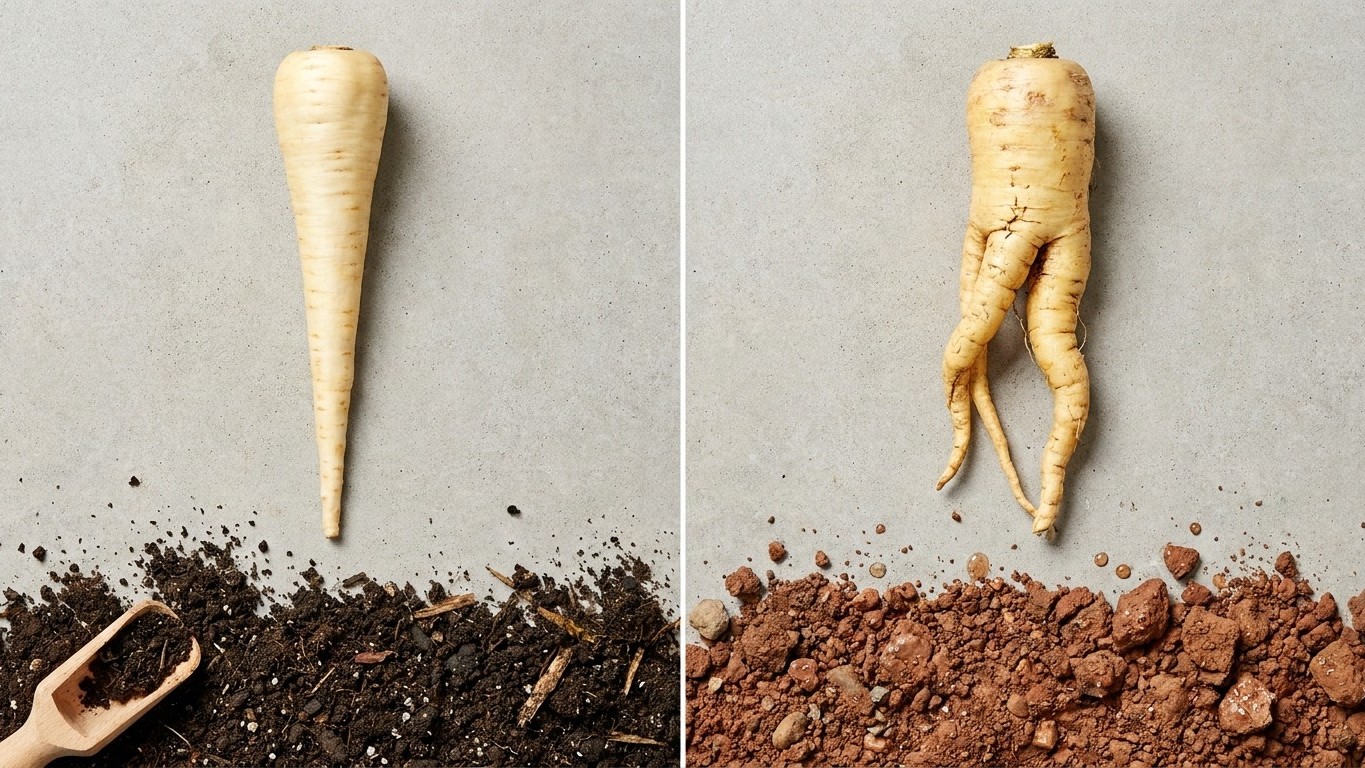

A forked parsnip root almost always comes down to one of two garden habits: growing it in heavy, stony, or shallow ground, or watering it too heavily once the root starts to size up. Utah State University Extension names both causes directly, and treating them as a single problem is the fastest way to keep pulling forked roots year after year.
The short answer
Utah State University Extension’s guidance on parsnips is specific about what the crop wants: soil that is “fertile, well-drained, deep, sandy… rich in organic matter.” That’s the baseline. A parsnip taproot is built to drive straight down for close to a foot, sometimes more, and it needs loose, obstruction-free ground the entire way to do that cleanly.
When the bed doesn’t offer that, the root doesn’t stop growing, it just stops growing straight. Extension is direct on the fix: “Heavy soils need to be amended with plenty of compost and should be double dug to allow good root development.” Skip that step, plant into unamended clay, or leave rocks and clods in the root zone, and the tip of the taproot meets resistance. It splits, bends, or sends out a second leg to get around whatever’s in the way. That’s forking cause number one, and it’s a soil-structure problem, full stop.
The second cause has nothing to do with soil texture at all. Extension’s warning here is short and easy to miss: “Avoid overwatering as hairy roots form and forking may occur.” A parsnip growing in perfectly loose, well-amended soil can still fork if it gets more water than it needs while the root is developing. The two causes don’t cancel each other out, and they don’t require the same fix. A gardener who double digs a bed but then waters on a heavy, frequent schedule out of habit can still end up with a fistful of forked roots at harvest, and never understand why the soil prep didn’t solve it.
So the short answer to “how do you get a forked parsnip root” really has two doors. Walk through the first by planting into heavy, rocky, or shallow ground without amending it. Walk through the second by keeping that bed consistently wet once the taproot is underway. Either one, alone, is enough to do the damage.
What actually decides it
The two causes work through different mechanisms, and separating them is the only way to actually fix either one.
Heavy, stony, or shallow soil
A parsnip’s taproot behaves like a plumb line dropped through the soil profile. It wants to grow down, not out. In loose sandy loam, it can. In clay, compacted subsoil, or ground littered with rocks and old root fragments, the growing tip runs into physical resistance long before it reaches full length. The root doesn’t have the option of pushing through, so it diverts around the obstruction, and the visible result is a taproot with one or more side branches, or a root that curls rather than running straight. Double digging matters here because it isn’t just about softness at the surface. It loosens and aerates soil well below where a trowel or tiller normally reaches, clearing a path for the entire length of root growth, not just the first few inches.
Too much water at the wrong time
Overwatering works on the plant differently. Instead of blocking the root physically, excess soil moisture during the swelling stage pushes the plant to put out extra hairy secondary roots along the taproot, and forking follows. This isn’t a soil-texture issue at all, which is why a gardener can do everything right with compost and double digging and still get a rough harvest if the bed is kept too wet. The two mechanisms, a physical obstruction below ground versus an excess of water reaching the root zone, call for entirely separate corrections, and neither one substitutes for the other.
How to do it
- Choose a bed with no history of heavy clay or buried debris, and double dig it, turning and loosening the soil well beyond a single spade’s depth so the future taproot has a clear path down.
- Work plenty of compost into that loosened soil to open up texture and add organic matter, following the same guidance Extension gives for heavy ground: amend generously before sowing, not after.
- Sow parsnip seed directly in place. Parsnips don’t transplant well, so there’s no starting indoors and moving seedlings later.
- Expect germination to take 14 to 21 days. This is slow compared with most garden vegetables, and it’s easy to assume a failed sowing and disturb the bed too soon. Wait out that window before concluding the seed didn’t come up.
- Water steadily as seedlings establish, but avoid heavy or frequent watering once the taproot begins developing size. This is the point where excess moisture triggers hairy, forked growth, so err toward less rather than more.
- Let the crop run its full season. Parsnips take roughly 100 to 120 days from seeding to harvest-size roots, so plan the sowing date with that full stretch in mind.
- Harvest only first-year roots. A parsnip left through a second year sends up a flower stalk and the root turns woody, losing the quality that made it worth growing.
- Wear gloves when handling the foliage and lifting roots. Parsnip tops carry sap that can irritate skin, so cover up before pulling a full row.
Once lifted, the payoff is straightforward. As NC State Extension puts it, “the fleshy sweet taproot from first-year plants is edible, either raw or baked, boiled, pureed, roasted, fried, grilled, or steamed.” That’s the source’s own list, and it’s worth noting the emphasis on first-year roots again: this is not a crop to leave in the ground past its first season expecting a bigger harvest.
What goes wrong
- Forked, split roots from the soil itself. Heavy, stony, or shallow ground blocks the taproot’s downward growth. Double dig the bed and work in plenty of compost before the next sowing, going deeper than a typical single turn of the soil.
- Hairy, forked roots despite good soil prep. Overwatering during the root’s development pushes out extra hairy side roots. Cut back on irrigation frequency once the taproot is visibly sizing up, rather than keeping the bed consistently wet.
- Patchy or seemingly failed germination. Parsnip seed is slow, taking 14 to 21 days to come up. Resist the urge to disturb or re-sow the bed before that window closes, since the seed may simply not have germinated yet.
- Tough, woody roots at harvest. This usually means the parsnip was left into its second year, when the plant bolts to flower and the root loses its eating quality. Harvest first-year roots only, within the 100 to 120 day window from seeding.
- Bland roots with none of the expected sweetness. Pulling roots too early, before the plant has been exposed to frosty weather, skips the process that develops flavor. Leaving roots in the ground through a stretch of frost, rather than simply gardening in a mild zone, is what makes the difference.
Common questions
Can a forked parsnip be fixed once it’s already growing?
No. Forking happens as the taproot develops underground in response to soil obstruction or excess water, and there’s no way to reshape a root that’s already split. The fix applies to the next sowing: amend and double dig the bed, and water more conservatively once roots begin sizing up.
How do I get sweeter parsnips?
Leave the roots in the ground through a period of frosty weather before harvesting. The sweetness comes from that frost exposure itself, not simply from gardening in a milder or colder zone, so don’t assume a comfortable climate does the same job as an actual cold snap.
Is parsnip sap dangerous to handle?
The foliage carries sap that can irritate skin, so wear gloves when handling the tops and when lifting roots at harvest. The root itself, once cleaned, is what’s eaten, either raw or cooked by the methods NC State Extension lists.
How long does it take from seed to harvest?
Parsnips are sown directly in place and take roughly 100 to 120 days from seeding to reach harvest size. Germination alone accounts for 14 to 21 days of that stretch, so patience early on matters as much as soil prep.