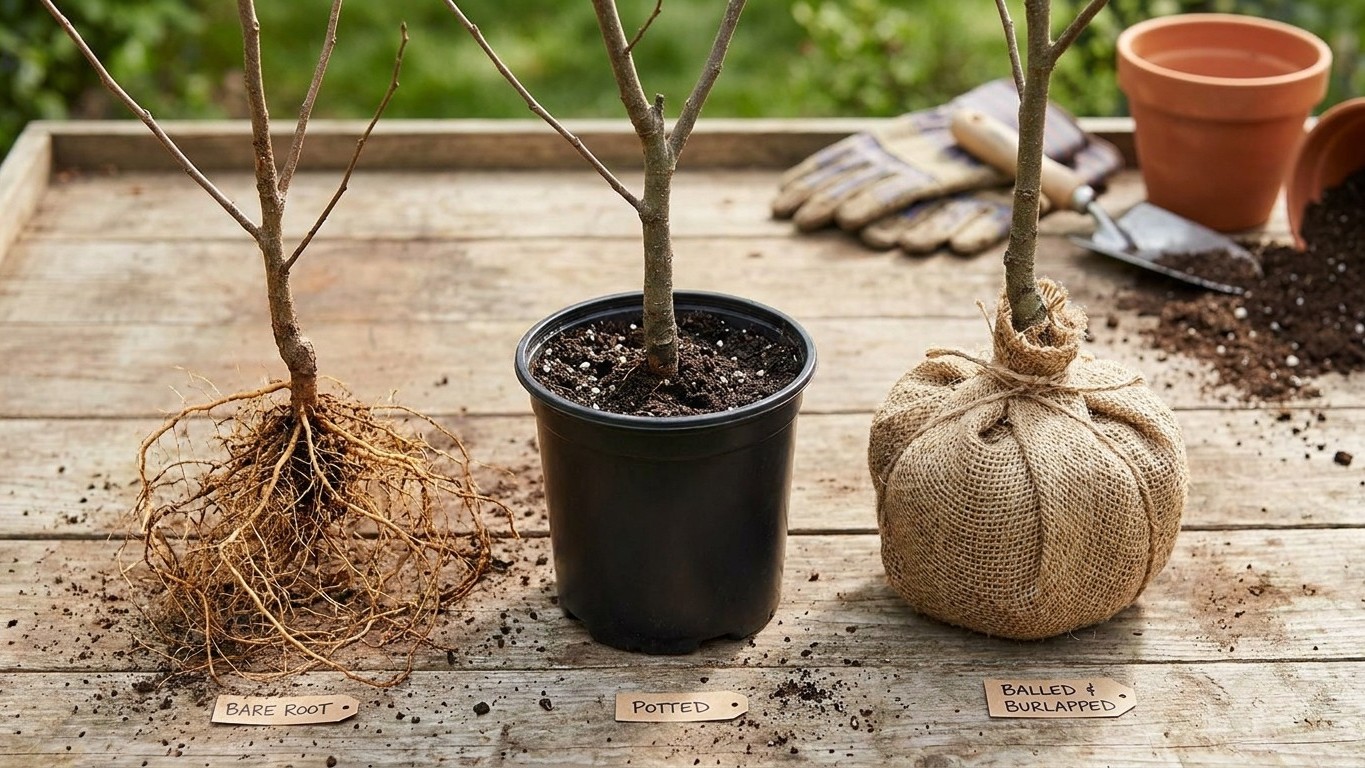

The label tells you plenty before you ever touch the plant. Bare root costs the least and demands the shortest window to plant it. Container costs more but forgives a slower schedule. Balled-and-burlapped costs the most and hides the most damage, because a field-dug root system is already a transplant before it reaches your yard. The real cost isn’t just the price tag, it’s how much of the root system survived the trip.
Three ways a plant arrives

| Form | What it is | When available | What you can see | Planting demands |
|---|---|---|---|---|
| Bare root | Dormant plant with soil washed off, roots exposed | Narrow dormant-season window, often mail-order | The entire root system, start to finish | Must go in fast, roots kept moist every minute out of the ground |
| Container-grown | Grown and sold in its pot, usually plastic | Nearly year-round at most garden centers | Nothing until you remove the plant from the pot | Loosening or scoring circling roots before planting |
| Balled-and-burlapped | Field-grown, dug with a soil ball wrapped in burlap | Spring and fall for the largest stock | Almost nothing without removing wrapping and digging into the ball | Handling wrapping, twine and wire, often with equipment for weight |
Read that table across, not down. The first two columns explain price and timing, which is what most shoppers compare first. The third column is the one that actually predicts how the plant performs for the next three years, because a root system you can inspect is a root system you can fix before it ever goes in the ground. Bare root gives you the whole story. Container gives you a locked box. Balled-and-burlapped gives you a wrapped, tied, sometimes wired box that most buyers never open at the point of sale.
That visibility gradient is the single biggest reason experienced growers keep buying bare root stock even when it’s less convenient. It’s also why container problems are so common: the defect is invisible at checkout and only shows up two or three seasons later, when a tree that should be thickening at the base instead looks pinched, as if strangled at soil line. B&B carries a version of the same risk, just buried deeper and wrapped in burlap instead of plastic.
None of this means one form is universally better. A gardener planting a hundred-foot hedge row in late winter has excellent reasons to buy bare root. A homeowner replacing one shade tree in July has no bare-root option at all, the season has closed. The right form is usually decided by the calendar and the size of the job before it’s decided by root quality, and the rest of this page is about managing the form you actually have in front of you.
Bare root, and why it is underrated
Bare root plants arrive without soil, dormant, light enough that a five-gallon-equivalent tree can ship in a padded sleeve instead of a pot full of dirt. That’s what makes them cheap to grow, cheap to ship and cheap to buy: nurseries aren’t paying to move soil around the country, and buyers aren’t paying to move it either. The tradeoff is timing. Bare root stock is dug and sold only while the plant is fully dormant, which is a narrower window than “container available nearly all year,” and once the season closes for a given region, bare root supply for that plant dries up until next year.
The reputation bare root has for being risky is mostly a handling problem, not a form problem. A bare root plant has no soil buffer around its roots, which means the fine feeder roots that do the actual water and nutrient uptake are exposed to drying air the moment the packaging comes off. Roots that dry out even briefly don’t recover, they’re dead, and a plant can lose its finest roots in the time it takes to answer a phone call in the driveway. That single fact explains most bare root failures better than anything about the species or the source.
What bare root actually gets you
Handle it correctly and bare root has real advantages that container and B&B can’t match. You see the entire root system before you commit to planting it, so there’s no guessing about whether roots are circling, kinked or broken somewhere inside a rootball. There’s no mismatch between the fine potting mix a nursery used and the heavier native soil in your yard, a mismatch that can create a barrier at the edge of the planting hole in container and B&B plantings. And because the roots spread out naturally into the hole rather than being unwound from a tight coil, establishment is often smoother than the plant’s low price would suggest. It’s an underrated form mainly because it asks for more attention in the first hour after arrival and gives almost nothing back if that hour is wasted.
Container, and what to check before buying
Container stock is the form most people buy without thinking twice, because it’s sitting on a garden center bench year-round, already leafed out, looking finished. That convenience is exactly why its main defect goes unnoticed so often. Roots grown in a rigid pot eventually hit the wall and turn, circling around the inside of the container instead of spreading outward the way they would in open ground. A plant left in its pot too long can build a spiral of roots that never fully straightens out once it’s in the ground, and that spiral can tighten around the trunk’s own base for years before it causes visible trouble.
The fix isn’t avoiding containers altogether, it’s inspecting before you buy, or at least before you plant. A few minutes of checking at the garden center catches most of the problems that would otherwise take years to show up.
- Look at the drainage holes on the bottom of the pot for roots already emerging or circling out of them.
- Look at the soil surface for the root flare, the point where trunk widens into roots; if it’s buried under an inch or more of potting mix, that’s a plant that’s likely been up-potted without correcting the depth.
- Ask if you can lift the plant partway out of the pot to check the root mass directly, which most independent nurseries will allow for a serious buyer.
- Compare the size of the top growth to the size of the pot; a plant whose canopy towers well over its container has usually been in that pot longer than is good for its roots.
Any circling you find at purchase is far easier to correct with a knife or your fingers at planting time than after the roots have thickened into permanent structure. For a full breakdown of how that damage develops and how to correct it, see the girdling roots guide on this site.
Balled and burlapped, and the wire basket
Balled-and-burlapped stock is how nurseries move the plants too large to grow economically in a pot: shade trees, big evergreens, anything where the root ball needed to support that top growth would need a container the size of a trash can. Instead, the plant is grown in a field, then dug with a mechanical spade that cuts a ball of soil around the roots and no farther. Most of the root system a field-grown plant actually had stays behind in the field dirt outside that cut line. A large B&B plant is, by definition, a transplant before it ever reaches your yard, arriving with a fraction of the roots it was using the day before it was dug.
That’s worth knowing not to reject B&B stock but to plant it with realistic expectations: it needs more careful aftercare in year one than a comparable container plant, precisely because it’s recovering from surgery rather than simply relocating.
What to deal with at the hole
Two things hide inside every B&B ball and both need attention rather than a shovel of soil dumped over them. First, the root flare is very often buried several inches deep inside the ball itself, a byproduct of how the ball was built up around the trunk at digging time; find it before deciding how deep to set the plant. Second, the burlap, the twine holding it, and in many cases a wire basket wrapped around the whole ball for shipping strength all need to be cut back or removed at planting rather than left in place. Twine left wrapped around a trunk girdles it as surely as a stake tie left too long, cutting into bark that thickens around it year after year until the trunk is choked at that point.
According to NC State Extension, “An ideal planting hole is only as deep as the root ball and at least two to three times wider, with roughened sides sloping in toward the bottom.” That width matters more with B&B stock than with any other form, because the heavy clay walls a spade leaves behind a wide hole otherwise act exactly like the smooth wall of a pot, discouraging new roots from ever pushing past the hole’s edge.
Mulch and staking finish the job. NC State Extension recommends a mulch layer to “reduce water loss and maintain uniform soil moisture and temperature around roots,” giving a range of “2-inch to 3-inch” for general plantings and a full “3-inch layer” for trees specifically, not deeper, since a thick mound piled against the trunk causes the rot and vole damage mulch is meant to prevent. That’s why the same source advises to “pull mulch 6 inches away from the base of plants to prevent bark decay and vole damage”: the bark at the trunk base should stay visible, a quick visual check anyone can do without a tape measure. If a B&B tree needs staking to stay upright through its first season, NC State Extension is clear that stakes should come out “within one year after planting or growth may be reduced,” and for trees planted in fall, “it may be possible to remove stakes… by midspring” once the season allows. For the hole size and depth in more detail, see the planting depth guide, and for handling large root balls specifically, the transplanting guide covers the process step by step.
Common questions
Is bare root cheaper because it’s lower quality?
No. The lower price reflects lower shipping and growing costs, not a weaker plant. A well-handled bare root plant with an intact, visible root system is often in better shape than a container plant that’s been sitting root-bound on a bench for an extra season.
Can I plant a container tree any time of year?
Container stock is sold nearly year-round, but “available” isn’t the same as “ideal timing.” Check your state’s frost date page for the safer planting window in your area rather than relying on the garden center’s shelf stock as a planting calendar.
Do I need to remove the entire wire basket from a B&B root ball?
At minimum, cut away the top portion of the basket, burlap and twine around the upper root ball and the trunk so nothing constricts the flare or the widening trunk as it grows. Leaving buried wire deep in the ball is less urgent than leaving anything wrapped around the trunk itself.
Should I use a root repellent or treatment when planting container stock?
There’s no reliable evidence supporting chemical root treatments or repellents at planting time. Correcting circling roots physically, by loosening or cutting them, is the step with documented backing; a product isn’t a substitute for that inspection.