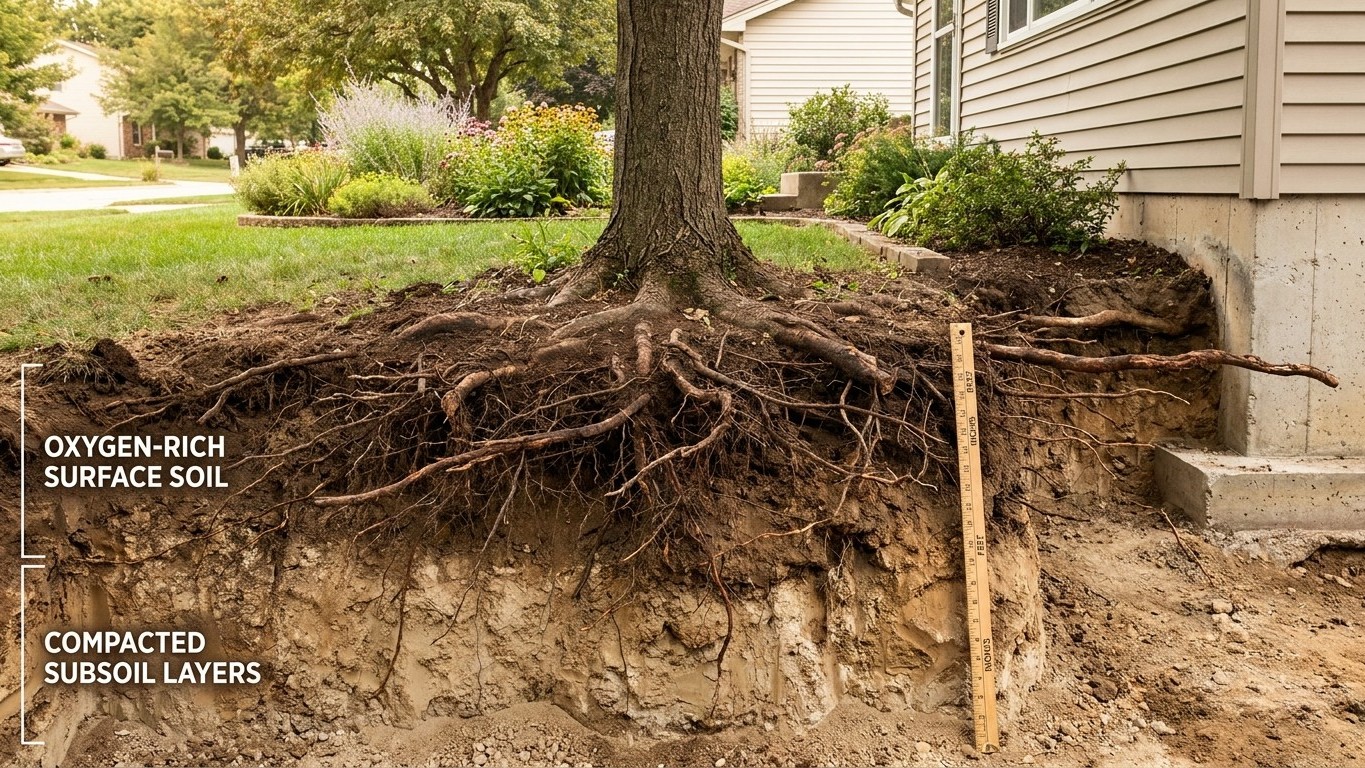

The mental image of a root snaking under a slab and cracking it like a fist is mostly wrong. Real foundation problems linked to trees come from a narrower set of causes: soil that shrinks and swells with moisture changes, drains that already have a crack or open joint, and paving sitting on shallow, compacted ground. Knowing which of these applies to a given yard changes what’s worth worrying about and what isn’t.
Roots go out, not down

Picture a tree’s root system as a wide, shallow plate rather than a mirror image of the branches above. The great majority of a tree’s roots live in the top 12 to 18 inches of soil, and they spread outward, often reaching two to three times beyond the edge of the canopy. That’s because roots follow air, water, and loose soil, and all three are concentrated near the surface. Below that shallow layer, soil compacts and oxygen drops off fast, so roots simply don’t bother going deeper unless they’re forced to by a very specific need, like reaching groundwater in a drought-prone spot.
This changes what “close to the foundation” actually means. A tree planted 15 feet from a house doesn’t have roots quietly working their way straight down and sideways toward the footing several feet underground. Its roots are spreading laterally near the surface, which puts them in contact with lawns, garden beds, driveways, and buried utility lines long before they’d ever reach a foundation footing that typically sits below the frost line.
That’s also why the popular fear (a root physically pushing over a wall or shoving through poured concrete) almost never matches what actually happens. Concrete and masonry are far stronger in compression than a growing root is in force. What roots do instead is slower and less dramatic: they exploit existing cracks, they lift things that are already resting unevenly on the surface, and in certain soils they change how much water is available to the ground right under a structure. Each of those is a different mechanism with a different fix, and none of them look like the horror-movie image of a root breaking a wall in half.
The distinction matters because it points to where attention should actually go. Surface heave under a walkway is a landscaping nuisance. A cracked drain letting roots in is a plumbing problem that started as a plumbing defect. And soil moisture changes under a foundation on shrinkable clay are a structural question that depends on geology far more than on any single tree. Sorting a specific situation into one of these three categories is more useful than asking the vague question “can this tree hurt my house.”
What roots actually do to hard surfaces
Laid out plainly, there are really three things roots do to hard surfaces and buried infrastructure, and they don’t carry equal weight.
| What happens | How it happens | The sign to look for |
|---|---|---|
| Lifting paving and paths | A root growing just under a slab or paver thickens over years and physically raises the surface above it, since the root has nowhere else to expand. | A section of walkway or driveway edge that has tilted or humped, usually tracing the path of a root visible at the surface nearby. |
| Entering drains | Roots grow toward the moisture and nutrients leaking from a joint or crack that already exists in the pipe. They don’t create the opening; they find it. | Slow drains, gurgling, or backups that a camera inspection traces to root intrusion at a specific joint or fracture. |
| Changing soil moisture (shrinkable clay) | On clay-heavy soils, a large tree’s roots draw enough water out of the ground during dry spells that the clay shrinks and the soil under a shallow foundation settles unevenly. | New or widening cracks that tend to appear or worsen during drought and partly close up again after wet periods. |
The drain case deserves a closer look, because it’s the one most often described backwards. Roots don’t drill through sound pipe. They follow a crack, a loose joint, or a spot where a pipe has already separated slightly, drawn by the moisture escaping from that defect. A pipe in perfect condition sitting next to a mature tree’s root zone for decades can stay root-free, while an already-compromised pipe two feet from a small shrub gets invaded within a couple of seasons. That’s why a root problem in a sewer line is, underneath it, a maintenance problem with the pipe that predates the roots finding it.
Notice what’s missing from this list: a specific safe distance to plant from a house or a driveway. That number depends entirely on the soil type and on how large a given species gets at maturity, and this page isn’t the place to guess at it. The mature size, spread, and root habit of a specific tree belong on that tree’s own plant page, and that’s the number to check before deciding how close is too close for a particular yard.
Getting it right at planting time
Most of the risk described above is set at planting, not discovered years later. Three decisions, made before the tree ever goes in the ground, do most of the work.
- Choose based on the tree’s size at full maturity, not the size it is in the nursery pot. A species that tops out at 60 feet needs to be planted with that eventual footprint in mind, not the 6-foot sapling standing in front of you.
- Keep species known for wide, aggressive root systems away from paving, foundations, and buried drain lines, and closer to open lawn or bed space where lifting a slab isn’t a concern.
- Think about where the crown and root spread will actually be in twenty years, since a tree planted 8 feet from a patio looks fine on day one and can be crowding that patio by the time it’s mature.
The tree’s own page is where the mature height, spread, and root behavior for that specific species live, and the state page for your zone is where the local frost dates and climate fit come in. Neither belongs restated here; both are the inputs this planning depends on.
The hole, the mulch, and the stakes
Beyond species and placement, how a tree is physically planted affects how stable and well-anchored its root system becomes. According to the NC State Extension Gardener Handbook, “an ideal planting hole is only as deep as the root ball and at least two to three times wider, with roughened sides sloping in toward the bottom.” Smooth-sided holes dug in clay behave like the inside of a pot, and roots that hit that glazed wall tend to circle rather than spread outward the way they should.
Mulch matters too, and more isn’t better here. NC State Extension recommends a “2-inch to 3-inch layer of mulch” to suppress weeds, and specifically for trees, a “3-inch layer of mulch to reduce water loss and maintain uniform soil moisture and temperature around roots.” Beyond that range, a thick mulch volcano piled against the trunk does the opposite of Protecting it. The same source is clear that mulch should be pulled “6 inches away from the base of plants to prevent bark decay and vole damage.” The number is worth measuring, but the quick visual check is simpler: the trunk flare should be visible, not buried under a mound of mulch.
Staking is meant to be temporary. NC State Extension advises to “remove all staking within one year after planting or growth may be reduced,” and notes that “it may be possible to remove stakes for fall-planted trees by midspring.” One year is the outer limit, not a target to aim for. A tree that’s still rigidly staked well into its second season isn’t building the flexible trunk and root anchoring it needs to stand on its own in wind, which is part of what keeps it stable near hardscape for decades afterward.
When the tree is already there
For a tree that’s already established near a house, the practical question isn’t “could roots ever cause a problem,” it’s “is something actually happening right now.” A few observable signs are worth tracking over time rather than reacting to once: cracks in walls or foundations that are new or visibly widening (rather than old, stable hairline cracks), doors and windows that have started sticking when they didn’t before, and paving or walkways that have visibly lifted or tilted near the tree’s root zone. Photographing cracks with a ruler or a coin for scale, checked every few months, tells you far more than a single glance.
Where this page has to stop is at attribution. Deciding whether a specific tree is actually responsible for movement in a specific foundation requires assessing the soil type, the depth and condition of the footing, drainage patterns, and often a period of monitoring, and that’s work for a structural engineer or a qualified arborist who can inspect both the soil and the structure together. A gardening page can describe the mechanism; it can’t diagnose a particular house.
One point is worth being direct about: removing a mature tree isn’t automatically the safe, cautious choice it seems like. On shrinkable clay soils, a large tree that’s been drawing water out of the ground for decades is, in effect, keeping that soil relatively dry and settled. Cut it down, and the ground can rehydrate and swell as it recovers, which has its own potential to move a foundation, sometimes worse than the original situation. That’s a case where doing nothing and getting a proper soil and structural assessment first beats a quick decision made out of worry.
Common questions
Do tree roots really crack solid, undamaged foundations?
Rarely. Concrete and masonry resist the outward force a root can generate far better than popular belief suggests. Most foundation movement blamed on roots actually traces back to soil moisture changes on clay-heavy ground, not a root physically breaking sound material.
How can I tell if a drain problem is caused by roots?
Slow drains, gurgling, or repeated backups are the first signs, but confirming root intrusion usually takes a camera inspection of the line. That inspection will also show the crack or joint defect the roots grew into, which is the part worth fixing alongside clearing the roots.
Is it safe to plant a tree near an existing patio or driveway?
It depends on the species’ mature root spread and the local soil type. Check the mature size and root habit on that tree’s own plant page, and favor smaller, less aggressive species close to any paving you don’t want to redo.
Will removing a tree stop foundation cracks from getting worse?
Not necessarily, and on shrinkable clay it can make things worse before they get better, since the soil can swell as it rehydrates once the tree stops drawing water from it. Any decision like this belongs with a structural engineer or qualified arborist who can assess the soil and the building together.