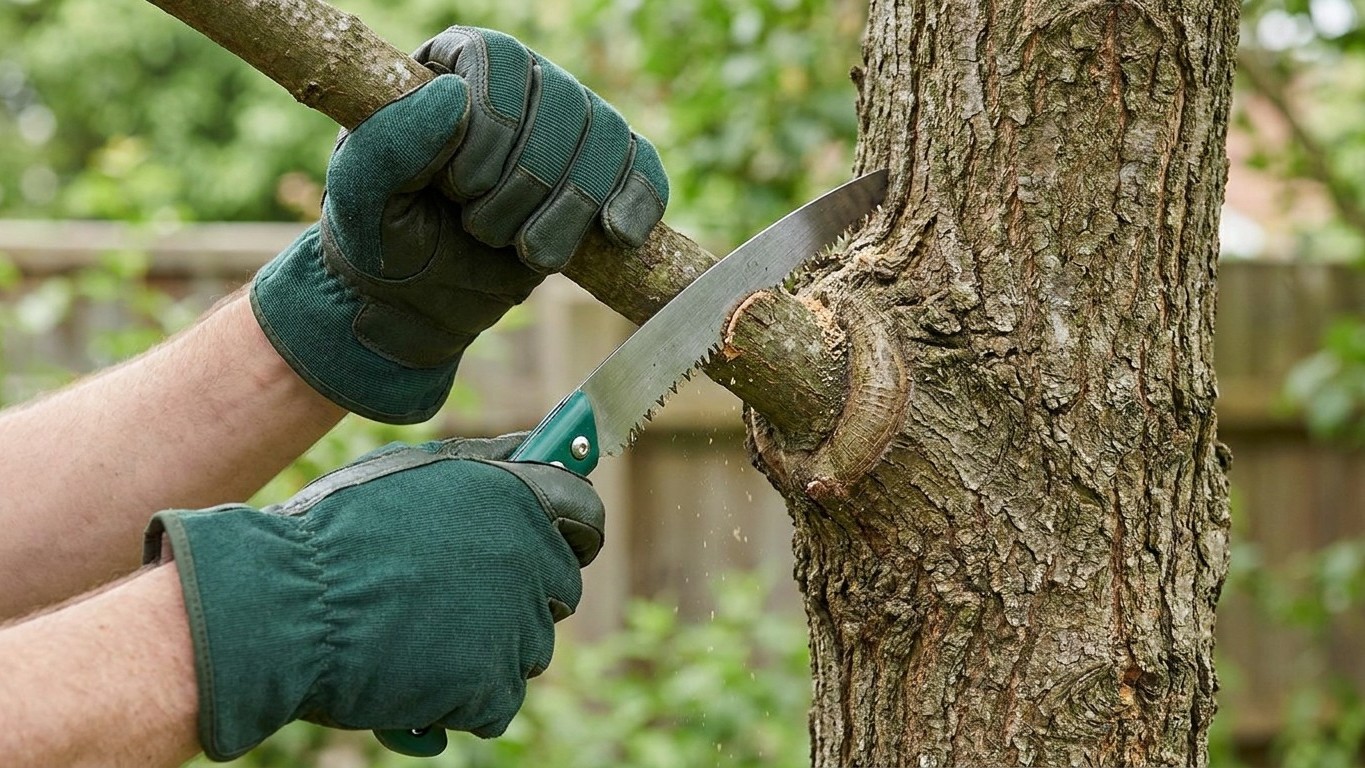

Cut just outside the branch collar, the slightly swollen ring where a branch meets the trunk, angling the cut so it follows that ring rather than slicing flat against the bark. Never cut flush with the trunk, and never leave a long stub. For anything too heavy to hold with one hand, use three cuts instead of one, because a single cut on a heavy limb tears bark down the trunk on its way to the ground. A tree does not heal a wound. It compartmentalizes it, walling it off permanently.
The collar is where the plant defends itself

Look closely at the base of almost any branch and you’ll find a slight swelling, sometimes barely noticeable, sometimes a visible ridge, where the branch tissue flares into the trunk. That ring is the branch collar, and it is not decorative. It’s the boundary the plant builds between the branch and the main stem, a zone of tissue specialized for sealing off damage. Cut outside that ring and the plant can close the wound over with new growth around the edges, layer by layer, over a period of years. Cut through the collar, flush against the trunk to make it look “clean,” and you remove the one structure the plant relies on to defend itself. The wound left behind is larger, slower to close if it closes at all, and far more exposed to decay organisms that move in through open wood.
This is the point where a lot of pruning advice gets the biology backwards. People talk about a tree “healing” a cut, the way skin heals a cut on a hand. That’s not what happens. Wood cells don’t regenerate and reconnect the way animal tissue does. Instead, the tree isolates the damaged area, building chemical and physical barriers around it so that decay, if it starts, is contained rather than spreading into healthy wood. Foresters and arborists call this compartmentalization. It’s a slower, more static process than healing, and it depends entirely on that collar tissue being left intact so the plant has the material to build the barrier with.
Removing the collar doesn’t just leave a bigger wound. It removes the mechanism itself. A flush cut through the collar exposes the trunk’s core wood directly, wood that was never built to be a surface layer, and gives decay a much shorter path inward. That’s why a flush cut, ironically the one that looks tidiest right after pruning, often ages into the worst-looking wound on the tree, sunken and dark, sometimes for the rest of the tree’s life.
None of this means the reader needs to hunt for an exact measurement before making a cut. The collar is visible on most branches if you look for the swelling or the change in bark texture where branch meets trunk. The working rule is simple: cut just outside that visible ring, following its angle, not straight across the trunk. If there’s no visible collar because the branch grew nearly flush already, cut as close to the trunk as possible without cutting into trunk bark. The collar, not a tape measure, is the guide.
Three cuts, not one
A single cut works fine on a small branch you can support with one hand while cutting with the other. Anything heavier than that needs three cuts, in this order:
- An undercut, made from below, a short way out from the collar
- A second cut from above, further out along the branch, that removes the bulk of the weight
- A final cut just outside the collar, removing the remaining stub cleanly
The undercut is the step people skip, usually because it feels backwards to cut from underneath before cutting from on top. But that first cut is what prevents the branch from tearing bark down the trunk as it falls. Without it, the weight of the branch starts to pull the wood downward before the top cut finishes separating it, and the branch snaps off early, ripping a strip of bark and outer wood down the trunk below the cut. That torn strip is often worse damage to the tree than the pruning itself, and it happens fast, in the last second of the cut, which is why so many people only discover it after the branch is already on the ground.
The second cut, from above and further out on the branch, takes the weight off entirely before anyone deals with the final, precise cut near the trunk. This is the step that turns a dangerous, heavy piece of wood into a manageable stub. Once the bulk is gone, the final cut near the collar can be made carefully and slowly, without the branch’s weight fighting the saw or splitting the wood as it falls.
There’s no fixed distance to give for where the first two cuts should sit on the branch, because branch diameter, wood density and how far the limb extends all change the math. The instruction that holds across species and sizes is this: make the first cuts far enough out from the trunk that the branch cannot tear back to the collar, no matter which way it falls or twists as it separates. On a branch a few inches thick, that might be a foot or two out. On a heavy limb high in a mature tree, it’s considerably farther, and that’s part of why heavier limbs belong to a different category of job entirely, discussed further down.
Wound paints, sealants and pruning “dressings” don’t change any of this. They are not a substitute for making the three cuts correctly, and a bad cut covered in sealant is still a bad cut underneath.
The cuts that cause trouble
Four mistakes account for most of the damage seen on pruned trees, and all four are avoidable once you know what to look for.
| Cut | What it does to the plant | What you’d see afterward |
|---|---|---|
| Flush cut | Removes the branch collar along with the branch, eliminating the tissue the plant needs to wall off the wound | A large, flat wound that stays open longer than it should, often darkening or sinking over years |
| Stub | Leaves dead wood beyond the collar with no living tissue to seal it off | A dead nub that never closes over, eventually rotting back toward the trunk |
| Torn cut | Rips bark and wood fiber below the cut instead of severing cleanly | A ragged strip of missing bark running down the trunk, sometimes several feet |
| Topping | Removes the tree’s main structural branches or leader, cutting into the crown indiscriminately | A stub-covered tree that regrows dense, weakly attached shoots from dormant buds near the cuts |
Topping deserves its own explanation, because it’s still marketed by some crews as a way to “control size” or reduce storm risk, and it does the opposite of both. A tree’s crown is a structure the plant has built over years, with branches attached at points and angles that distribute weight and wind load reasonably well. Topping removes that structure wholesale, cutting main limbs down to stubs regardless of where a collar is. The tree responds by pushing out new growth from dormant buds near each cut, and that new growth comes in as a cluster of fast, weakly attached shoots rather than a properly formed branch. Those shoots grow quickly because the tree is reacting to a crisis, and they attach to the stub with a much weaker union than an original branch ever had. A few years after topping, a tree often carries more total foliage than before, on branches far more likely to fail in a storm, attached at the exact points that were cut. The tree that was topped to reduce hazard usually ends up more hazardous than the one left alone.
Wound paint and sealant show up again here because people reach for them specifically after a flush cut or a topping job, hoping to cover the damage. They don’t restore a collar that’s been removed, and they don’t stop the tree’s own compartmentalization process, which is already underway with or without a coating. If the cut was made wrong, sealing it doesn’t make it right.
What is not a homeowner’s cut
Some pruning belongs to a professional, and the line is worth drawing clearly rather than softening it. Anything overhead that could fall on a person, a car, a roof or a fence if it comes down wrong is not a job to learn on. Anything that requires a ladder with a saw in hand is a fall risk that isn’t worth the branch. Anything near a power line should never be touched by a homeowner, full stop. And anything on a large mature tree where the cut can’t be reached comfortably from the ground, using hand tools or a pole saw while standing on solid footing, is a job for someone trained to work above ground level safely.
That’s the point at which calling an arborist makes sense. An arborist is a professional trained specifically in tree care, pruning technique and tree biology, and a certified arborist has passed exams covering exactly the kind of anatomy and technique described above, the collar, compartmentalization, proper cut placement on mature trees. When calling one, ask what certification they hold, whether they carry liability insurance, and whether they’ll explain their pruning plan before cutting rather than just showing up and starting. A professional should be able to point to the collar on a branch and explain why they’re cutting where they are, the same logic that applies to a small branch in a backyard applies at forty feet up in a hundred-year-old oak, just with equipment and training most homeowners don’t have and don’t need to acquire for a once-a-year job.
Staking and mulch decisions around a young tree don’t carry the same physical risk, but they follow the same logic of doing the job at the right time rather than leaving it too long. Stakes used to support a newly planted tree should come out within one year after planting, or growth may be reduced, and for trees planted in fall it may be possible to remove the stakes by midspring. Mulch around the base should sit at a 3-inch layer, pulled back 6 inches from the trunk so the bark stays visible and clear, since built-up mulch against the trunk invites decay and gives voles cover to chew bark over winter.
Common questions
Do I need to cut at an angle, or straight across?
Follow the angle of the branch collar rather than aiming for a specific angle in degrees. The collar usually isn’t perfectly perpendicular to the trunk, so a cut that respects its shape will naturally come out angled somewhat.
Is it ever okay to make a flush cut?
No. Even when a branch looks like it’s growing nearly flush against the trunk already, there’s still a collar to look for and cut just outside of, not through.
Can I prune a branch that’s already broken or torn?
If the torn end is low enough to reach safely from the ground, cleaning it up by cutting back to just outside the nearest collar is reasonable. If the tear is overhead or on a large limb, treat it like any other overhead cut and call a professional.
Will a bad cut kill the tree?
Not usually on its own, but a flush cut, a stub or a torn cut all create larger, longer-lasting entry points for decay than a proper cut does, and repeated bad cuts over the years compound that risk considerably.