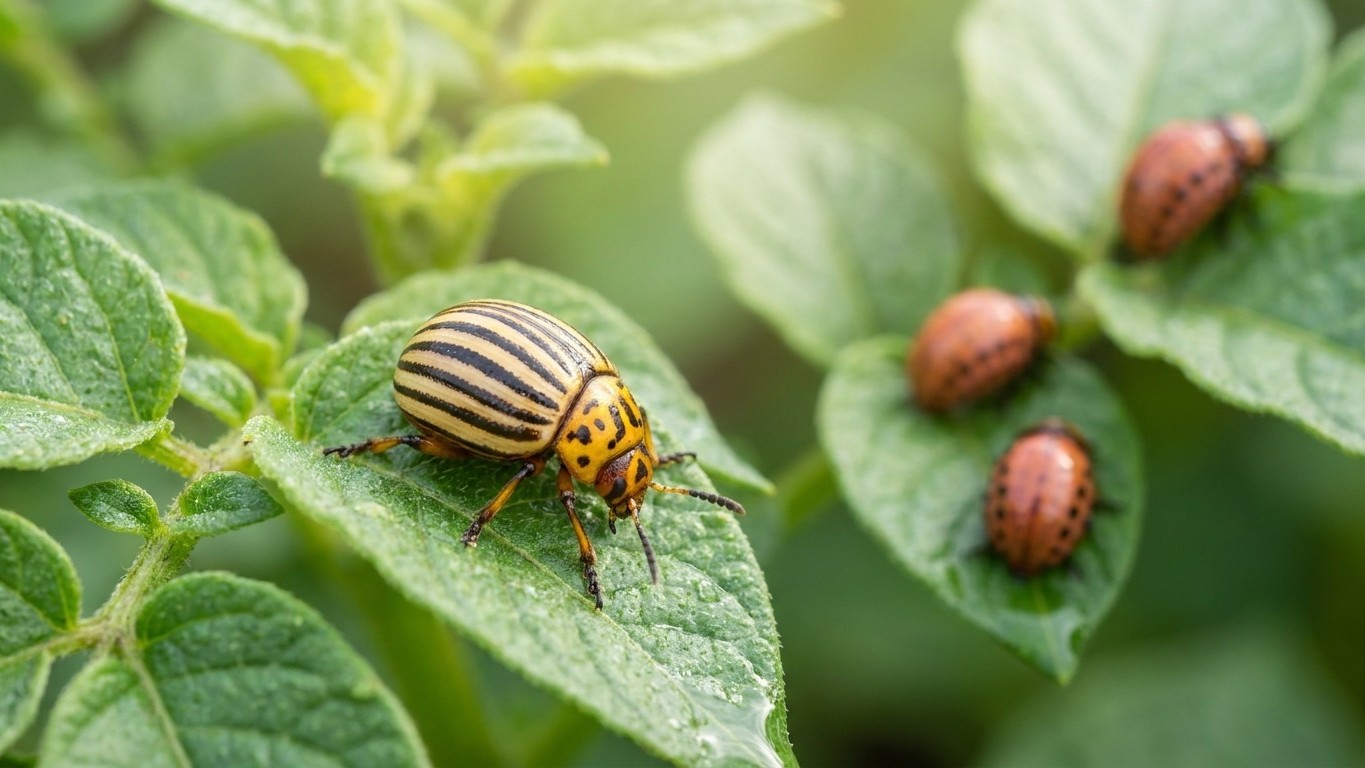

A Colorado potato beetle sighting on your plants means fast action, not observation. Utah State University Extension describes the adult as a yellow and black striped beetle measuring about 1/2 inch long and 1/4 inch wide, with larvae that are reddish orange and marked with black spots on each side. Left alone, larval feeding defoliates the plants. The fix starts with your hands: pick adults off, rub out egg masses.
The short answer
Utah State University Extension, in its guidance on Potatoes in the Garden, gives a precise physical description that removes most of the guesswork: a yellow and black striped beetle, 1/2 inch long and 1/4 inch wide. That size matters more than gardeners tend to think. A lot of striped or spotted insects show up on potato foliage over a season, and half of them get blamed on “potato bugs” without anyone checking dimensions. The Colorado potato beetle sits in a fairly narrow size range, and the stripe pattern on the wing covers is distinct enough to confirm with a quick look, not a lab test.
The larval stage looks nothing like the adult, which trips up a lot of people scouting their rows for the first time. Reddish orange body, black spots running down each side, no stripes at all. If you’re only picturing the striped adult and ignoring the soft-bodied, spotted larvae crawling over the same leaves, you’re missing half the population doing the actual damage. That’s the detail Utah State University Extension flags directly: larval feeding is what defoliates the plants. Adults do feed too, but the larvae are the ones capable of stripping a plant down to bare stems in a short stretch of warm weather, because they hatch in clusters and feed as a group on the same leaves.
Eggs come before any of that. They show up in tight clusters on the underside of leaves, usually bright orange-yellow, and they’re the stage most gardeners walk past without noticing. By the time the stripes on an adult or the spots on a larva catch your eye, there’s already a next generation glued to the leaf underneath. That’s why the published control leads with egg masses specifically, not just visible insects. Scouting the top of the plant and skipping the underside of the leaves means missing the stage that turns one beetle problem into three.
None of this requires special equipment. A daily or every-other-day walk through the potato patch, checking both leaf surfaces, catches the beetle at every stage before defoliation gets serious. The description from Utah State University Extension is specific enough that once you’ve seen it once, misidentifying the adult becomes hard to do. The larvae take a bit more attention, mostly because gardeners expect a “beetle problem” to look like a beetle, not a soft orange grub.
What actually decides it
Size and pattern decide the adult identification, and they decide it fast. The 1/2 inch by 1/4 inch measurement isn’t a rough estimate, it’s the detail that separates the Colorado potato beetle from smaller or larger striped insects that occasionally wander onto potato foliage. Combine that measurement with the yellow and black stripe pattern running lengthwise down the wing covers, and there’s very little room for confusion once you’ve actually looked closely rather than glancing from a few feet away.
The larval stage works on a completely different set of markers, because color and spot pattern replace stripes entirely. Reddish orange body, black spots along each side, no shell pattern to speak of since the larvae are soft-bodied rather than hard-shelled like the adults. That contrast between adult and larva is the single biggest mechanism at play here: two visually unrelated life stages on the same plant, both capable of feeding, only one of them described as doing the defoliating damage. A gardener who identifies the striped adult but never registers the spotted larva as the same species is only catching half the problem, and often the less destructive half.
Feeding location adds another layer. Both adults and larvae work the foliage rather than tunneling into stems or tubers, which is a meaningful distinction from soil-dwelling or tuber-boring pests that show up on the same plants at different points in the season. If the damage you’re looking at is leaf tissue disappearing, with visible chew marks working inward from the leaf edges or through the middle of the leaf blade, that points toward foliage feeders like this beetle rather than something working underground. Tuber damage, stem tunneling, or wilting from a vascular problem point somewhere else entirely, and treating for the wrong pest wastes both time and whatever control method gets applied.
The egg stage decides timing more than identification. Because the clusters sit on the underside of leaves and hatch into the larvae described above, catching and removing eggs before hatch is the single most efficient point of intervention, both in terms of numbers removed and labor required. One egg mass rubbed out before hatching accounts for far more potential feeding damage prevented than picking off larvae one at a time after the fact. That timing detail, more than any single visual marker, is what actually determines how much damage a garden sees over a season.
What to do about it
- Confirm the identification first. Match what’s on the plant against the published description: a yellow and black striped beetle about 1/2 inch long and 1/4 inch wide for adults, reddish orange larvae with black spots on each side. Treating the wrong insect wastes effort and can delay action against the actual problem.
- Check leaf undersides for egg masses on a regular schedule. Eggs are the easiest life stage to remove in bulk, since one cluster rubbed out prevents an entire batch of larvae from ever hatching. This step is far more efficient than waiting until larvae are already feeding.
- Hand pick adults from the plants as they appear. This is the control method Utah State University Extension names directly, and it works because adults are large enough and slow enough to remove by hand without special tools.
- Rub out egg masses as they appear, not just once. This isn’t a one-time task early in the season. New egg masses show up as long as adult beetles are active, so the check needs to repeat through the growing weeks, not stop after the first pass.
- Watch for larval feeding and defoliation between checks. Since larval feeding is what defoliates the plants, a jump in visible leaf loss between scouting visits is a signal that hand removal alone isn’t keeping pace with the population on that plant.
- Bring in appropriate insecticides only if hand removal falls behind. Correct identification has to come first, because an insecticide applied against the wrong pest, or applied without confirming the beetle and larval stages present, is money and time spent without addressing the actual defoliation.
What goes wrong
- Mistaking the larva for something unrelated to the adult. The reddish orange, black-spotted larva looks nothing like the striped adult, and gardeners who don’t connect the two stages sometimes treat the adult while leaving an active larval population feeding on the same plants.
- Confusing other spotted or striped garden insects for this beetle. A range of beetles and larvae show up on vegetable foliage over a season, and general similarity in color, orange or black markings on an otherwise unfamiliar insect, leads to misapplied control. The specific size (1/2 inch by 1/4 inch) and the striped pattern on the adult are the details that actually confirm identification, not a general impression of “striped bug on the potato leaf.”
- Overlooking egg masses entirely. Because eggs sit on the underside of leaves, a scouting pass that only checks the top of the plant misses the stage where removal is most effective, and the gardener ends up reacting to larvae instead of preventing them.
- Assuming leaf damage without visible beetles means a different problem. Larval feeding can defoliate a plant quickly, and if the check happens after larvae have already moved on or been washed off by rain, the damage can look mysterious even though the cause was straightforward foliage feeding by this beetle’s larval stage.
- Waiting for heavy visible infestation before checking leaf undersides. By the time adult numbers are obvious, egg masses and early larvae are often already established, which turns a manageable hand-picking task into a larger defoliation problem across more plants.
Common questions
How big is a Colorado potato beetle exactly?
Utah State University Extension describes the adult as about 1/2 inch long and 1/4 inch wide, with a yellow and black striped pattern on the wing covers.
Do the larvae look like the adult beetle?
No. The larvae are reddish orange with black spots on each side, without any of the striping seen on the adult stage, according to Utah State University Extension.
What does the feeding damage actually look like?
Larval feeding defoliates the plants, per Utah State University Extension, meaning the visible damage is leaf tissue loss rather than tuber or stem injury.
What is the recommended way to control it without naming a specific product?
Hand pick adults from the plants and rub out egg masses as they appear, the control method described by Utah State University Extension. Appropriate insecticides can be considered if hand removal isn’t keeping pace, but identification comes first.