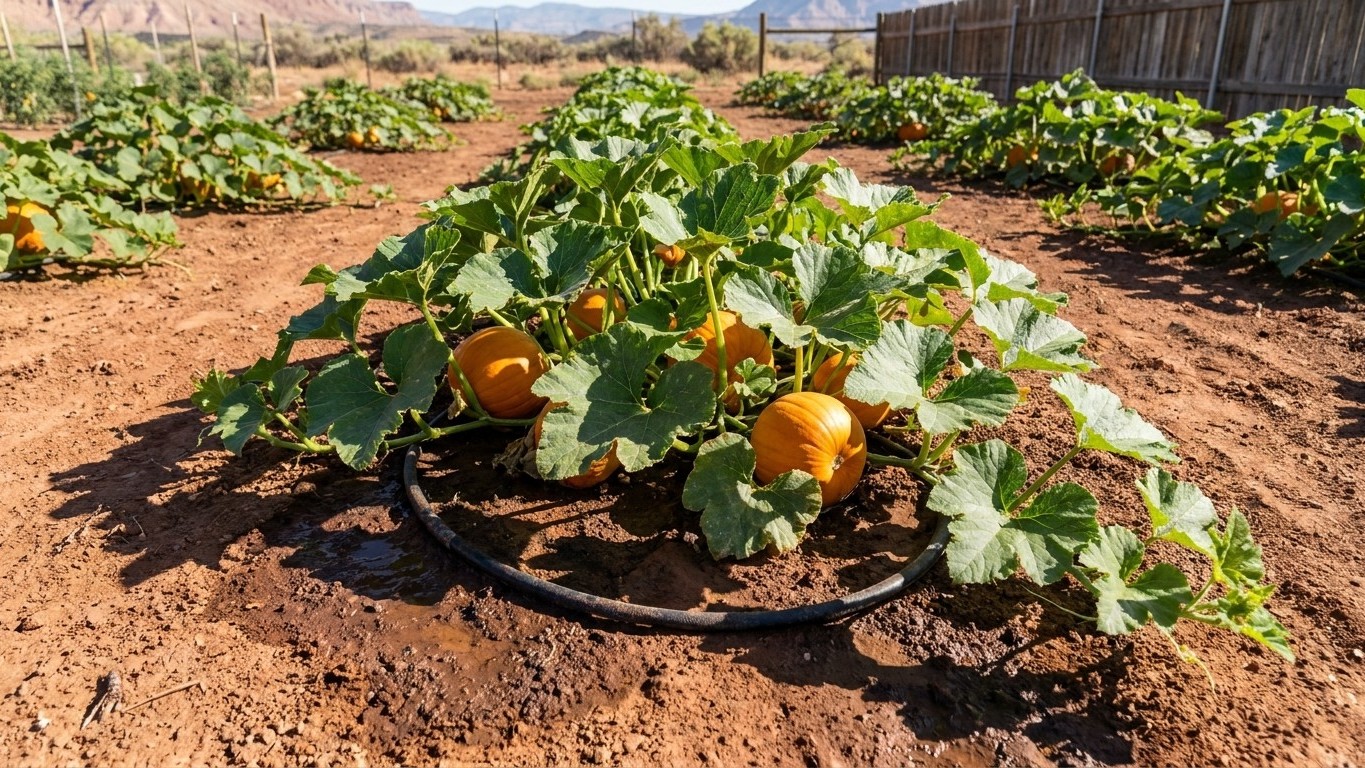

Utah State University Extension puts it plainly: pumpkins need 1-2 inches of water per week, applied deeply and infrequently rather than in daily sips. That single guideline settles most of the confusion gardeners have about hoses, sprinklers, and how often to check the soil. The trick isn’t remembering a number. It’s understanding why deep and infrequent beats frequent and shallow, and how your garden’s layout changes the math.
The short answer
One to two inches a week, delivered in a way that soaks the root zone rather than dampening the surface. That’s the standard from Utah State University Extension, and it applies whether you’re growing a single vine in a backyard bed or a full patch destined for the fall stand. The number itself doesn’t shift with plant size. What shifts is how you deliver it.
Spacing plays into this more than most gardeners expect. Utah State University Extension recommends setting transplants 2-3 feet apart in the row, with rows spaced 4-6 feet apart. That layout means each plant has a defined patch of soil to draw from, and watering deeply ensures the moisture actually reaches the roots sitting under that footprint instead of running off between plants that are packed too close.
Giant pumpkin growers work with an entirely different scale. Utah State University Extension notes that a giant pumpkin wants at least 100 square feet of garden space per hill. That’s not a typo. A single hill destined for a competition-sized fruit needs roughly the footprint of a one-car garage stall. With that much soil volume per plant, a deep watering holds moisture longer, which is exactly why the infrequent part of the guideline matters as much as the amount.
Here’s the practical takeaway: measure water in inches, not minutes. A kitchen thermometer won’t help you here, but a straight-sided can set out during watering will. If an inch of water collects in that can after a watering session, you’ve hit half the weekly target already. Two sessions like that, spaced several days apart, gets you to the full 1-2 inch range without ever turning on a hose daily.
None of this changes if the weather turns hot. The 1-2 inch figure is the baseline from Utah State University Extension, and it’s the number to build a watering routine around rather than guessing based on how the soil surface looks on any given morning.
What actually decides it
The mechanism is about root depth, not thirst. When you water a little bit every day, moisture only penetrates the top inch or two of soil. Roots follow the water, so they stay shallow. Shallow roots dry out fast, which pushes you toward watering even more often, and the plant ends up locked into a fragile cycle where it can’t handle even a short gap between waterings.
Deep watering breaks that cycle. When you apply 1-2 inches at once and then wait, water pushes further down through the soil profile. Roots extend to chase it, building a deeper, more resilient system that can tap moisture reserves several inches or more below the surface. That deeper root mass is what lets a pumpkin plant shrug off a few dry, hot days between waterings instead of wilting by early afternoon.
Several things influence how a garden actually meets that weekly target, and they don’t all pull in the same direction. Soil texture matters: sandy soil drains fast and may need the water split across two sessions rather than one. Clay-heavy soil holds moisture longer but can puddle if you apply the full amount too quickly, so a slower soak works better than a fast dump. Mulch changes the equation too, since a mulched bed loses less water to evaporation than bare soil sitting in full sun.
Spacing is the factor that ties back directly to the Utah State University Extension figures. A plant set at the recommended 2-3 feet within the row, in rows 4-6 feet apart, has a predictable volume of soil to itself. A giant pumpkin hill claiming its full 100 square feet has vastly more. That soil volume is what determines how long a deep watering actually lasts before the plant draws it down and needs another round.
Of all these variables, root depth is the one that settles the outcome. Soil type and spacing shape how you deliver the water, but it’s the depth the roots have already reached that determines whether the plant can coast through the days between waterings or starts showing stress by midweek.
How to do it
- Set spacing before you plant. Space transplants 2-3 feet apart within the row and leave 4-6 feet between rows, per Utah State University Extension. For a giant pumpkin hill, reserve at least 100 square feet so the plant has room to draw on a full reservoir of soil moisture.
- Water at the base, not overhead. Direct the hose, drip line, or soaker hose to the soil around the root zone. Wetting the leaves doesn’t help the plant and just adds moisture where disease can take hold.
- Apply a full 1-2 inches in one session. Use a straight-sided container set nearby to gauge how much water has actually gone down, rather than timing the hose and guessing.
- Let the soil dry between waterings. Don’t return to the hose the next day. Deep, infrequent watering only works if you allow the interval between sessions to do its job of pulling roots downward.
- Check progress at the base of the plant. Before rewatering, look at how the plant is handling the interval rather than watering on a fixed calendar schedule regardless of conditions.
- Adjust for rainfall. If a rainstorm delivers a chunk of that weekly inch or two, skip or shorten the next scheduled watering so you don’t overshoot the target.
- Keep the routine consistent through fruit set. Vines expand quickly once they start running, and maintaining the same deep, infrequent pattern as the plant grows keeps the root system doing the work instead of the hose.
What goes wrong
- Watering a little every day. This keeps roots shallow and the plant dependent on constant moisture. Switch to full 1-2 inch sessions spaced several days apart so roots are pushed to grow deeper instead of staying near the surface.
- Wetting the foliage instead of the soil. Damp leaves sitting through the evening invite fungal problems. Redirect the hose or drip line to the base of the plant and keep the canopy dry.
- Crowding plants tighter than the recommended spacing. Packing vines closer than 2-3 feet in the row, or rows closer than 4-6 feet, means roots compete for the same soil moisture even when you’re delivering the right total amount of water. Thin or replan spacing before the vines take over the bed.
- Underestimating a giant pumpkin hill’s footprint. Giving a giant variety less than the 100 square feet it needs per hill forces the root system to work with a smaller water reserve than the plant’s size demands. Mark out the full footprint before transplanting, not after the vine has already sprawled.
- Stressed plants inviting pests. A pumpkin plant running short on water is more vulnerable to feeding damage from pests like squash bugs and cucumber beetles. Keeping the watering routine steady is one of the simplest ways to keep plants sturdy enough to withstand pest pressure.
- Guessing at volume instead of measuring it. Running a hose for a set number of minutes doesn’t tell you how much water actually reached the soil. Use a straight-sided can or similar marker to confirm you’re hitting the 1-2 inch weekly target rather than assuming.
Common questions
How much water do pumpkin plants need each week?
Utah State University Extension recommends 1-2 inches per week, applied deeply and infrequently rather than in small daily amounts.
Should I water the soil or the leaves?
The soil. Watering at the base keeps moisture directed at the roots and keeps foliage dry, which reduces conditions favorable to disease.
Does hill spacing change how I water giant pumpkins?
Yes. Utah State University Extension notes a giant pumpkin needs at least 100 square feet of garden space per hill, which means more soil volume to hold a deep watering compared to a standard pumpkin planted at 2-3 feet in the row.
Can I use a sprinkler instead of a hose or drip line?
A sprinkler can deliver the volume, but it also wets the foliage, which the deep, infrequent approach tries to avoid. Directing water to the base with a hose or drip system keeps the same 1-2 inch weekly target without dampening the leaves.