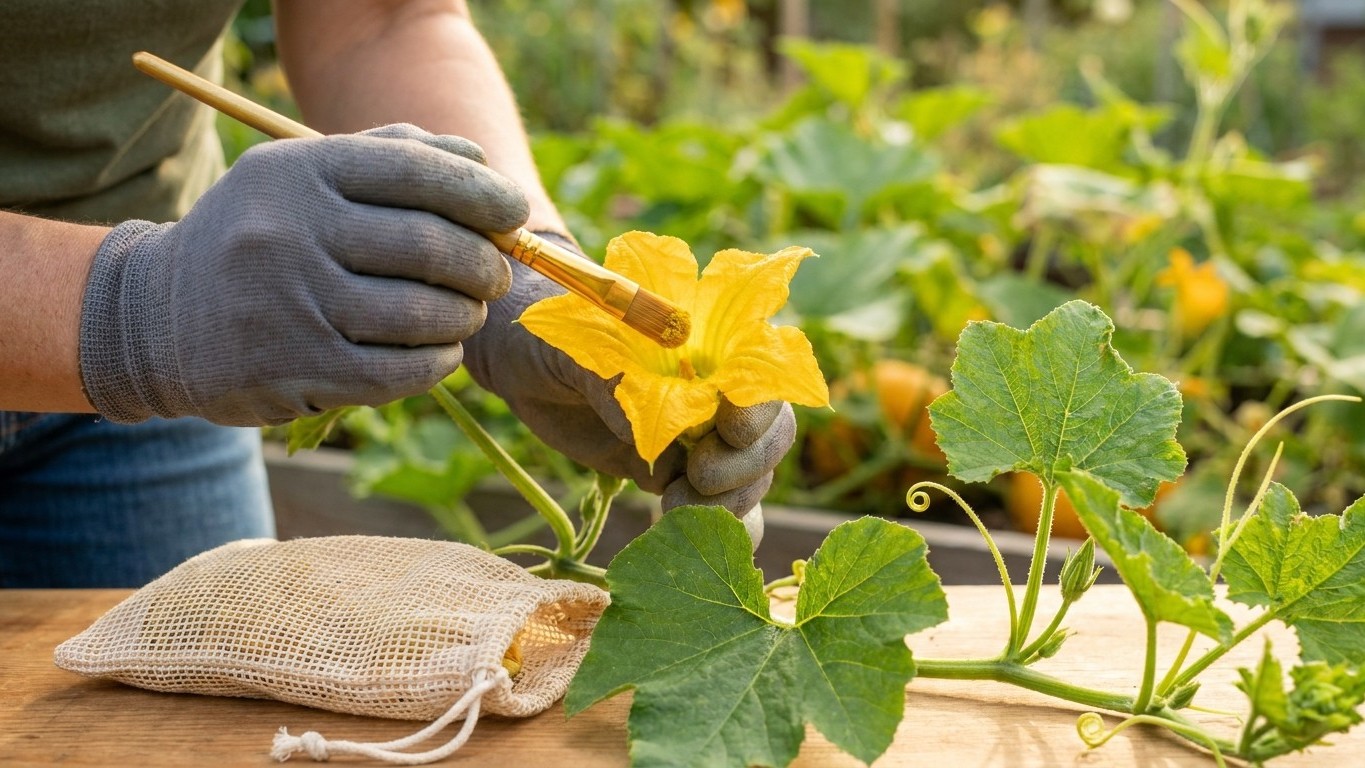

Hand-pollinating a pumpkin flower does nothing to the fruit growing on the vine right now. It changes what’s inside the seed, not the pumpkin itself. Utah State University Extension puts it plainly in its guidance on pumpkins in the garden: to keep a variety true, gardeners should hand pollinate, then bag the flowers so cross pollination with a different variety doesn’t happen. That single line answers most of the confusion people bring to this topic.
The short answer
Crossing is a seed problem, not a fruit problem. If a bee carries pollen from a different pumpkin variety onto your plant’s flower this season, the pumpkin that grows from that flower still looks, weighs, and tastes exactly like it’s supposed to. Shape, color, ribbing, size, all of that comes from the mother plant’s own tissue. The cross only shows up in the next generation, when someone plants seed saved from that fruit and gets something unexpected, maybe a lumpy hybrid between a pie pumpkin and whatever squash was blooming three rows over.
That’s why Utah State University Extension frames hand pollination as a seed-saving tool. Its instruction is direct: hand pollinate, then bag the flowers, specifically to prevent out crossing with a different variety. Notice the goal isn’t “get more pumpkins” or “get bigger pumpkins.” It’s protecting the genetic identity of the seed for whoever plants it later.
This matters enormously to one kind of gardener and not at all to another. Someone who buys fresh seed packets every year from a supplier doesn’t need to touch a single flower by hand. The company selling that seed already did the isolation work, or the variety is stable enough that a little stray pollen won’t matter to them. But a gardener who wants to save seed from this year’s best pumpkin, the one with the perfect handle and the deep orange color, and plant it again, needs to control pollination now if there’s any other pumpkin, squash, or gourd variety blooming nearby.
Home gardens are full of exactly that risk. A single suburban lot might have a jack-o’-lantern variety, a pie pumpkin, a decorative gourd, and a summer squash all flowering within bee-flight distance. Bees don’t care about variety labels. They move from flower to flower gathering nectar and pollen, and they’ll happily carry pumpkin pollen from one type to the stigma of another. The fruit that results this year is fine. The seed inside it is now a genetic mix, and nobody will know until it’s planted.
What actually decides it
Pumpkin plants produce two kinds of flowers on the same vine, male and female. Male flowers sit on a plain stem. Female flowers have a small, swollen bulge right behind the petals, which is the unfertilized ovary, essentially a baby pumpkin waiting to be told to grow. Neither flower type can fertilize itself. Pollen has to move from a male flower’s anther to a female flower’s stigma, and in most gardens that transfer happens entirely through insect visits, mainly bees moving from bloom to bloom.
Several things influence how a pumpkin patch behaves during flowering season: how many pumpkin or squash varieties are planted nearby, how active the pollinator population is that morning, how many male flowers are open at once, and how close plants are spaced. All of those affect the odds of a cross happening. But only one factor actually settles whether a specific fruit’s seed ends up crossed: whose pollen reaches that particular female flower’s stigma before or during hand pollination.
If a bee gets to an open female flower first and deposits pollen from a different variety, the cross is already locked in, no matter what a gardener does afterward. If the gardener bags the female flower before it opens, so no insect can reach it, and then hand-delivers pollen from a male flower on the same variety, the seed stays true. Everything else, spacing, insect pressure, number of varieties in the yard, only changes the probability. The bagging and the timing of hand pollination are what actually determine the outcome for that one flower.
This is also why partial measures don’t work. Hand pollinating a flower that already opened and had visitors an hour earlier doesn’t undo whatever pollen a bee already dropped off. Once a stigma receives pollen, additional pollen added later doesn’t erase the first delivery. The flower has to be isolated before it opens, controlled through the pollination itself, and kept isolated afterward for the seed to be considered reliably true to variety. Skipping any one of those three stages reopens the door to a stray insect.
How to do it
- Scout the vine the evening before, looking for female flowers (identified by the small ovary bulge behind the petals) that are swollen and colored but still closed, since these are the ones likely to open the next morning.
- Also mark a nearby male flower, plain stem, no bulge, that looks close to opening on the same vine or the same variety elsewhere in the garden.
- Bag or gently tape both the chosen female flower and the chosen male flower closed that evening, before any insect can reach them overnight or at first light.
- The next morning, once the flowers would naturally be opening, unbag the male flower first and remove its petals to expose the pollen-covered anther.
- Unbag the female flower and brush or press the anther directly against the stigma in the center of the flower, transferring pollen by hand rather than relying on an insect visit.
- Close the female flower’s petals back over the stigma if possible, or re-bag it, so no bee can add outside pollen on top of what was just delivered by hand.
- Tie a piece of string, ribbon, or a tag around the base of that flower’s stem so the resulting fruit can be identified later as hand-pollinated, since it will look identical to every other pumpkin on the vine.
- Record the variety name and the date on a garden log or plant tag, since months later, at harvest, there will be no visual way to tell which pumpkin came from a controlled cross.
None of this changes how the fruit grows, how big it gets, or when it’s ready to pick. The entire point of the exercise happens inside the seed, and it only pays off the following season when that seed goes into the ground.
What goes wrong
- Bagging too late. If the flower is already open when the bag goes on, a bee likely visited it first thing that morning before anyone got outside. The remedy is bagging the evening before, while the flower is still closed, not the morning of.
- Confusing male and female flowers. Grabbing two male flowers, or two females, means no pollen transfer happens at all. The female always has the small ovary bulge behind the petals; the male never does. Check that bulge before doing anything else.
- Skipping the re-bag after pollination. Hand-delivering pollen and then leaving the flower open the rest of the day invites a bee to add a second, unwanted pollen source on top of it. Close or re-bag the female immediately after transferring pollen.
- Losing track of which fruit was treated. A hand-pollinated pumpkin looks exactly like every other pumpkin on the vine. Without a tag or tie at the base of the stem, there’s no way to find it again at harvest time.
- Damaged flowers before pollination day. Insect feeding can chew through petals or ovaries before a flower ever gets the chance to open properly. Garden pests like squash bugs and cucumber beetles both target pumpkin plants directly and can damage flowers or vines enough to interfere with the whole process, so checking for them during flowering season matters as much as the pollination technique itself.
- Assuming a cross ruins this year’s crop. It doesn’t. A crossed flower still produces a completely normal pumpkin this season. The mistake only shows up if that pumpkin’s seed gets saved and replanted without anyone realizing it carries mixed genetics.
Common questions
Does hand-pollinating change how this year’s pumpkin looks or tastes?
No. Utah State University Extension’s guidance ties hand pollination and bagging to preventing cross pollination in the seed, not to altering the current fruit. Shape, color, and flavor come from the mother plant regardless of which pollen fertilized the flower.
Do I need to hand-pollinate if I buy new seed every year?
No. This technique exists for gardeners saving seed from their own plants to grow again. Anyone starting fresh from purchased seed each season doesn’t need to isolate or hand-pollinate flowers.
Can I still let bees pollinate the rest of my pumpkin patch?
Yes. Bagging only applies to the specific flowers being controlled for seed-saving purposes. Every other flower on the vine can be left open to normal insect pollination without any issue.
Will two pumpkin varieties actually cross if I plant them close together?
They can, which is exactly why Utah State University Extension recommends hand pollinating and bagging the flowers in the first place. Without that isolation step, bees moving between varieties in the same garden can mix pollen freely.