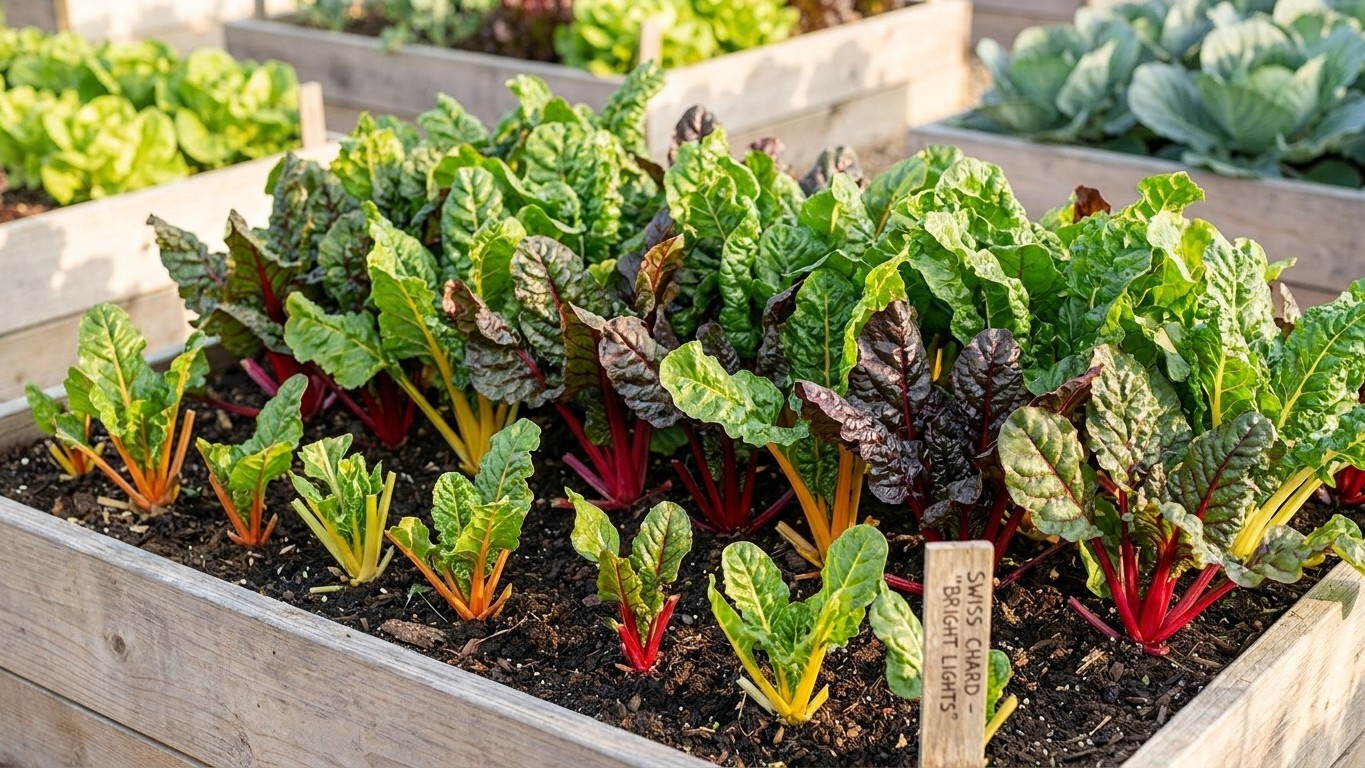

Six inches. That’s the tightest in-row spacing found anywhere in this garden cocoon, and it belongs to Swiss chard. Utah State University Extension’s fact sheet on Swiss chard puts it plainly: six inches between plants in the row, with rows set 12 inches apart. Lettuce needs 8 to 12 inches. Cabbage demands 12 to 18. Chard alone tolerates a spacing tight enough to make a raised bed look like a hedge.
The short answer
Utah State University Extension’s guidance is specific and doesn’t hedge: six inches between plants in the row, rows 12 inches apart. That’s the number, full stop, and it applies whether the chard started as direct-seeded rows or as transplants moved out from trays.
What makes that figure worth pausing on isn’t the number itself, it’s what it tells you about how chard grows compared to its garden neighbors. Head-forming crops need room because the whole plant swells into a single harvestable unit. A cabbage head can’t form properly if its neighbor is six inches away, elbowing into the same soil volume. Chard doesn’t work that way. It’s a cut-and-come-again leaf crop, and the outer leaves get harvested a few at a time while the center keeps producing. That growth habit is exactly why the spacing can compress this far without hurting yield.
| Crop | In-row spacing | Row spacing |
|---|---|---|
| Swiss chard | 6 inches | 12 inches |
| Lettuce | 8-12 inches | varies |
| Cabbage | 12-18 inches | varies |
Notice chard is the only one of the three where a single figure applies rather than a range. That precision matters for anyone converting a bed layout into row-feet: a 10-foot row of chard supports roughly 20 plants at that six-inch interval, a density that would be unthinkable for cabbage in the same footprint.
None of this means chard tolerates being planted at random density and thinned later on a whim. The six-inch figure is the target after thinning, not the seeding rate. Direct-seeded rows typically go in thicker than that, then get thinned down to the six-inch stand once seedlings are established. Getting to that final spacing, and understanding why it’s set that tight, is where the next section picks up.
What actually decides it

The six-inch figure isn’t arbitrary. It comes from a specific set of tradeoffs that Utah State University Extension spells out, and each one carries a condition that changes how you should actually manage the row.
Density as weed control
The fact sheet states it directly: dense plantings will reduce weed pressure. Chard, according to the same source, does not compete well with weeds, and weed control is particularly important during establishment. Closely spaced plants help control weeds simply by shading out the bare soil where weed seeds would otherwise germinate. That’s the whole logic behind pushing the spacing this tight. It’s the same principle behind lettuce’s closer spacing compared to cabbage, just carried a step further with chard. The condition here is timing: the canopy has to close before weeds get a foothold, which means the crowding only pays off if plants go in at a uniform, tight stand from the start rather than being left sparse and thinned late.
Shallow cultivation, not deep
Tight spacing changes how you’re allowed to weed by hand or hoe. Utah State University Extension instructs growers to cultivate shallowly and avoid root pruning to ensure uninterrupted growth. That instruction only matters because the roots of plants six inches apart are already competing for the same soil volume. A deep hoe pass that would barely graze a cabbage’s root zone can slice straight through a chard root system growing at this density. The condition attached to the instruction is real: cultivate, yes, but shallow, always.
Feeding a crowded stand
Packing plants closer together means more of them are drawing nitrogen from the same stretch of row, and the fact sheet’s feeding schedule reflects that. It calls for 1/4 cup per 10-foot row of 21-0-0 four weeks after transplanting or thinning, timed to encourage rapid leaf growth. The condition buried in that instruction is the four-week mark itself, tied to whichever event happened last, transplanting or thinning, not to the calendar.
How to do it
- Direct-seed 3-4 weeks before your last frost date. Utah State University Extension’s guidance has seed going into the ground several weeks ahead of transplants, giving it time to germinate in cool soil before the frost-date planting window opens for transplants.
- Set transplants out near your last frost date. This is the later of the two planting routes. Transplants started indoors move to the garden right around the last frost date itself, weeks after the seeded rows already went in.
- Thin seedlings down to the six-inch stand. Whether the row was direct-seeded thick or transplanted at wider spacing initially, the target after thinning is six inches between plants, with rows 12 inches apart.
- Cultivate shallowly around the base of each plant. Skim the surface only. Avoid root pruning so growth continues uninterrupted through the densest part of the season.
- Feed four weeks after transplanting or thinning. Apply 1/4 cup of 21-0-0 per 10-foot row at that four-week mark to push rapid leaf growth once the stand is established.
What goes wrong

- Skipping the thin and leaving seedlings crowded past six inches’ worth of competition. A row left unthinned doesn’t just stunt individual plants, it undercuts the weed-suppression benefit the spacing was supposed to deliver, since a tangle of undersized seedlings shades nothing effectively. Thin to the six-inch stand as soon as seedlings are large enough to handle.
- Hoeing too deep and root-pruning the row. Utah State University Extension calls this out specifically: root pruning interrupts growth. In a row spaced this tight, a deep cultivation pass has nowhere to go but through somebody’s root zone. Keep the blade shallow, skimming weed seedlings rather than trenching around mature roots.
- Confusing the seed date with the transplant date. Treating both planting routes as if they share one calendar date ignores the gap Utah State University Extension builds into its own guidance, seed going in 3-4 weeks ahead of transplants set out near the last frost date. Track them separately in a planting log rather than by memory.
- Forgetting the nitrogen feed at the four-week mark. Dense plantings pull nutrients faster than a sparse stand would, and skipping the 21-0-0 application at four weeks after transplanting or thinning leaves rapid leaf growth without the fuel it needs. Set a reminder tied to the thinning or transplant date itself, not a fixed calendar month.
- Picking a variety name and assuming it changes the spacing. Rhubarb, Bright Lights, Lucullus, and Fordhook Giant are all varieties Utah State University Extension names in its fact sheet, but the source attaches no separate spacing figure to any of them. The six-inch, twelve-inch layout applies across the board.
Common questions
Can I space chard closer than six inches to fit more into a small bed?
Utah State University Extension’s recommendation is six inches in the row with rows 12 inches apart. Going tighter than that isn’t part of the guidance, and given that the six-inch figure already leans on dense planting for weed control, pushing closer risks the kind of root competition the shallow-cultivation instruction is designed to avoid.
Why does chard need so much less space than lettuce or cabbage?
Chard is harvested leaf by leaf as a cut-and-come-again crop rather than as a single head that needs room to bulk up. That growth habit is why its recommended spacing, six inches, sits well under lettuce’s 8 to 12 inches and cabbage’s 12 to 18.
What happens if I never thin the row down to six inches?
An unthinned row stays crowded past the point the fact sheet recommends, and instead of the dense stand shading out weeds effectively, undersized competing seedlings tend to struggle against the very weeds the spacing was meant to suppress.
Do seed and transplants go into the ground on the same date?
No. Utah State University Extension’s guidance has direct-seeded chard going in 3-4 Weeks Before the last frost date, while transplants are set out later, near the last frost date itself. They’re two different windows, not one.