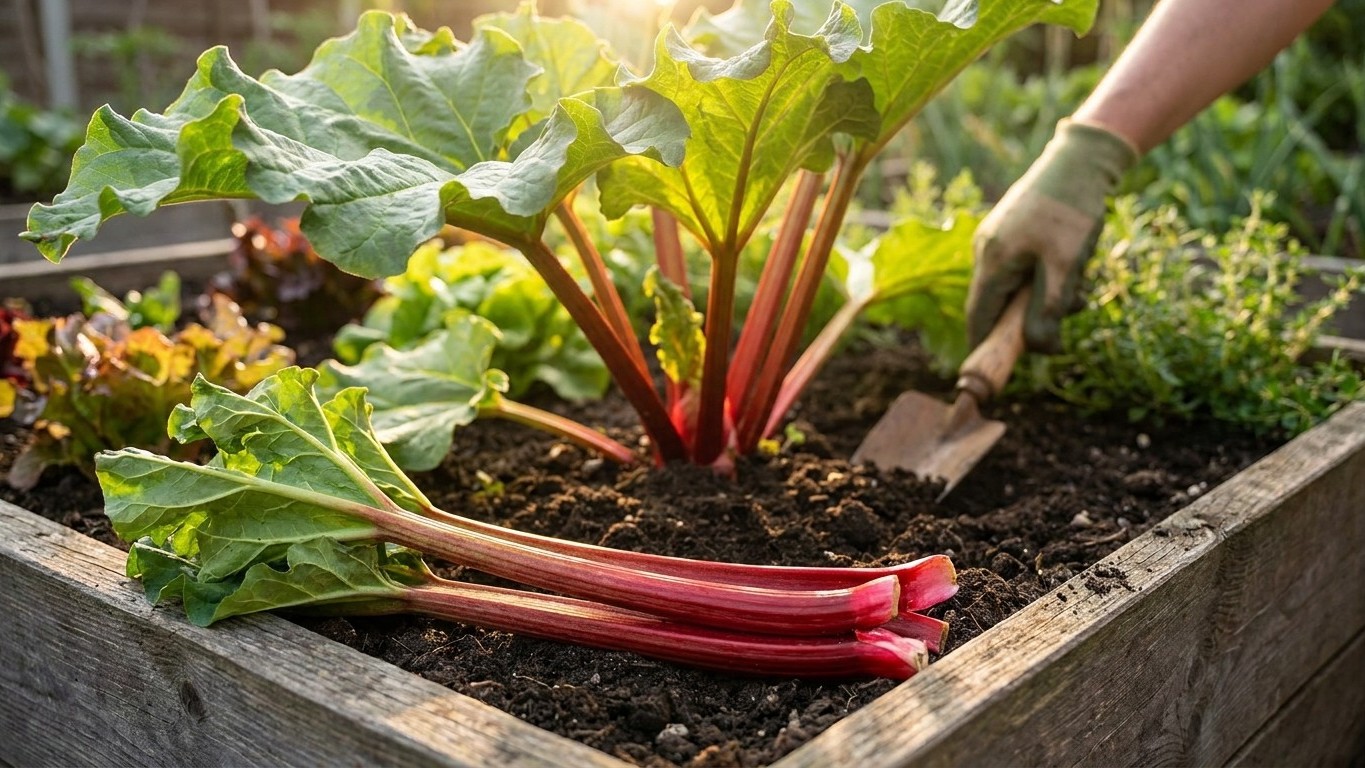

Two years of nothing, then three to four weeks in year three, then six to ten weeks every year after that once the plant reaches its fourth season. That’s the arithmetic Utah State University Extension lays out for rhubarb: no stalks pulled while the crown establishes, a short trial harvest once it’s proven itself, and full production only after that. Once you’re there, the plant can keep going for ten to fifteen years.
The short answer
Utah State University Extension is blunt about the waiting period: “Do not harvest any stalks for the first 2 years.” The crown, whether planted as a bare-root cutting or a small containerized start, needs those first two seasons to build root mass and store energy before it can afford to lose a leaf.
Year three changes the rule, but only a little. The Extension guide allows stalks to be harvested “for 3 to 4 weeks” that season, a trial run that tests the plant’s vigor without draining it. It isn’t until year four that rhubarb earns its keep: “After the fourth year, harvest stalks for 6 to 10 weeks or until plants begin to lose vigor.”
What makes the wait worth tracking is what comes after it. A single established plant yields “between 4 to 12 lbs of stalks… annually,” and a well-kept planting can stay productive “for 10 to 15 years” before it needs dividing or replacing.
One point worth settling first: rhubarb isn’t started from seed in most home gardens. Utah State University Extension notes that it “is almost always purchased as starts (cuttings),” each one needing “at least one leaf bud on top and healthy roots… on the bottom.” The two-year clock starts the day that cutting goes into the soil, and nothing about that clock can be rushed by choosing a different starting method.
What actually decides it

Planting depth: the inch that decides everything
Rhubarb is unusually sensitive to how deep it goes into the ground, and the tolerance is measured in a single inch. Utah State University Extension instructs gardeners to “plant so that the leaf bud is 1 inch beneath the soil” and to “cover crowns with no more than 1 inch of soil.” For a containerized plant, the rule is the same: “cover the top of the root-ball with 1 inch of garden soil.” Go deeper, and the source states plainly that “planting crowns or established plants excessively deep delays maturity and can result in plant death.” On a plant that already asks for two years before it produces anything, an extra inch of soil can cost a full season, or the plant outright.
The one-third harvest rule
Once the waiting period ends, a second measurement takes over: how much of the plant you’re allowed to remove at any one time. The guidance is to “leave 1/3 of stalks at any given time to maintain plant health.” Stalks are ready when “the petiole is 10 to 15 inches long,” but length alone doesn’t authorize a full harvest. This is also where the harvest gesture matters: stalks should be removed by grasping “the stalk just below the leaf and pull upwards and to one side.” Cutting is specifically discouraged, because it “leaves plant tissue potentially open as a disease entry point.”
Variety: what survives the pot and what bolts
Utah State University Extension lists eight rhubarb varieties, and two traits stand out. The first is whether stalk color holds up through cooking and canning; Chipman’s Canada Red and Valentine are both noted for color that “resists fading when processed.” The second is how readily a variety sends up a flower stalk instead of staying focused on leaf and petiole production; Victoria is described as “very likely to produce flower stalks that need removal,” while Cherry Wine and Strawberry “produce few flower stalks.” Neither trait is given a yield figure or hardiness zone in the source, so pick on flavor and behavior, not on numbers that aren’t there.
| Variety | Stalk color | Notable trait |
|---|---|---|
| Chipman’s Canada Red | Moderate red | Color resists fading when processed; high yielding |
| Crimson Red | Bright red | Sweet-tart flavor, not stringy; likely to flower |
| Cherry Wine | Bright red | Moderate vigor; produces few flower stalks |
| Early Sunshine | Intense red | Useful for pie filling; moderate producer |
| MacDonald | Bright pink to red | Common, high yielding; pies, freezing, canning |
| Valentine | Deep red | Historic variety; color resists fading when processed |
| Strawberry | Light red | Moderate vigor; produces few flower stalks |
| Victoria | Pink at base, fades to green | Very likely to flower; needs removal |
How to do it
- Prepare the bed in early spring, before new growth begins. Control all perennial weeds first, then incorporate 2 to 4 inches of well composted organic matter 6 inches deep into the planting area.
- Plant the cutting. Choose a start with a large leaf bud on top and an undamaged root underneath. Set it so the leaf bud sits 1 inch beneath the soil surface, covering crowns with no more than 1 inch of soil (containerized plants get 1 inch of garden soil over the root-ball instead). Space plants every 3 feet, with rows 4 feet apart. Press soil firmly around the crown and water well.
- Year one: do nothing but let it grow. No fertilizer during this first year of establishment, and no harvest.
- Year two: continue waiting. Still no stalks harvested, regardless of how full the plant looks.
- Year three: take a short, limited harvest. Once petioles reach 10 to 15 inches, harvest for 3 to 4 weeks, always leaving 1/3 of stalks on the plant. Pull each stalk just below the leaf, upward and to one side; never cut from the base. Discard every leaf into the compost pile or leave it in the garden as mulch, since the leaves carry high concentrations of oxalic acid and are not safe to eat or feed to livestock.
- Year four and beyond: fertilize and harvest fully. Just as leaves begin to emerge in spring, work 1/2 cup of 16-16-16 granular fertilizer around the base. Harvest for 6 to 10 weeks, or until plants begin to lose vigor, still leaving 1/3 of stalks at any given time. Remove any flower stalks as soon as they begin to elongate.
- Store or preserve what you harvest. Fresh stalks keep 2 to 4 weeks refrigerated in plastic sacks. To freeze, blanch stalks in boiling water for 1 minute, cool them promptly in an ice bath, then pack tightly and freeze with or without sugar. To can, cut stalks into 1/2 to 1 inch pieces (7 pounds fills nine pint bottles), mix with 1/2 cup sugar per quart of cut stalks, let stand until juice appears, then heat to boiling before filling jars with 1/2 inch head space. Process in a boiling water bath for 20 minutes at elevations of 1,000 to 6,000 feet, or 25 minutes above 6,000 feet.
- Every 5 to 10 years, divide the crown. In early spring, before new growth begins, dig up the entire crown and divide it so each section carries one large bud. A healthy, mature crown typically produces 5 to 10 new plants, replanted 3 feet apart in a fresh area of the garden. If sections can’t be replanted right away, cover them with moist potting soil, sawdust, peat moss, or vermiculite at 32 to 40 degrees Fahrenheit until you’re ready.
What goes wrong

- Harvesting before year three. Pulling stalks during the first two seasons robs the crown of the reserves it needs to establish. Wait for year three’s short harvest window before touching a single stalk.
- Planting the crown too deep. More than 1 inch of soil over the leaf bud delays maturity and can kill the plant. Replant at the correct depth, no more than 1 inch of cover.
- Taking more than two-thirds of the stalks. Stripping a plant beyond that leaves it without enough leaf area to recover. Always leave 1/3 of stalks standing, even during a strong harvest year.
- Cutting stalks at the base instead of pulling them. A cut leaves an open wound that becomes an entry point for disease. Grasp the stalk below the leaf and pull upward and to one side instead.
- Eating the leaves, or feeding them to animals. Rhubarb leaves carry high concentrations of oxalic acid that can cause serious illness and kidney failure. Discard leaves into the compost pile or leave them as mulch, never as feed.
- Thin, weak stalks. This symptom has several possible causes, each with its own fix: over-harvesting calls for leaving more stalks per pull; poor nutrition calls for the spring fertilizer application; inadequate water calls for more consistent irrigation; temperature stress is largely out of a gardener’s hands; and an older, overcrowded planting calls for dividing the crown.
- Root rot in wet soil. Rhubarb develops root-rot diseases when over-irrigated or grown in soil that stays wet. Improve drainage or cut back watering rather than adding more.
- Leaves turning red with rot starting in the roots. This is red leaf disease, reported in many states. There’s no fix once it sets in beyond removing affected plants; prevention rests on good drainage and healthy, unstressed crowns.
- Stalks pierced or scarred. The rhubarb curculio can cause minor damage by piercing stalks, typically a cosmetic issue rather than a threat to the plant’s survival.
- Flower stalks taking over. Flowering reduces leaf and petiole production, and some varieties, like Victoria and Crimson Red, are especially prone to it. Remove flower stalks as soon as they begin to elongate.
Common questions
Can you eat rhubarb leaves? No. Utah State University Extension is explicit that the leaves carry high concentrations of oxalic acid, “can make you quite sick and lead to kidney failure,” and shouldn’t be fed to livestock either. Only the stalks are edible; discard every leaf into the compost pile or use it as garden mulch.
How long does a rhubarb plant keep producing? Once established, a rhubarb plant can live in the garden for 10 to 15 years, yielding between 4 and 12 pounds of stalks annually per plant. Dividing the crown every 5 to 10 years helps keep that production going as the plant ages.
Can rhubarb be grown from seed instead of a cutting? Utah State University Extension’s guidance covers rhubarb “purchased as starts (cuttings),” taken from healthy crowns with a leaf bud and healthy roots. It doesn’t address seed-grown plants, so the schedule described here applies specifically to plants started from crown cuttings.
Why are my rhubarb stalks getting thinner every year? Thin stalks aren’t a single problem but a symptom with several possible causes: over-harvesting, poor nutrition, inadequate water, temperature stress, or an aging, overcrowded planting. Older plants that have gone too long without dividing are especially prone to shrinking stalk size, which is why dividing the crown every 5 to 10 years is part of routine rhubarb care.