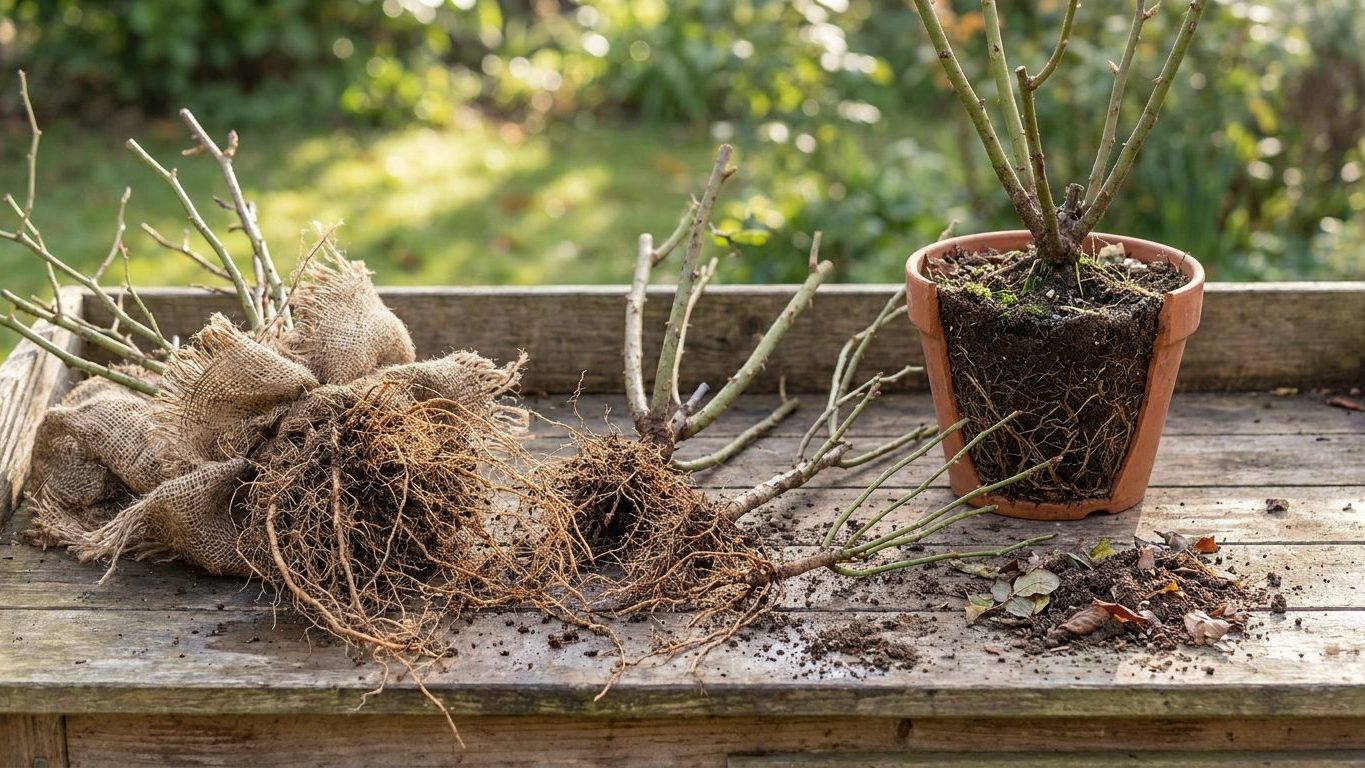

Bare-root roses cost less, ship dormant, and give you access to a much wider catalog of cultivars, but they demand planting before growth starts. Container roses cost more and are heavier to handle, but they can go into the ground almost any time the plant isn’t stressed. The “grade” stamped on either one is a separate quality rating, based on cane count, cane thickness, and root mass, not on which form you bought.
Why this matters
A bare-root rose has no soil buffering its roots. Every hour between digging at the nursery and planting in your yard is an hour the fine root hairs can dry out, and dried root hairs don’t come back. A container rose carries its own root ball, so it tolerates a slower, less urgent planting day, but it can also hide a problem the bare-root form makes obvious: roots that have circled the pot for a season too long, or a union set too deep to inspect without digging.
Grade matters independently of format. A low-grade plant, thin canes, a skimpy root system, may survive but will lag a full season or more behind a top-grade plant of the same cultivar, because it starts with less stored energy to push new growth. Skip checking the grade and you can pay full price for a rose that spends its first year catching up instead of blooming.
| Factor | Bare-root | Container |
|---|---|---|
| Cost | Generally lower | Generally higher |
| Planting window | Narrow, dormant season only | Wider, avoid active bloom/heat stress |
| Root inspection | Fully visible before planting | Hidden until you slide the plant out |
| Shipping tolerance | Good if kept moist and cool | Heavier, bulkier to mail |
When to do it
Bare-root roses go in the ground while the plant is fully dormant: no swelling buds, no soft new leaves, canes still hard and unyielding. If the buds along the cane have already broken and show green, the window has closed for that particular plant and it should be potted temporarily instead of planted bare into open ground. Watch the buds, not a date on a bag of mulch.
Container roses are more forgiving because the roots never lose contact with soil. The best signal isn’t a stage of the plant’s own cycle but the absence of stress: avoid transplanting a container rose that’s in the middle of its first heavy flush of bloom, since redirecting energy into root establishment competes directly with holding those flowers open. A rose that has finished a bloom cycle and is pushing fresh, still-soft new shoots is a better candidate than one loaded with open flowers.
Exactly when the dormant window falls, and how deep to set the union once it’s in the ground, depends on your USDA hardiness zone (roses as a genus span zones 5a through 11b according to the NC State Extension Gardener Plant Toolbox). That timing detail belongs on your state-specific page, not here, because a dormant cane in zone 6 and one in zone 9 are on entirely different clocks.
How to do it
Reading the plant before you buy it
Start with the tag. Grade is usually marked as a category rather than a single number, ranking plants from a top tier with the most canes and the thickest cane diameter down through lesser tiers with fewer, thinner canes. A top-grade plant establishes faster and blooms sooner in its first year; a lower grade isn’t defective, it’s simply starting with less stored energy.
On a bare-root plant, look for canes that are firm and show green or tan color under a light thumbnail scratch, not gray, wrinkled, or brittle. The roots should look moist and pale, never black, slimy, or bone-dry. A healthy bare-root rose typically shows several canes radiating from a visible union or crown, not one spindly shoot.
On a container plant, slide it partway out of the pot at the nursery if you’re allowed to. Roots should be pale and fill the pot loosely; a solid mat of roots circling the inside wall means the plant has been in that container too long and will need root work at planting to keep it from girdling itself later.
Planting each form
Soak a bare-root rose’s roots in a bucket of water for several hours before planting, never for days, since a prolonged soak invites rot rather than hydration. Dig a hole wide enough to spread the roots without bending them sharply, mound a cone of soil in the center so the crown sits at the correct height for your zone, and spread the roots down and outward over that cone before backfilling.
For a container rose, water it well an hour before you plant so the root ball slides out cleanly. Loosen any circling roots with your fingers, or make a few vertical slices through a dense root mat with a clean knife, then set it at the same depth it sat in the pot unless your zone calls for the union set lower.
Check the tag for rootstock. Hybrid teas, grandifloras, and many climbing roses are budded onto a separate rootstock, which means there’s a union to protect over winter. Most landscape shrub roses sold today, Knock Out and Drift among the widely planted examples, are own-root with no union at all, so what you’re protecting each winter is the crown, not a graft line. The tag, not the shape of the plant, tells you which one you have.
Water thoroughly right after planting either form, and mulch to conserve moisture without piling material against live canes.
What goes wrong
The most common bare-root failure is simple: roots that dried out during handling, either before purchase or in the gap between digging the hole and getting the plant in the ground. A rose planted with desiccated roots often leafs out weakly, then collapses weeks later once its small remaining energy reserve runs out, which makes the cause hard to trace back after the fact.
On container roses, the mistake that looks like extra care but isn’t is trimming the canes back hard at planting time “to help the plant focus on roots.” A newly transplanted rose needs its leaves to photosynthesize and fund root establishment; heavy top pruning at the same moment removes the very tissue producing that energy. Wait until the plant is settled before shaping it.
Another recognizable failure is planting a budded rose with the union buried too deep for its zone, or an own-root rose mounded as if it had a union to protect: both come from skipping the tag check described above. Watch also for stock that arrived already carrying trouble, look over canes and leaves for the named pests (Fuller rose beetle, Japanese beetle, rose chafer, rose thrips, southern red mite, two-spotted mite) and the named diseases (botrytis, blights, powdery mildew, leaf spots, anthracnose) before you commit a whole season to a plant that started compromised.
Doing it differently
Growing in containers long-term changes the calculus at purchase. Miniature roses, ground cover types, and many polyanthas tolerate pot culture well, and buying these already established in a container skips a transplant altogether if you intend to keep them potted. For an in-ground destination, though, a genuinely dormant bare-root plant of the same cultivar usually roots in more thoroughly over its first year than one transplanted straight out of a nursery pot.
Raised beds favor container stock slightly, since the loose, well-draining fill common to raised beds makes it easy to settle a root ball without the compaction risk that plagues bare-root planting in heavier native soil. Clay or loam with a pH from acid (below 6.0) to neutral (6.0-8.0) suits the genus either way, according to the NC State Extension Gardener Plant Toolbox, so soil type rarely decides the format question on its own.
Old garden roses and rugosas, often sold own-root by specialty growers, are commonly available bare-root by mail because they ship and establish well that way. Hybrid teas and grandifloras, more often budded, are frequently sold in containers at retail simply because a visible bloom on the tag sells the plant. Neither pattern is a rule, and the tag remains the only reliable source for which rootstock situation you’re actually buying.
Common questions
Are rose thorns dangerous? They are prickles, not true thorns. Prickles grow from the outer skin of the stem, which is why they snap or rub off sideways rather than staying rigid the way a woody true thorn would.
Does a higher grade mean a better rose variety? No. Grade rates the physical condition of that individual plant, cane count, cane thickness, root mass, not the cultivar’s quality or disease resistance, which varies by cultivar rather than by group.
Can I plant a bare-root rose if a few buds have already broken? It’s risky. Once buds have broken, the plant has committed energy to top growth before roots are established in soil; potting it temporarily until roots take hold is safer than planting bare into open ground at that stage.
How do I know if my rose is own-root or budded? Check the nursery tag first. If it’s unclear, look at the base: a budded rose often shows a visible swelling or knob (the union) just above the roots; an own-root rose has a smooth transition from roots to canes with no such knob.