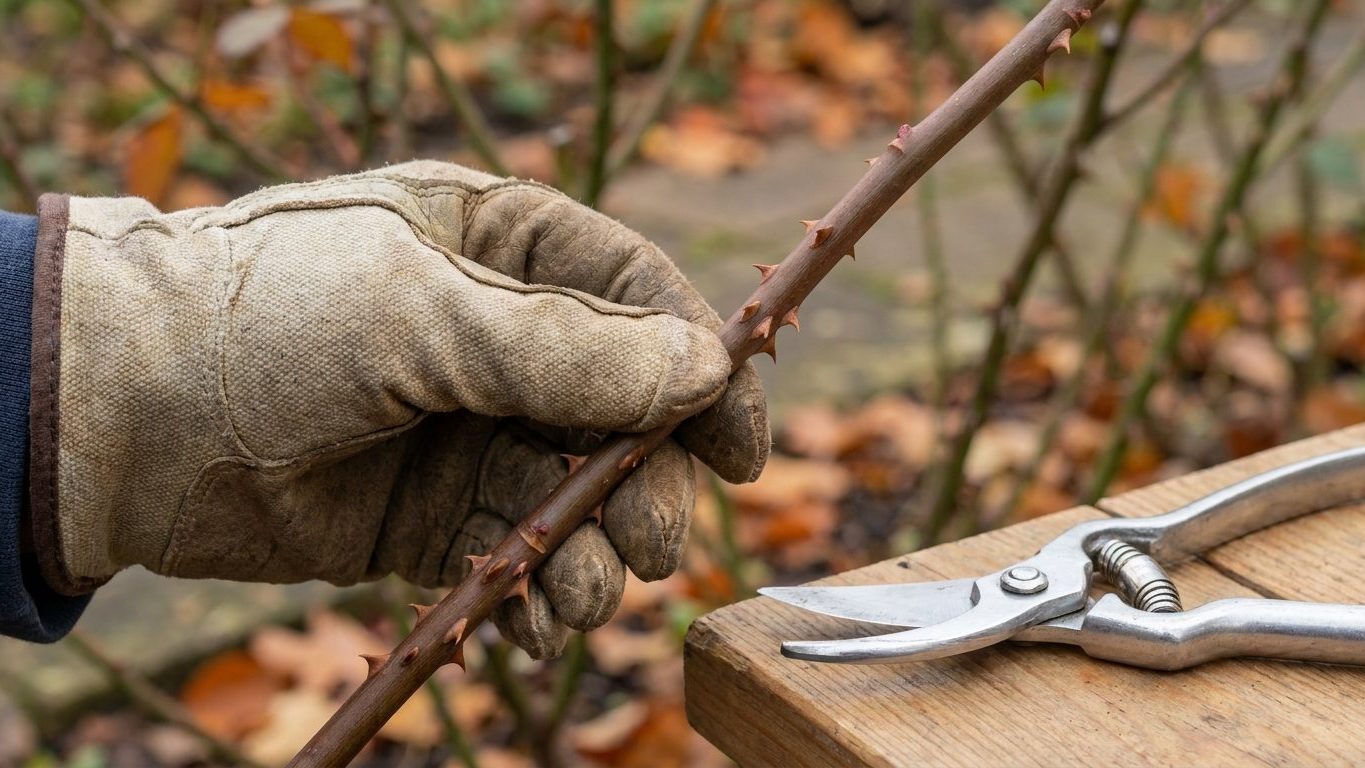

Those sharp points along a rose cane aren’t thorns at all. They’re prickles, outgrowths of the stem’s outer skin (epidermis), which is exactly why they snap off sideways with a firm rub instead of staying anchored like a true thorn would. A true thorn is a modified stem, woody straight through, and it won’t budge. That distinction changes how you should actually grip and cut a cane.
Why this matters
Handling canes the wrong way doesn’t just cost you a scratch. Every tear in the stem skin, whether from a prickle catching your glove or a dull blade dragging through bark, is an open door for the pathogens covered on the rose diseases page, including botrytis and the various leaf spots that can move into wounded canes during wet weeks. A clean handling technique keeps that risk low without any extra product or spray.
There’s also a plant-health angle that has nothing to do with your skin. Bent or crushed canes from rough handling stunt the vascular tissue running through them, which slows sap flow to the buds above the injury. On a plant already rated high maintenance by extension horticulturists, that’s one more stress point you can avoid just by changing how you grip the wood.
When to do it
Most routine cane work, including the yearly structural prune, happens while the plant is still dormant, before the buds swell and push soft new growth. Watch the buds along the cane rather than a date on the calendar. Once they’ve broken and show green, you’re cutting into active tissue, and the plant responds differently than it does in dormancy.
Wood age matters just as much as timing. Ramblers flower from old wood, so removing last year’s canes on a rambler wipes out this year’s bloom. Climbers do the opposite: they flower from new wood, so last season’s growth can be shaped back hard without sacrificing flowers. Know which type you’re holding before you make a cut, because the same pruning calendar produces opposite results depending on that one fact.
If you’re cutting stems for a vase rather than pruning the plant, timing is about the bud, not the season. Cut once the sepals have folded back and the first petal or two is starting to unfurl. A bud cut tighter than that often never opens once it’s off the plant. Exact pruning dates shift with climate zone, so treat the main rose growing guide as your starting point for the broader seasonal picture.
How to do it
Start with the right hand protection. Standard garden gloves stop most prickles from breaking skin, but gauntlet-style gloves that cover the forearm are worth it once you’re reaching into a dense, established shrub where canes cross in every direction. The gloves aren’t about the plant, they’re about letting you work slowly and precisely instead of flinching every time a cane brushes your arm.
For the tool, use a clean, sharp bypass pruner for anything under about pencil thickness, and switch to loppers for old, thick basal canes. A dull blade crushes stem tissue instead of slicing it, and a crushed cut heals slower and looks ragged, which is exactly the kind of entry point that invites the fungal issues on the diseases page. A cut made with sharp bypass blades should look flat and clean, almost like a fresh pencil shave, with no torn bark hanging at the edges.
Step by step
- Grip the cane low, below where you’ll cut, keeping your thumb away from the prickle line running up the stem’s ridge.
- Identify the bud you’re cutting above. Look for an outward-facing bud so new growth heads away from the shrub’s center.
- Cut at a slight angle, roughly a quarter inch above that bud, sloping down and away from it so water runs off rather than pooling on the cut bud.
- For dead or damaged wood, cut back to healthy white or pale green pith rather than removing the entire cane. Extension guidance calls for cutting dead stems back to 12 to 24 inches and leaving that stub standing, since hollow rose canes make good nesting sites for stem-nesting native bees.
- Remove crossing canes that rub against each other, since the repeated friction wears through the skin the same way a careless grip would.
If you need to rub prickles off a cane, for grafting work or simply to make a section easier to handle, a gloved thumb dragged firmly along the stem does it. Because prickles are only attached to the outer skin layer, they release without damaging the wood underneath. Try that on a true thorn elsewhere in the garden and it won’t budge, which is the simplest field test for telling the two apart.
What Goes Wrong
The most common mistake is cutting flush against the main stem instead of leaving that quarter-inch buffer above a bud. A flush cut removes the collar of tissue the plant needs to seal the wound, and the cane often dies back further than intended, sometimes taking the bud below it too.
Mistaking wood type is a close second. Hard-pruning a rambler like you would a repeat-blooming shrub strips away the old wood carrying this year’s flowers, and you won’t see the mistake until bloom season arrives with almost nothing on the plant.
The error that looks like diligence but isn’t: stripping every prickle off a cane for a tidier look or easier future handling. Removing that much epidermis at once creates a long, exposed strip of tissue rather than a few small wound points, and that strip is where the fungal issues on the rose diseases page (powdery mildew, anthracnose, the various blights) find an easy foothold. A prickle rubbed off here and there for a specific reason is fine. Stripping a whole cane cosmetically is not extra care, it’s extra risk.
Last one worth naming: removing all dead wood down to soil level in the name of a clean bed. That takes away the standing 12-to-24-inch stubs that stem-nesting native bees rely on, for no gain to the plant itself.
Doing it differently
Container-grown roses and those in raised beds tend to have shallower, more crowded root systems, so canes there benefit from lighter, more frequent thinning rather than one heavy annual cut, since the plant has less root reserve to recover from a big wound all at once. Good drainage and structure in that soil matter here too, and the basics are covered on the soil preparation page if the bed hasn’t been amended recently.
Variety also changes the calculation. Own-root shrub roses, common among modern landscape types, have no graft union to protect, so a hard accidental cut near the base doesn’t risk losing the named cultivar the way it would on a budded hybrid tea. Check the plant tag before you assume which kind you have.
Thornless cultivars such as ‘Zephirine Drouhin’ need essentially none of the glove-and-grip caution described above, since the prickles are largely bred out along the cane. That’s a genuine case where the handling method should change, not just a stylistic preference.
Common questions
Are rose thorns dangerous? They’re prickles, not true thorns, and they snap off with pressure rather than staying fixed in your skin the way a real thorn would. They still break skin, so gloves are worth wearing, but the injury is shallow and rarely embeds a fragment the way a woody thorn can.
Can you remove rose prickles without harming the cane? Yes. Since they grow from the stem’s outer skin layer rather than from the woody core, rubbing them off doesn’t cut into living tissue the way removing a true thorn would.
Do all roses have prickles? No. A small number of cultivars, including ‘Zephirine Drouhin’, are bred with far fewer prickles along the cane and are marketed as thornless, even though the term is really describing an absence of prickles.
What’s the actual difference between a prickle and a thorn? A prickle is an outgrowth of the epidermis, the stem’s outer skin, and detaches without damaging the wood beneath it. A true thorn is a modified stem, woody to the core, and removing one means cutting into the plant’s actual structure.