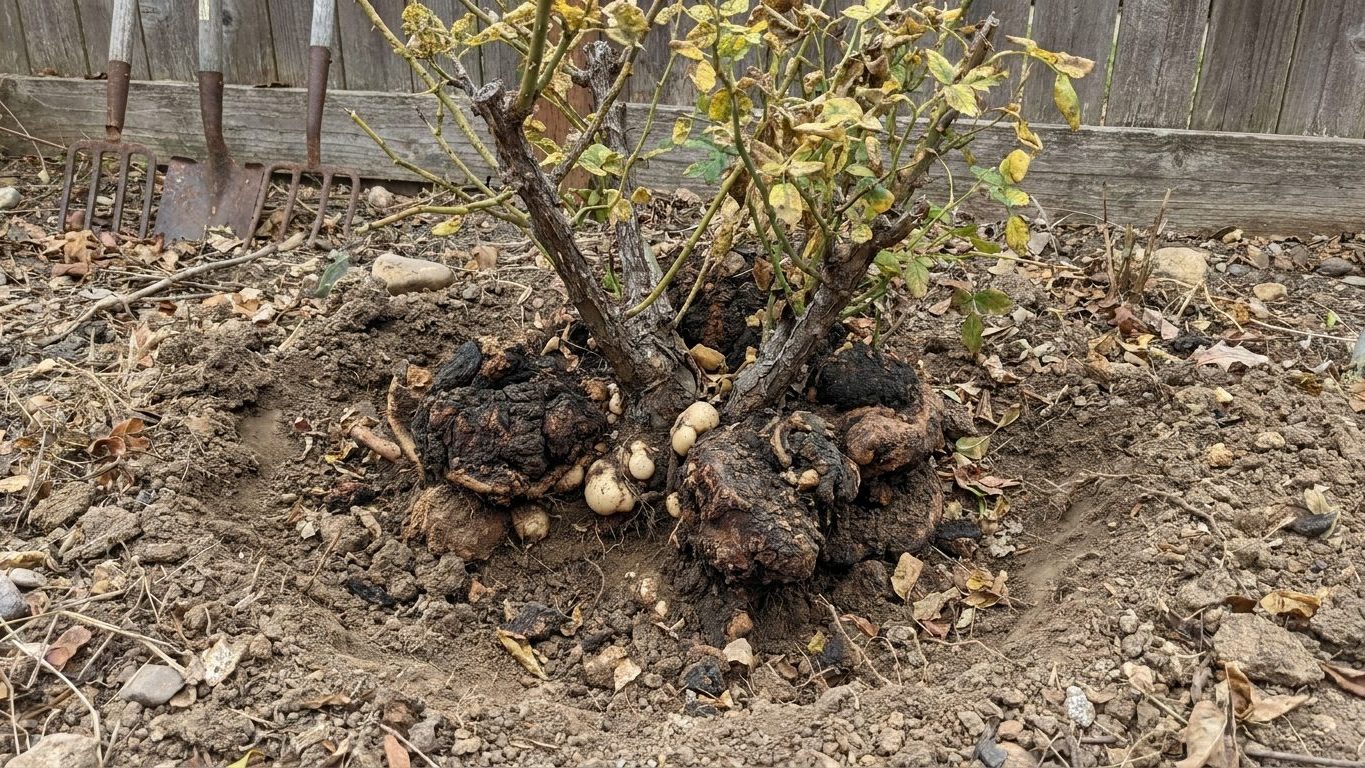

The lump at the base of a rose is crown gall, caused by a soil bacterium that permanently rewrites the plant’s own cells to keep growing tumor tissue. It is not a fungus, not curable with a spray, and not something that heals once the swelling appears. A rose with a mature gall girdling its crown is on a one-way decline, and removal, not treatment, is the realistic path forward.
What you are looking at
This is not a leaf disease, so don’t look for spots. Look at the base of the plant, right where the stems meet the soil, or dig gently around the upper roots. A rose in decline for no obvious reason, with poor bloom and stunted new growth, often has the answer sitting an inch or two underground.
The young gall
Early on, the swelling is soft, rounded, and pale, sometimes cream or light tan, roughly the size of a marble or a small walnut. It feels spongy rather than woody, and the surface is smooth or slightly bumpy, not cracked. At this stage it can be mistaken for a callus from a bruise, which is part of why it gets ignored until it grows.
The mature gall
Given a season or two, the same swelling hardens into a rough, dark brown to black mass, corky and irregular on the surface, often larger than a fist on an older bush. It can form a single dominant lump or a cluster of smaller ones fused together, and it may partially or fully encircle the stem or crown. Once it girdles the tissue, water and nutrient flow above that point starts to fail.
Where it shows up on the plant
Crown gall favors the crown itself (the transition zone at the soil line), the upper roots, and sometimes the graft union on budded roses. Galls on canes higher up the plant are less common but happen at old pruning wounds or mechanical injury sites. The disease does not travel leaf to leaf the way a fungal blight does; each gall is a localized, permanent change in that patch of tissue, and the plant’s overall decline (yellowing leaves, weak canes, wilting in dry heat) is a downstream effect of the blocked plumbing, not a separate symptom to diagnose on its own.
What it is not
Three things get mistaken for crown gall often enough to matter, and confusing them leads to either needless panic over a healthy plant or wasted effort trying to save one that’s already lost.
Normal graft union swelling
Budded roses are grafted onto a different rootstock, and the union where scion meets rootstock naturally swells into a smooth, uniform ridge that follows the bark’s normal pattern. It is firm, evenly colored, and consistent in shape year after year. A true gall is lumpy, off-color compared to surrounding bark, and keeps changing shape and size as it grows. If the swelling has looked the same since the plant went in the ground, it’s the graft, not the disease.
Cane canker
Canker lesions are sunken and discolored, often a purplish-brown or grayish patch with a defined margin, running lengthwise along a cane rather than bulging outward. The cane may show a slight flattening or dieback above the lesion, but there’s no raised, tumor-like mass. Cankers are the opposite shape of a gall: they cave in, galls push out. Treating a canker like a gall (trying to excise a swelling that isn’t there) wastes time that should go toward pruning out the dead cane instead.
Root knot nematode galls
Nematode damage produces small, bead-like swellings strung along fine roots, usually no bigger than a pea, and there are typically many of them rather than one dominant mass. Crown gall produces a single large, woody lump concentrated at the crown or on a major root, not a string of small beads. The distinction matters because nematode-damaged roses can sometimes be managed with soil practices and still produce a reasonable season, while a true crown gall at the base signals a plant that will not recover its vigor.
Where it comes from and when it strikes
Crown gall is caused by a soil-dwelling bacterium, most commonly identified as Agrobacterium tumefaciens (also classified as Rhizobium radiobacter). What makes it unusual among plant pathogens is its mechanism: the bacterium inserts a piece of its own genetic material directly into the plant’s cells, and those altered cells then divide uncontrollably to form the gall. This is a genuine, if crude, form of genetic transformation happening in the soil, which is why cutting off the visible lump rarely solves the problem: the surrounding cells have already been reprogrammed.
The bacterium survives in soil for extended periods and can persist in old gall tissue and plant debris left behind after a rose is removed. It needs a wound to get in, since intact bark and root tissue resist infection. Common entry points include pruning cuts, the graft union itself, mechanical injury from a mower or trimmer at the base, frost cracks, and even the small wounds created during transplanting. Contaminated nursery stock is a frequent and underappreciated route of introduction, meaning some roses arrive already carrying the infection before they ever touch native soil.
Warm, moist soil favors both the bacterium’s movement and the plant’s wound-healing response slowing enough to let infection take hold, while cool, dry conditions slow the process down. There is no single trigger event; it’s a matter of a wound meeting bacteria-laden soil at a time when the plant’s defenses are compromised.
What to do about it now
Be direct with yourself about what’s fixable. A gall that has already girdled the crown or a major root cannot be reversed, because the affected cells are permanently altered, not simply infected in a way antibiotics or fungicides can clear. Cutting the visible lump off does not remove the problem; the bacterium and the transformed tissue extend beyond what’s visible, and the gall typically returns.
If the plant is otherwise healthy and the gall is small, isolated, and not on the main crown, some gardeners choose to excise it with a clean cut well below the visible tissue and monitor closely. This is not a reliable cure, and it should be treated as a delay tactic at best, not a solution.
For a rose with a mature gall at the crown or girdling the base, the more honest and useful step is full removal: dig out the entire plant, including as much of the root system as possible, since roots left behind can continue harboring the bacteria. Do not compost the removed plant material; bag it or dispose of it away from garden soil. Disinfect any pruning tools that touched the plant with a bleach solution or high-percentage alcohol before using them on anything else, since tools are a documented way the bacterium moves from one plant to another.
Roses aren’t a food crop in the way tomatoes or peppers are, but for gardeners who do use rose hips, crown gall itself does not produce a toxin that would make hips from an otherwise affected plant unsafe. The more practical issue is that a plant in decline rarely produces hips worth harvesting in the first place.
Keeping it out next season
Soil-borne survival for this bacterium is measured in years rather than weeks, though an exact published duration for garden soil isn’t available here, so treat “several years” as the working assumption rather than a precise count. That alone argues against replanting a new rose, or any closely related woody ornamental, in the exact spot where an infected plant was removed. Give the area a rest with unrelated plantings first.
Unlike some vegetable diseases, roses don’t come with a widely published system of letter codes marking crown gall resistance on tags or catalogue listings, so no such codes are named here; resistance breeding in roses has focused far more on black spot and powdery mildew than on this bacterium. The more reliable defense is prevention at the point of purchase and at the point of care.
Practical steps that actually reduce risk:
- Buy nursery stock from a source that inspects crowns and roots before sale, and check the crown yourself for any swelling before planting.
- Protect the base of established plants from mower and trimmer damage, and mulch to buffer against mechanical wounds and frost cracks at the soil line.
- Sanitize pruning shears and loppers between plants, not just between garden visits.
- Avoid working wet soil around the crown, and don’t overwater in a way that keeps the base of the plant constantly saturated.
- Space plants for airflow and avoid crowding that leads to accidental injury during routine maintenance.
Common questions
Can a rose survive crown gall?
It depends on the gall’s location and size. A small, early gall away from the main crown sometimes allows the plant to limp along for a season or two, but a gall that girdles the crown or a major root cuts off water and nutrient flow permanently, and the plant will decline regardless of care.
Is crown gall contagious to other plants in the garden?
Yes, through contaminated soil, water splash, and especially through pruning tools that touch an infected plant and then a healthy one. It also affects other woody plants beyond roses, including many fruit trees and shrubs, so removed material should never be composted back into the garden.
Should I report crown gall to anyone, like a state extension office?
It’s not a regulated or reportable disease the way certain fast-moving pathogens are, but a local extension office can help confirm the diagnosis if you’re unsure, since a positive identification changes what you do next far more than guessing does.
Can I just cut off the gall and keep the rose?
You can try, but treat it as a stopgap rather than a fix. The bacterium has already altered tissue beyond what’s visible on the surface, and galls commonly regrow after excision. If the plant is sentimental or hard to replace, isolate it, watch closely, and accept that full recovery is unlikely.