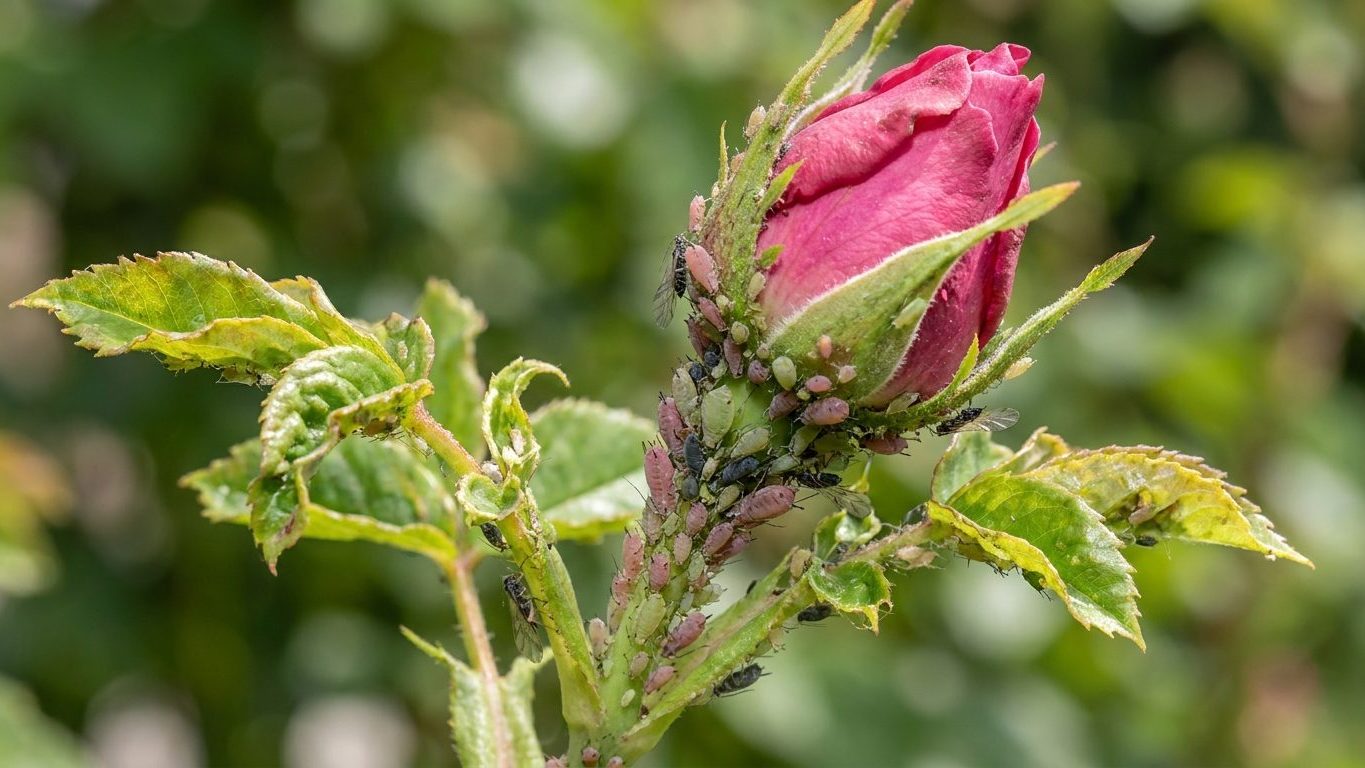

Rose aphids show up as a tight cluster of small, soft-bodied insects packed onto a bud or the newest stem tip, usually pale green or pink, sometimes almost black. On an Established rose bush this is mostly cosmetic and the plant will outgrow it. On a young rose or a seedling, a heavy cluster can stunt or distort the new growth before it ever opens.
What the damage looks like
The detail that gives it away before you even need a hand lens: the insects are clustered, not scattered. You will find twenty, fifty, sometimes well over a hundred tiny bodies packed shoulder to shoulder around the base of a bud, along the soft green stem just below it, or on the underside of the newest unfurled leaflets. They do not spread evenly across older, hardened foliage. That clustering on tender tissue only is the single most useful visual clue on a rose.
Look closer and the bodies are soft, pear-shaped, and roughly pinhead to matchhead size, with two small tailpipe-like tubes (called cornicles) at the rear end. Color varies by population, from bright green to dusky rose-pink to grayish black, and a single cluster can contain a mix of shades. Some individuals have wings, most do not.
The surrounding tissue tells the rest of the story. New growth may look slightly curled, puckered, or twisted, because the insects are feeding by piercing and sucking sap rather than chewing. That is a key distinction: you will not see ragged holes or notched leaf edges here, the kind you would get from a beetle or caterpillar. Instead the leaf surface stays intact but distorted.
A sticky film often coats the leaves just below the cluster, and sometimes a black, sooty-looking coating develops on top of that stickiness. That is honeydew, the sugary waste the insects excrete, followed by a harmless mold that grows on it. It is a strong secondary sign, and it is also what draws ants up the stem, since many ant species tend these clusters for the honeydew and will actively defend them from predators. Seeing a line of ants marching up a rose cane toward the buds is often the first thing gardeners notice, even before they spot the insects themselves.
Shed pale skins, tiny and papery, sometimes collect around the cluster too, left behind as the insects molt through several growth stages in a single season.
Making sure it is this and not something else
The clustering habit and the soft, sap-sucking body type rule out most chewing insects immediately, but a few other soft-bodied pests can cause confusion at first glance.
Mealybugs
Mealybugs also feed in clusters and produce honeydew, but they are covered in a white, waxy, cottony coating that makes them look dusted with flour. Rose aphid clusters have no such coating; the bodies are smooth and shiny. Wipe a cluster with a fingertip: aphids smear as soft green or pink residue, mealybugs leave a white waxy streak.
Scale insects
Scale insects attach to stems and sometimes older canes, but they sit under a hard or waxy shell and do not move once settled, and they rarely cluster tightly around a single bud tip. Try to flick one off with a fingernail. A scale pops off as a static, shell-like bump. A rose aphid, if disturbed, will move its legs or attempt to walk away.
Spider mites
Spider mites cause a fine stippled or bronzed look on leaf surfaces and fine webbing between leaflets, but they are nearly invisible without magnification and never form a visible cluster of bodies. Tap a suspect leaf over white paper. Mites appear as moving specks; aphids do not fall this way since they are anchored to the bud itself.
If the insects you see are grouped, soft, mobile, and concentrated on new growth with honeydew nearby, it is rose aphid and not one of these look-alikes.
When It Shows Up
Rose aphids build up whenever the plant is pushing soft, tender new growth, whether that is the first flush after dormancy, a fresh set of shoots following a hard pruning, or a repeat bloom cycle later in the growing season. The insects need that succulent tissue to feed; they largely ignore hardened, mature canes and leathery older leaves. That means the risk window is tied to the plant’s own growth rhythm rather than a fixed point on the calendar, and a rose that keeps producing flushes of new growth through the season can see repeat, smaller waves of clustering rather than one single event.
Warm, mild stretches after a cool spell tend to trigger the fastest population buildup, since these insects reproduce rapidly under favorable conditions and populations can go from a handful of individuals to a dense cluster in a short span. Stressed or over-fertilized plants are more attractive too. Roses pushed hard with high-nitrogen feeding put out unusually soft, lush growth, and that soft tissue is exactly what draws the heaviest clustering. A plant growing at a more moderate pace, with balanced feeding, tends to see lighter, more manageable numbers.
Established, multi-year rose bushes generally tolerate a cluster or two without lasting harm, since they have enough leaf area and root reserve to shrug off the sap loss. A first-year rose, a rooted cutting, or anything still building its root system is the case where a heavy cluster deserves quicker attention, since stunted new growth on a young plant can set it back for the rest of the season.
What to do now
- Knock them off with water first. A firm spray from the garden hose, aimed directly at the cluster, physically dislodges most of the population. Rose aphids are slow to climb back up a wet, disturbed stem, and repeating this every few days during a heavy flush is often enough on its own for an established plant.
- Squash by hand on small plants. For a young rose or a single bad cluster, a gloved thumb and finger, or a light wipe with a damp cloth, removes the entire group in seconds at zero cost and zero risk to anything else in the garden.
- Encourage the predators already showing up. Lady beetles and their larvae, lacewing larvae, and hoverfly larvae all feed heavily on aphid clusters, and a cluster that has been present for a week or two often already has some of these predators working on it. Check before treating; a cluster full of lady beetle larvae is usually a self-solving problem.
- Insecticidal soap for anything water and hand-removal did not fully clear. A ready-to-use or concentrate insecticidal soap, sprayed to wet the cluster directly, breaks down the insects’ outer coating on contact. It has little residual effect once dry, which is part of why it is gentler on the predator insects that arrive afterward.
- Horticultural oil or neem oil as a slightly stronger contact option if soap alone is not keeping pace, applied the same way, directly on the cluster, avoiding open blooms and applying when temperatures are moderate to reduce leaf stress.
- Systemic or broad-spectrum insecticide as a last resort only. These products are absorbed into the plant’s tissue or kill on wide contact, and they also kill the lady beetles, lacewings, and other predators that would otherwise be doing this work for free. Some active ingredients in this category carry state-specific use restrictions on ornamentals, so check the product label and your state’s cooperative extension guidance before buying, and reserve this option for a young plant facing a genuinely heavy, spreading infestation that other steps have not controlled.
Stopping it coming back
- Check new growth tips and buds every few days during active flushes, since catching a small cluster early means a quick hose-off instead of a bigger cleanup later.
- Go easy on high-nitrogen fertilizer; balanced, moderate feeding produces sturdier new growth that draws smaller clusters than lush, over-fed shoots.
- Plant flowering companions nearby, such as alyssum, dill, or yarrow, that attract and hold populations of lady beetles, lacewings, and hoverflies through the season.
- Skip routine broad-spectrum spraying as a preventive habit; it wipes out the predator insects that keep populations in check on their own and often leads to worse rebounds later.
- Control ants around the base of the plant with barriers or baits where they are heavy, since ants actively protect aphid clusters from predators to keep Harvesting the honeydew.
- Prune out any heavily distorted shoot tips once flowering is done rather than leaving them, since a cluster that has already deformed the growth will not straighten out on its own.
Common questions
Do rose aphids spread to other plants in the garden?
They favor rose tissue but can move to other soft-stemmed ornamentals nearby if populations get dense and new rose growth runs short. Isolated clusters rarely justify treating the whole bed, just the affected plant.
Will a light aphid cluster actually kill a rose bush?
On an established, multi-year bush, no. The plant has enough reserve to push past a cluster or two without lasting damage. The concern is limited to young plants, rooted cuttings, or repeated heavy clustering on the same new growth.
Is the sticky residue on my rose leaves harmful by itself?
The honeydew itself is not toxic to the plant, but the sooty mold that grows on it can block light from the leaf surface if it builds up thickly over a season. Wiping or rinsing leaves once the insects are gone clears both.
Should I remove ladybugs I see on an aphid cluster?
No. Lady beetles and their larvae are actively feeding on the cluster at that point, and leaving them in place is usually faster and cheaper than any spray option.