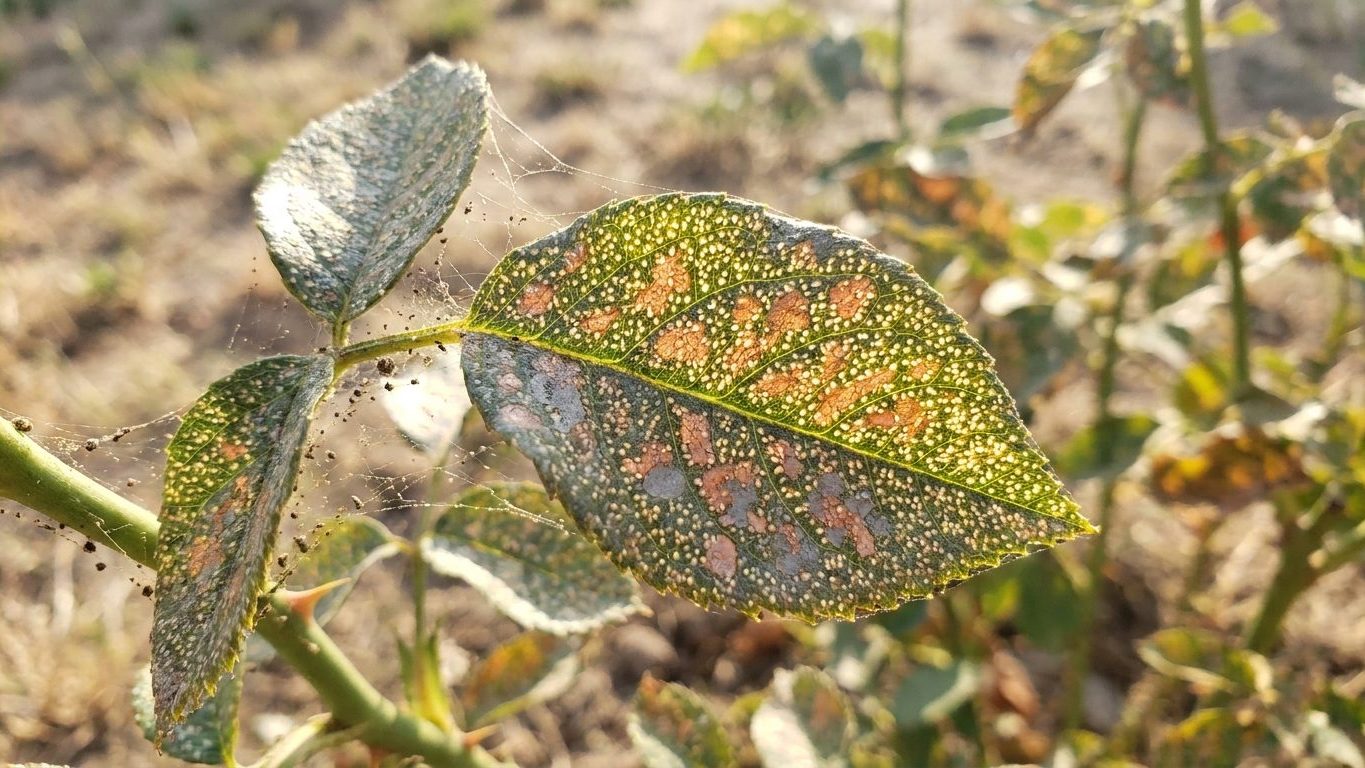

Tiny yellow or white speckles across rose leaves, followed by a dry, dusty look and leaves that drop early, point to two-spotted spider mites. They thrive in hot, dry weather with little rain, feeding on the underside of leaves where they’re easy to miss until the damage is already visible.
What the damage looks like
The giveaway isn’t a hole or a chewed edge. It’s stippling: hundreds of pinprick-sized pale dots scattered across the top surface of a leaf, as if someone had dabbed it with a fine needle dipped in bleach. Hold a damaged leaf up to the light and the dots look almost translucent. Left alone, those dots merge into larger bronze or gray patches, and the whole leaf takes on a dull, sandpapery texture instead of its normal glossy green.
Flip the leaf over and, on a bad infestation, you’ll find the actual clue that separates this pest from nearly everything else on a rose bush: fine silk webbing, stretched between leaf veins, along the stem, or across where a leaf meets its stalk. It’s not thick like a spider’s web. It’s sparse and dusty-looking, and it catches bits of debris and shed mite skins, giving it a grayish, cobwebby cast. On a heavy infestation the webbing can wrap around whole clusters of leaves and new growth tips.
The mites themselves are close to invisible without help. An adult two-spotted spider mite measures about 1/50 inch, roughly the size of a period on a printed page. With a hand lens you’ll see pale yellow-green oval bodies, each with two darker spots on the back (that’s where the name comes from), moving slowly across the leaf underside. In cooler weather or as populations decline going into a stressful period, some mites turn orange or brick-red.
Established rose bushes rarely die from this. What you’re usually looking at is cosmetic to moderate damage: fewer flushes of clean new growth, some early leaf drop, and a plant that looks tired going into the next hot stretch. On a young rose, a newly potted one, or a bush already stressed by drought or poor soil, the same infestation can be serious, stripping enough foliage to weaken the plant heading into winter. The context matters more than the count of speckled leaves.
Making sure it is this and not something else
Stippling shows up from a handful of causes on roses, and the fastest way to sort them is a simple test: hold a sheet of white paper under a suspect leaf and tap the leaf sharply. Spider mites fall onto the paper as tiny moving specks. Drag a finger across them and they smear into a faint reddish or greenish streak. That smear is the confirmation, since none of the look-alikes leave it.
Thrips
Thrips also cause a silvery, stippled look, but they favor flower petals and buds as much as leaves, and their damage often comes with tiny black fecal specks scattered across the discolored area, like ground pepper. Thrips move fast when disturbed and don’t leave webbing. The white paper test catches them too, but they won’t smear the same way; they’re slender, dark, and quick to scurry off the page.
Lace bugs
Lace bug damage looks similar from above, pale and stippled, but the underside tells a different story: instead of fine webbing, you’ll find dark, tar-like specks of excrement stuck to the leaf, and the insects themselves have distinctive lacy, transparent wings visible with a hand lens. Lace bugs tend to cluster on a few leaves rather than spreading webbing across the whole plant.
Heat and drought stress alone
Sometimes there’s no pest at all. Roses baking in full sun during an extended dry spell can develop a bleached, stippled look from sunscald and moisture stress, especially on the side of the plant facing afternoon sun. No webbing, no moving specks on the paper test, and the discoloration tends to follow a sun-exposure pattern rather than spreading randomly across the bush.
When it shows up
Two-spotted spider mites build up fastest during extended dry, hot stretches, particularly when a rose has gone several days without deep water and the surrounding air is dusty and dry. Heat speeds their whole reproductive cycle dramatically. In cool, humid conditions a generation can take several weeks; under hot, dry conditions that same cycle compresses to about a week, which is why a barely-noticeable few mites can turn into a visible infestation in a short window once the weather turns hot and dry.
Location on the property matters as much as the calendar. Roses planted near a gravel driveway, a dusty path, or under an eave that blocks rainfall tend to see mites first and worst, since dust on foliage seems to favor them and the plants there are already missing out on the natural rain-washing that keeps populations in check elsewhere in the garden. Container roses, which dry out faster than those in the ground, are also frequent early hosts.
Plant stage plays a role too. New, tender growth flushes are especially attractive, and a rose pushing a lot of soft new foliage during a hot dry spell is the classic setup for a fast build-up. A rose that’s semi-dormant or hardened off from cooler conditions is far less appealing to them. Watch new growth tips and the undersides of the newest few leaves on each cane first; that’s where an infestation typically starts before it spreads to older foliage.
What to do now
- Hose the undersides down. A strong, direct spray of water aimed at the underside of the leaves, repeated every few days, physically knocks mites and eggs off the plant and breaks up the webbing they depend on. It’s free, it works, and it should be the first response on almost any infestation caught early.
- Fix the drought stress. Deep, regular watering and a layer of mulch around the base reduce the dust and moisture stress that let populations explode in the first place. A well-hydrated rose also tolerates some feeding damage far better than one already struggling.
- Try insecticidal soap or horticultural oil. Both are widely available at garden centers, work on contact, and need to reach the leaf undersides to do any good. They break down quickly and have far less impact on beneficial insects than broader sprays, but they only kill what they touch, so thorough coverage and repeat applications every several days are what make them effective.
- Let predatory mites do the work. Roses often already host predatory mites and other beneficial insects that feed on two-spotted spider mites and can hold populations in check without any spraying at all. If you’ve been reaching for a broad-spectrum insecticide for another rose problem, stop; those products kill the predators far more efficiently than they kill the mites, and infestations frequently get worse right after a broad spray, not better.
- Reach for a labeled miticide only as a last resort. On a valuable or badly infested plant, a miticide specifically labeled for spider mites on roses, sold at garden centers, is the appropriate chemical option, not a general insecticide. Read the label carefully: some active ingredients are restricted for home use in certain states, and rotating between different active ingredients (rather than repeating the same one) helps avoid resistance building up in the mite population.
Stopping it coming back
- Water deeply and consistently through hot stretches instead of letting roses dry out between waterings; drought-stressed plants are consistently the first to show heavy damage.
- Rinse foliage, especially the undersides, every week or two during hot, dry weather as routine maintenance, not just as a treatment after damage appears.
- Keep roses away from constant dust sources where possible, or rinse them more often if they’re planted near a gravel drive or dirt path.
- Avoid routine use of broad-spectrum insecticides on roses; they remove the predatory mites and other beneficial insects that otherwise keep populations from ever reaching damaging levels.
- Check the undersides of new growth with a hand lens every couple of weeks once hot weather sets in, so a small population gets caught and hosed off before it spreads and webs over the plant.
- Space plants for airflow and avoid letting foliage from different roses constantly touch, since mites spread easily from plant to plant by simple contact.
Common questions
Do two-spotted spider mites kill roses? Rarely on an established, healthy bush. The damage is usually cosmetic: early leaf drop and fewer clean flushes. Young, newly planted, or already-stressed roses can be seriously weakened by a heavy infestation, especially if it hits repeatedly through a dry summer.
Can I actually see spider mites without a magnifying glass? Barely. Adults are about 1/50 inch long. A hand lens or a smartphone camera zoomed in on the leaf underside makes them much easier to spot; without one, the webbing and stippling are usually the first things you’ll notice.
Will rain make them go away on its own? Often, yes. Rain and higher humidity physically wash mites off the foliage and slow their reproduction, which is exactly why populations spike during extended dry spells and drop off once regular rain returns.
Can they spread to other plants in the garden? Yes. They move by crawling between touching leaves, on garden tools, and by drifting on wind currents, so an infestation on one rose can reach nearby plants, including non-rose hosts, if conditions stay hot and dry.