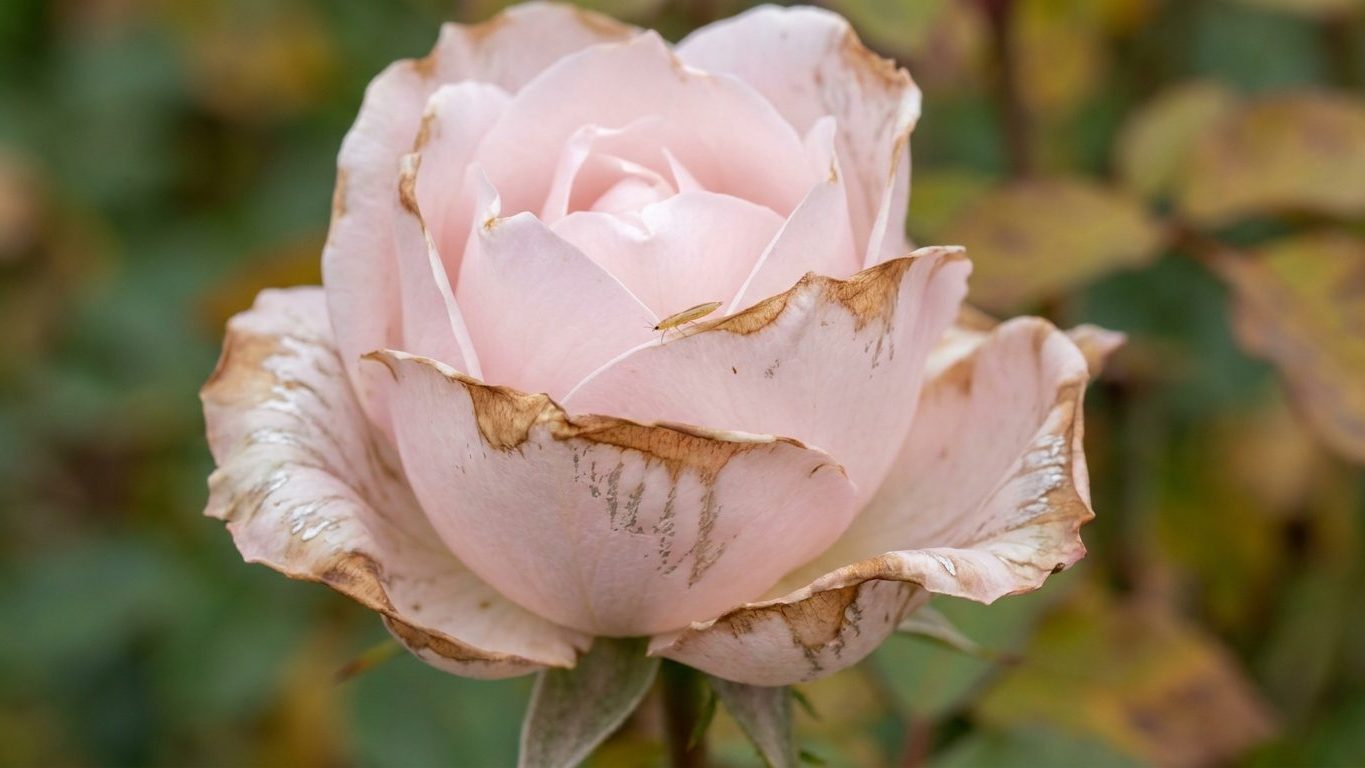

Brown, papery edges on rose petals that never fully unfurl almost always point to thrips, tiny slender insects that hide inside buds and rasp the tender petal tissue before it opens. On an established, healthy rose bush this is mostly a cosmetic problem. It gets serious only when it hits a young plant or a prize bloom you’re saving for a show.
What the damage looks like
Look at the flower first, not the leaves. That’s the detail that separates thrips from almost everything else that troubles a rose bush: the damage concentrates on the bloom itself, especially at the petal margins, while the foliage stays clean or shows only minor stippling. Buds swell normally, then stall. When they do open, the outer petals look scorched along the rim, tan to rusty brown, sometimes with faint silvery streaks running toward the center where feeding punctures caught the light before they dried out.
Light-colored varieties give up the game fastest. White, cream, pale pink, and soft yellow roses show every blemish, while deep red or maroon blooms can hide moderate feeding almost entirely. That’s not a coincidence of the insect being pickier about color; it’s simply contrast. The damage is the same, you just see it better on a pale petal.
Pull a damaged bud apart and you’ll usually find the cause still inside. Thrips are slender, no longer than a grain of rice cut into eighths, roughly 1/16 inch, colored anywhere from pale yellow to dark brown depending on the species and life stage. They wedge themselves between overlapping petals where it’s tight, humid, and shielded from wind and predators, then rasp the surface layer of cells and suck up the released sap. That feeding pattern, scrape first and drink second, is what produces the streaked, dried-out look rather than clean holes or chewed margins.
Distortion often comes with the discoloration. A rose that would normally open into a symmetrical cup instead opens lopsided, with one side of petals crumpled or shorter than the rest, because the feeding damaged the tissue on that side before it had a chance to expand. Some blooms abort altogether, staying tight and brown at the tip like a bud that got scorched by frost, though no frost was involved.
On established shrubs with plenty of blooms to spare, this is an appearance issue, not a survival issue. On grafted young roses, container-grown minis, or a plant already stressed by drought or transplant shock, heavy thrips pressure can stunt new growth and reduce the number of blooms that open at all, which is where it crosses from cosmetic to something worth actively managing.
Making sure it is this and not something else
Confirming thrips takes one simple test: hold a damaged bloom over a sheet of white paper or a white plate and tap it firmly two or three times. Thrips are weak fliers and tend to drop rather than fly off, and on white paper they show up as tiny moving slivers, yellowish to dark brown, wriggling toward the edge. If you see that movement, you have your answer. If the paper stays empty, look elsewhere.
Botrytis blight (gray mold)
Botrytis produces brown, mushy petal blotches, often with a fuzzy gray coating in damp weather, and it tends to show up after rain or heavy dew rather than during hot, dry stretches. The texture is the giveaway: botrytis damage feels soft and rotten, while thrips damage feels dry and papery, almost crisp, because the cells were drained of moisture rather than infected with fungal growth.
Spider mites
Spider mite damage centers on foliage, not blooms; you’ll see fine stippling and a bronzed, dusty look on leaves, sometimes with faint webbing on the undersides during heavy infestations. A rose with brown petal edges but clean, undamaged leaves is not a mite problem.
Sunscald or mechanical bruising
A single scorched patch on one side of a bloom, especially after an intense heat spell or after the flower brushed against a trellis wire or cane, can mimic thrips streaking. The tap test settles it fast: no insects fall out, and the damage pattern is usually one clean patch rather than scattered streaking across multiple petals.
When it shows up
Thrips pressure tracks with the bud stage, not the calendar. The window that matters is the period between bud swell and the first crack of color, when petals are still tightly wrapped and offer the insects a snug, humid hiding spot with a steady food source right at their mouthparts. Once a bloom is fully open and petals have spread apart, thrips have far less shelter and tend to move on to the next unopened bud nearby.
Hot, dry stretches favor population buildup, since thrips reproduce faster in warm conditions and dry weather doesn’t wash them off the plant the way a hard rain does. A rose bush pushing a heavy flush of new buds all at once, common after a hard prune or a strong feeding, gives thrips a concentrated buffet of exactly the tight, tender bud tissue they prefer, so a flush of new growth is often when damage becomes noticeable even if the insects were present in low numbers before.
Stressed plants draw more attention too. A rose short on water, or one pushed hard with high-nitrogen fertilizer that produces soft, sappy growth, tends to show heavier thrips damage than a well-watered, moderately fed plant nearby, because that softer tissue is easier to feed on and holds moisture longer inside the closed bud.
What to do now
- Remove and destroy affected buds and blooms. Snip off any bud already showing brown streaking and drop it straight into a bag rather than the compost pile, since the insects and their eggs can ride along and re-infest nearby plants once the compost heats up less than expected.
- Knock them down with water. A firm spray from the hose, aimed into the crown of the plant and at the base of buds, physically dislodges a good share of the population without any product at all. Repeat every few days during a heavy bloom flush.
- Set out sticky traps. Thrips are drawn to blue more strongly than yellow, so blue sticky cards hung just above the bloom cluster will catch adults moving between flowers and give you a rough read on how bad the problem actually is before you reach for anything stronger.
- Try insecticidal soap or horticultural oil. Both work on contact and only affect the insect while it’s wet with the spray, so thorough coverage inside partially open buds matters more than the product itself. These options are low-risk to bees when applied in the evening after bloom has closed for the day.
- Step up to spinosad if pressure stays high. Spinosad-based sprays, sold under various garden brand names and OMRI-listed for organic use, target thrips more directly than soap or oil and are widely available at garden centers. Apply in the evening; spinosad is toxic to bees while wet but breaks down within hours of drying.
- Reach for a systemic insecticide only as a last resort. Products containing neonicotinoids will handle heavy infestations but come with real downsides: several states restrict or limit their use on flowering plants specifically because of pollinator risk, and they also kill the predatory mites and minute pirate bugs that would otherwise keep thrips populations in check on their own. Check your state’s rules before buying, and never apply while the plant is in bloom and actively visited by bees.
Stopping it coming back
- Deadhead spent blooms promptly rather than letting them linger, since old flowers left on the bush give thrips a place to keep breeding after the damage is already done.
- Ease off high-nitrogen feeding, especially quick-release products, and favor a balanced fertilizer that builds sturdier tissue instead of soft, fast growth that thrips prefer.
- Keep weeds and grass mowed short around the bed; many broadleaf weeds host thrips between rose bloom flushes and act as a reservoir population.
- Avoid routine broad-spectrum spraying. Predatory mites and minute pirate bugs (Orius species) feed on thrips naturally, and a blanket insecticide wipes out those allies along with the pest, often making the next flush worse rather than better.
- Water deeply and consistently rather than letting the soil swing between bone-dry and soaked, since drought-stressed roses draw heavier thrips pressure than plants kept on an even moisture schedule.
- Space plants for airflow. Crowded bushes hold humidity around the buds longer after watering or rain, extending the window thrips have to establish before a bloom opens.
Common questions
Will thrips kill my rose bush?
No, not on an established plant. Thrips damage blooms, not the plant’s structure or root system, so a mature rose bush will keep growing and flowering even during a heavy infestation. The exception is a young or newly transplanted rose, where repeated damage to tender new growth can slow establishment.
Can I still cut damaged roses for a vase?
You can, but check the bud first. A bloom already showing brown streaking won’t improve indoors and may open even more lopsided in a vase. Cutting slightly earlier, before the streaking starts, and checking inside the petals for hitchhiking insects gives better results.
Do thrips spread to other plants in the yard?
Yes. Thrips feed on a wide range of garden plants, not just roses, and readily move between hosts, especially onions, gladiolus, and many flowering annuals. A bad thrips year on the roses often shows up on nearby flower beds too.
How do I know if the population is actually declining after treatment?
Watch the newest buds rather than the ones already damaged, since existing streaking won’t reverse. If buds forming after treatment open cleanly, the control worked. Sticky traps also give a rough week-to-week comparison of adult numbers if you want a more concrete gauge.