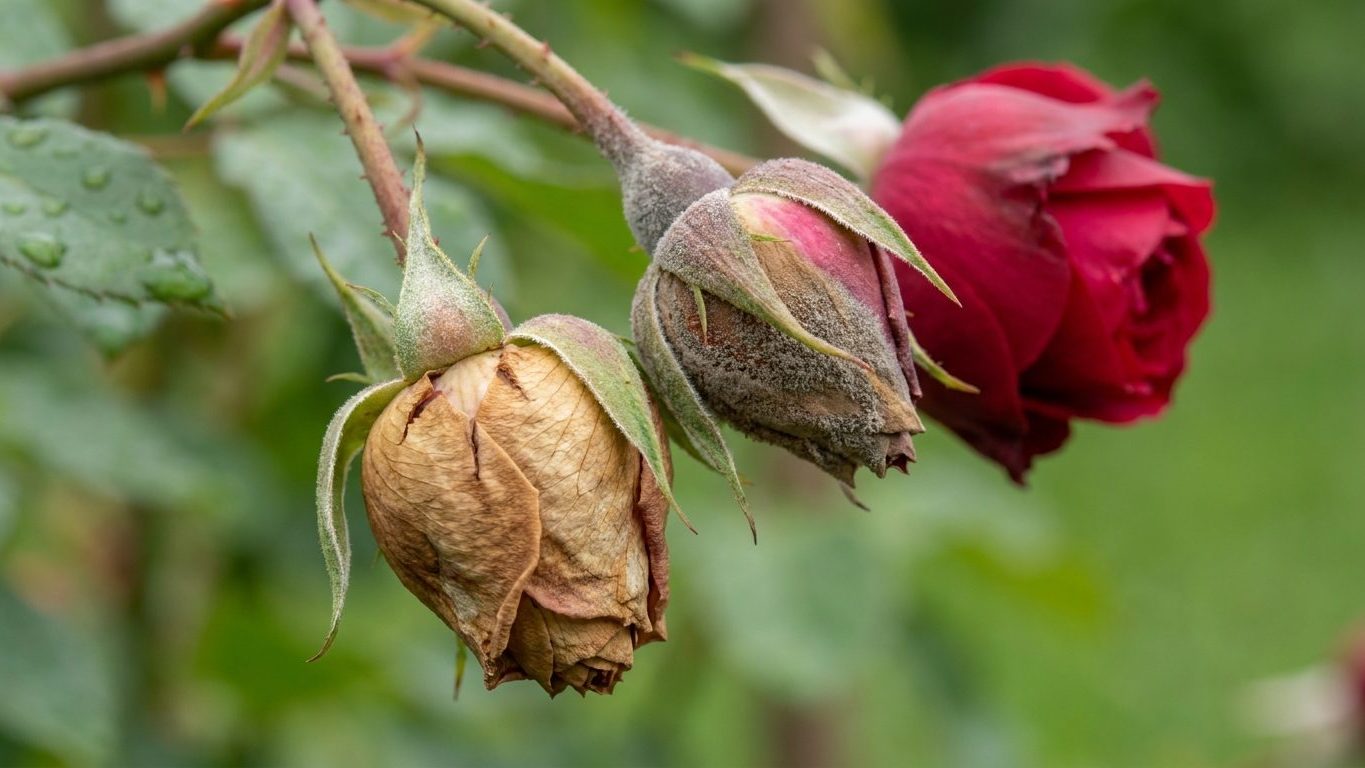

Rose buds that rot before they open are usually suffering from one of two things: gray mold (botrytis blight) or “balling,” a moisture-trapping problem where outer petals seal shut before the bloom can form. Neither is usually fatal to the plant itself, but every affected bud is lost for this bloom cycle. The fix is about airflow and moisture management, not fertilizer.
What you are looking at
Look closely at the bud before you do anything else. If the outer petals have turned tan or brown and feel dry and papery, almost like parchment, while the center stays tightly closed and never unfurls, that’s balling. The bud may still be green or reddish underneath the papery shell, but it will never open on its own. Pull one apart and you’ll often find the inner petals soft, brown, and starting to break down from trapped moisture.
If instead you see fuzzy gray-brown mold, almost like a dusting of ash, on the bud surface or where it meets the stem, that’s botrytis blight (gray mold). It spreads fast in cool, damp weather and can move from one bud to the next within a few days, especially on crowded plants. Petals affected by botrytis often show water-soaked brown spots first, then collapse into a slimy, mushy mess as the fungus takes hold.
Both problems tend to hit the outer edge of the bud first, since that’s the part most exposed to rain and humidity. Compare that to frost damage, which blackens the whole bud uniformly after a single cold night, or thrips feeding, which leaves streaky, silvery scarring on petal edges rather than rot. Aphid clusters on a bud cause distortion and stickiness (honeydew) but not the brown mushy collapse described here. If your buds are shriveling and dropping without ever showing rot or mold, that’s usually stress (heat, drought, or transplant shock), a separate issue entirely.
The short version: papery and sealed shut means balling; fuzzy and mushy means botrytis. Many gardens have some of both at once, since balled buds that stay wet often develop secondary botrytis inside the trapped petals.
What actually causes it
Here’s where a lot of rose advice goes wrong: bud rot is not a sign your plant lacks calcium or fertilizer. That myth persists because rotting buds look similar, in a general sense, to nutrient-deficiency symptoms gardeners have read about in other plants. In roses, the cause is almost always moisture and airflow, not nutrition.
Botrytis cinerea, the fungus behind gray mold, needs prolonged leaf and petal wetness to establish itself. It thrives when temperatures sit in the 60s to low 70s Fahrenheit with high humidity, extended overcast periods, or repeated overnight dew that doesn’t dry off by mid-morning. Spores are airborne and land on damaged or aging petal tissue, then spread through the plant especially where canes are packed close together and air can’t move freely.
Balling has a different mechanism. It happens when rain or heavy dew coats the outer petals, and then the sun comes out fast and dries that outer layer before the moisture underneath has a chance to evaporate. The outside fuses into a stiff shell while the inside stays damp, and that trapped moisture rots the inner petals from within. Varieties with many thin petals (classic old garden roses and some heavily double modern varieties) are far more prone to this than single or semi-double roses, because there’s simply more petal surface to trap water.
To tell the two apart in practice: botrytis usually shows visible mold and spreads to nearby buds and foliage within days, while balling stays contained to individual buds and doesn’t spread the way an active fungal infection does. If you’re seeing whole clusters of buds fail together during a stretch of humid, rainy weather, you’re most likely dealing with botrytis, since it’s an active pathogen looking for new tissue to colonize.
What to do now
Any bud already balled or moldy will not open. That bloom cycle is lost, and there’s no treatment that reverses it. Cut the affected buds off cleanly with sanitized pruners, cutting back to a set of five healthy leaves on the stem. Don’t just snap them off, since a clean cut heals faster and gives the fungus less torn tissue to colonize.
Dispose of removed buds in the trash, not the compost pile. Botrytis spores can survive in compost that doesn’t reach a high enough temperature, and tossing infected material back near the garden defeats the purpose of removing it.
Once the damaged buds are gone, turn your attention to the plant’s structure. Thin out crowded interior canes to open up the center so air moves through freely. If botrytis is active and the weather forecast shows more cool, damp days ahead, a fungicide labeled for botrytis blight on roses, applied according to the product label, can protect the next round of buds coming up. It won’t save what’s already lost, but it can stop the fungus from reaching healthy new growth.
Check your watering habits immediately. If you’ve been watering overhead in the evening, switch to soil-level watering in the morning instead, so foliage and buds have all day to dry. This single change often matters more than any spray for stopping the next wave of rot before it starts.
Give it two to three weeks. Healthy new buds forming now, with better airflow and drier foliage, should open normally if the weather cooperates and the fungal pressure eases.
What does not work
Because rose bud rot looks like it might be a plant health problem, gardeners often reach for nutrient fixes first. They don’t work, and here’s why.
Crushed eggshells worked into the soil add calcium slowly over months as they break down, but bud rot in roses isn’t a calcium deficiency to begin with. There’s nothing here for the extra calcium to correct.
Foliar calcium sprays are marketed as a quick fix for various “rot” symptoms across the garden, borrowed from advice aimed at blossom end rot in tomatoes and peppers, a genuinely calcium-related issue in fruiting vegetables. Roses are not fruiting vegetables, and their buds don’t fail for the same physiological reason. Spraying calcium on a botrytis-infected or balled bud does nothing to the fungus or the trapped moisture causing the rot.
Adding lime to soil that already tests adequate for calcium just pushes soil pH upward without addressing the actual problem, and can make soil less hospitable for the rose over time if applied without a soil test showing an actual deficiency.
Cutting off every bud on the plant “just in case,” before any sign of trouble, is also unnecessary and costs you blooms you didn’t need to lose. So is waiting out the problem without changing watering habits or improving airflow, since the conditions that caused the first round of rot will simply repeat with the next flush of buds. And applying fungicide only after a bud is already moldy is too late for that bud. Treatment protects buds that haven’t opened yet, not ones already collapsing.
Preventing it next time
Airflow matters more than anything else you can do. Space plants at least 3 feet apart where the mature variety allows it, and prune each spring to open up the center of the bush rather than letting canes cross and crowd each other. A rose that dries out quickly after rain rarely develops botrytis or balling, regardless of what else you do.
After airflow, watering habits come next. Water at the base of the plant, early in the morning, so any splash on foliage has the whole day to dry. Avoid evening watering and overhead sprinklers entirely during humid stretches.
Clean up fallen petals and spent blooms promptly. Dead petal tissue on the ground or caught in the bush is exactly where botrytis spores overwinter and re-infect the plant the following season.
If you garden in a consistently humid or rainy climate, choose fewer-petaled, more open varieties for new plantings. They dry faster after rain and simply give the fungus and the balling mechanism less surface area to work with. Reserve preventive fungicide applications for the wettest, coolest stretches of the growing season rather than spraying on a routine schedule regardless of weather.
Common questions
Can a balled bud be saved by peeling it open by hand?
No. Forcing a balled bud open usually tears the petals and exposes the already-rotting inner tissue to more air and moisture, speeding up decay rather than reversing it. Remove it instead.
Does bud rot mean the whole rose bush is diseased?
Not necessarily. Botrytis and balling are both driven by local moisture and airflow conditions around individual buds and canes. A bush can lose several buds to rot while the rest of the plant, and even nearby buds with better air circulation, stay perfectly healthy.
Will this come back on the same variety every year?
It’s likely if the underlying conditions (crowding, overhead watering, a humid microclimate) don’t change. Many-petaled varieties in wet climates are prone to repeat trouble unless airflow and watering habits are adjusted.
Is it safe to compost the diseased buds if I hot-compost?
Only if your compost pile reliably reaches and sustains temperatures high enough to kill fungal spores throughout the pile, which most home compost setups don’t achieve consistently. When in doubt, bag and trash the affected material instead.